
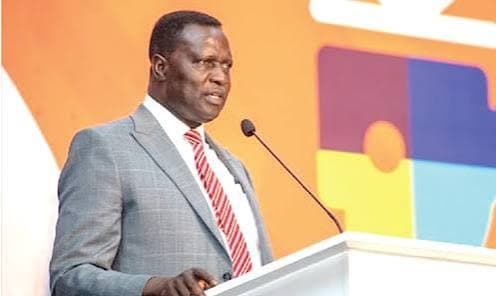
Former Education Minister Yaw Osei Adutwum has cautioned against any attempt to permanently exclude thousands of Basic Education Certificate Examination (BECE) candidates from senior high school, saying such a move would take Ghana back to the era of cut-off points.
His comments come amid concerns over the initial exclusion of about 54,000 BECE candidates from the Computerised School Selection and Placement System (CSSPS) for failing to secure a pass in the four core subjects.
According to Dr Adutwum, the issue should not be treated simply as a question of students failing their examinations, arguing that the BECE is primarily a ranking exercise rather than an examination with a fixed pass mark.
“In this country, there was a time before free senior high school that there used to be called something like a cut-off point. So in some years, if you have aggregate 28, you couldn’t attend a government school,” he explained on Good Evening Ghana on Metro TV on Tuesday, September 8, 2026.
He said students who failed to meet the cut-off were often described as having failed, even when their inability to secure a place was largely due to limited spaces in public senior high schools.
“The point of the matter was not about fail. Because if you look at the BECE, it’s a non-reference exam. It’s just ranking of students, one against the other,” he said.
Dr Adutwum said the introduction of Free Senior High School under the previous government was meant to change that approach by ensuring that students were not denied access to secondary education because of their BECE performance.
He therefore questioned the rationale behind the large number of students initially excluded from the placement process.
“Then all of a sudden you have 54,000. And then the spokesperson goes on to say that they use either or,” he said.
He explained that using an “either/or” criterion for English and Mathematics would automatically create a much larger pool of students who could be excluded.
“If either fail math or fail English, you’re excluded,” he said, contrasting it with the previous approach where students who failed both subjects were the ones considered for exclusion.
He cited placement figures from previous years to illustrate the difference.
According to him, 13,042 students were excluded in 2023, while the figure dropped to 10,184 in 2024 before rising slightly to 13,019 in 2025.
The sudden jump to more than 54,000, he argued, therefore required closer scrutiny.