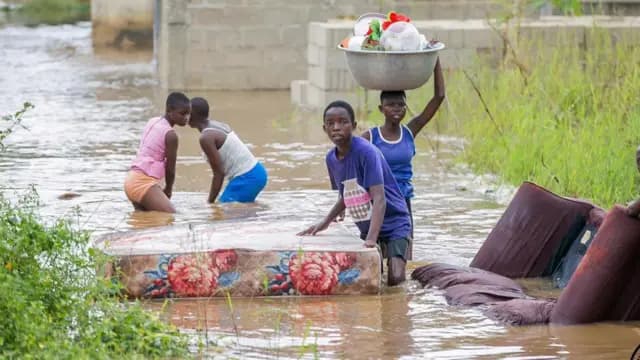
Every Rainfall Has Become a National Emergency
Every year, the story is the same. Heavy rains fall over Accra and other parts of Ghana. Roads become rivers. Homes and businesses are submerged. Traffic grinds to a halt. In some cases, lives are lost and families are displaced.
As the floodwaters rise, so does public anger. Citizens blame government agencies for failing to construct adequate drains. Politicians accuse their opponents of neglecting infrastructure development. Social media becomes flooded with images of stranded commuters, submerged vehicles and devastated communities.
The recurring scenes have become so common that many Ghanaians now expect major flooding whenever there is a heavy downpour. Yet flooding should not be regarded as a normal part of life in a modern city.
Government Cannot Escape Responsibility
There is some justification for the public’s frustration. Successive governments have struggled to implement lasting solutions to Accra’s flooding challenge.
Drainage projects are often delayed, abandoned or poorly maintained. Urban planning regulations are inconsistently enforced. Building permits are sometimes issued without proper due diligence. In many instances, authorities react after disasters rather than preventing them.
The result is a cycle of flooding, public outrage, emergency response and political blame that repeats itself year after year.
Government therefore cannot completely absolve itself of responsibility. Strong leadership, consistent enforcement and long-term planning are essential if the problem is to be addressed.
Climate Change Is Making the Situation Worse
Beyond governance failures, climate change has become an important part of the flooding conversation.
Scientists have warned that weather patterns across the world are changing. Rainfall events are becoming more intense and unpredictable. Rising global temperatures are increasing the frequency of extreme weather conditions.
Ghana is not immune to these changes. Heavy rains now often occur within shorter periods, increasing pressure on drainage systems and flood-prone communities.
Climate change is therefore a significant factor. However, it is not the complete explanation for Accra’s flooding crisis.
The Bigger Problem Is Human Behaviour
If climate change explains the intensity of rainfall, human behaviour explains why that rainfall becomes a disaster.
Many of Ghana’s flooding problems are self-inflicted. Over the years, natural waterways that once carried excess water safely to rivers and the sea have been blocked, narrowed or completely built over.
Wetlands that naturally absorbed floodwaters have disappeared under housing projects and commercial developments. Streams have been diverted. Drainage channels have been obstructed.
The consequence is simple. Water that once had a natural path to follow is now forced into homes, roads and business premises.
Nature is only reclaiming spaces that originally belonged to it.
The Destruction of Wetlands and Ramsar Sites
One of the greatest environmental failures in Ghana has been the continuous encroachment on wetlands and Ramsar sites.
These areas were never meant for large-scale development. They serve as natural water retention systems and environmental buffers that reduce the impact of flooding.
Yet over the years, many of these protected areas have been invaded by residential, commercial and industrial developments.
What should have been protected ecological zones have gradually been converted into real estate opportunities. Every wetland lost to development reduces the city’s ability to manage stormwater naturally. When heavy rains eventually arrive, the consequences become unavoidable.
Building on Waterways Is a Disaster Waiting to Happen
Across Accra, houses, shops and entire communities have emerged in areas that should never have been developed. Some structures sit directly on waterways. Others occupy flood plains and drainage reservations. Many residents only discover the danger after their properties become submerged during heavy rainfall. The reality is that no engineering solution can permanently protect structures that have been built in the natural path of water. Water will always find its way back to where it naturally belongs.
The Question Nobody Wants to Ask: Who Sold the Land?
Every illegal structure has a history. Somebody sold the land. Somebody prepared the documents. Somebody approved the plans. Somebody ignored the violations. While homeowners are often criticised, the responsibility does not begin with them. Traditional authorities, landowners, developers, local assemblies and planning authorities all play critical roles in determining how land is used.If land located within waterways and wetlands continues to be sold and developed, then the problem extends beyond individual property owners to the institutions responsible for regulating development.
Why We Resist the Solutions We Demand
Perhaps the greatest contradiction in Ghana’s flood management efforts is the public reaction to demolition exercises. After floods occur, many citizens demand action. They call for stricter enforcement and the removal of illegal structures. However, when demolition exercises begin, resistance quickly emerges. Residents protest. Politicians intervene. Court injunctions are sought. Authorities are accused of being insensitive. Social media campaigns are launched against the demolitions. The same structures blamed for flooding suddenly become protected. As a result, enforcement becomes difficult and illegal developments remain untouched until the next disaster occurs.
Poor Sanitation Is Compounding the Problem
Flooding is not caused only by illegal construction. Poor waste management has become another major contributor. Drains that should carry stormwater are often filled with plastic waste, food containers, construction debris and household refuse. When heavy rains occur, these blocked drains cannot function effectively. Water overflows into surrounding communities, causing avoidable flooding. No city can win the fight against floods while simultaneously turning its drainage systems into dumping sites.
NADMO and Emergency Responders Cannot Solve Flooding
Whenever disaster strikes, attention quickly turns to emergency agencies. NADMO, the Ghana National Fire Service, the Police Service and the Armed Forces are expected to rescue victims and provide relief. Their interventions are essential and often save lives. However, emergency response should not be mistaken for flood prevention. Rescuing people after floods does not stop future floods. Distributing relief items does not prevent illegal developments. Emergency agencies manage the consequences of flooding; they do not eliminate the causes.
The Human and Economic Cost
The cost of flooding extends far beyond damaged roads and submerged vehicles. Families lose homes and personal belongings. Businesses lose stock and revenue. Workers are unable to reach their workplaces. Students miss school. Communities suffer emotional trauma. In severe cases, lives are lost. The economic impact runs into millions of cedis annually, while the social consequences are often immeasurable.
What Government Must Do
Addressing the flooding crisis requires political courage and sustained commitment. Government must strengthen urban planning enforcement and protect wetlands and Ramsar sites from further encroachment. Drainage infrastructure must be modernised and regularly maintained. Illegal developments must be addressed regardless of political pressure. Land administration systems must be reformed to prevent the sale of environmentally sensitive lands. Most importantly, enforcement must be consistent and not seasonal.
What Citizens Must Do
Government action alone will not solve the problem. Citizens must also change behaviours that contribute to flooding. Waste should never be dumped into drains. Developments in waterways should not be encouraged or supported. Communities must report illegal construction activities. Environmental regulations should be respected. The culture of opposing every enforcement exercise while demanding flood prevention must come to an end.
A National Problem Requires a National Change in Attitude
Accra’s flooding crisis is often discussed as an environmental issue. In reality, it is also a governance issue, a planning issue, an enforcement issue and a behavioural issue. Climate change may increase rainfall intensity. Government failures may worsen vulnerabilities. Weak institutions may enable illegal developments. But human attitudes continue to amplify the problem. Until citizens, institutions and political leaders collectively change their approach, flooding will remain a recurring national emergency.
The Hard Truth
The rain is not the enemy. The real enemy is years of poor planning, weak enforcement, environmental destruction and public indiscipline. We cannot build in waterways and expect dry homes. We cannot destroy wetlands and expect natural flood protection. We cannot block drains and expect efficient drainage systems. We cannot resist lawful demolitions and later complain about preventable disasters. If Ghana is serious about ending the cycle of annual flooding, then the conversation must move beyond blame and towards responsibility. Only then can Accra become a city that works with nature instead of constantly fighting against it.
Source: Shadrack Odame Agyare and Daniel Oduro Agyepong