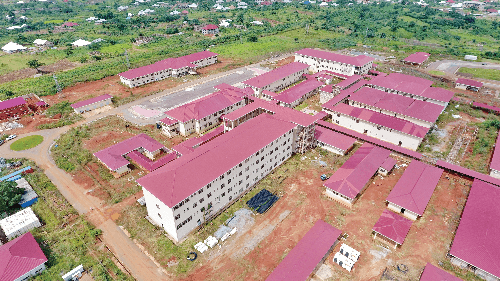
In the quiet community of Afari in Ghana’s Ashanti Region stands a vast hospital complex that was intended to transform healthcare delivery in the middle and northern belts of the country.
Nearly two decades after the project was conceived, the 500-bed Afari Military Hospital remains unfinished despite repeated promises of completion by successive governments.
The hospital’s history reflects the broader challenges that have confronted some of Ghana’s major infrastructure projects: changes in location, funding constraints, contractual disputes and shifting political priorities.
2008: The project is born
The Government of Ghana signed an agreement with Egyptian construction firm Euroget De-Invest on 20 August 2008 for the construction of a 500-bed military hospital together with residential accommodation for staff.
Originally, the project was expected to be completed within 42 months of commencement. The facility was initially planned for Tamale before being relocated, first to Accra and later to its current site at Afari near Kumasi.
2010-2013: Preparatory phase
Although the contract had been signed, progress was slow as project arrangements, financing and location changes delayed the start of physical construction.
2014: Construction begins
Actual construction work commenced in Afari in 2014.
At the time, the project was expected to be completed by July 2016 and become one of the largest military medical facilities in West Africa.
2016-2017: First missed deadline
The 2016 completion target passed without the hospital being finished.
Government officials later attributed part of the delay to difficulties in securing tax exemption approvals needed for the importation of equipment and materials.
2018: Contract disputes emerge
A major setback occurred when disputes developed between the main contractor and subcontractors.
The disagreements reportedly lasted several months and resulted in the termination of subcontract agreements.
New subcontractors were eventually brought on board, but the transition further delayed the project.
2019: Fresh completion promise
Defence Minister Dominic Nitiwul informed Parliament that the project was progressing and could be completed by the end of the year, although utility connections, particularly electricity, could push operationalisation into 2020.
The project was already several years behind schedule.
2021: 92% complete – but still not operational
In November 2021, Parliament was informed that the hospital was approximately 92% complete.
Government announced a new target of less than one year for full completion and commissioning.
Reports also emerged that millions of dollars worth of medical equipment procured for the facility had remained unused while construction delays persisted.
2023: Government targets operationalisation
In August 2023, Defence Minister Dominic Nitiwul inspected the project and disclosed that financial approval delays and contractor changes had contributed significantly to the prolonged construction period.
Government expressed optimism that the facility could become operational before the end of the year.
2024: Another deadline missed
By December 2024, former President John Mahama publicly lamented the continued delay, describing the unfinished state of the hospital as “sad”.
The facility remained unopened despite earlier assurances that it would be completed by March 2024.
2025: New administration renews commitment
In February 2025, Defence Minister Dr Edward Omane Boamah conducted an inspection tour and directed efforts toward resolving outstanding financial, legal and technical issues affecting the project.
Government again pledged to complete and operationalise the hospital.
Local political leaders welcomed the renewed commitment, describing the hospital as critical to healthcare delivery in the Ashanti Region and beyond.
2026: Project remains unfinished
By January 2026, media visits to the site revealed stalled construction activity and overgrown vegetation around parts of the facility.
In April 2026, National Democratic Congress Chairman Johnson Asiedu Nketiah publicly called on government to ensure the project’s completion, arguing that the hospital’s strategic importance made further delays unacceptable.
Why the hospital matters
When completed, the Afari Military Hospital is expected to serve both military personnel and civilians. It is designed to ease pressure on the Komfo Anokye Teaching Hospital and provide specialist healthcare services for millions of people across northern and middle Ghana.
Yet almost 18 years after the contract was signed and 12 years after construction began, the facility remains a symbol of both ambition and delay.
Whether the latest promises finally bring the project to completion remains one of the most closely watched infrastructure questions in Ghana’s health sector.