
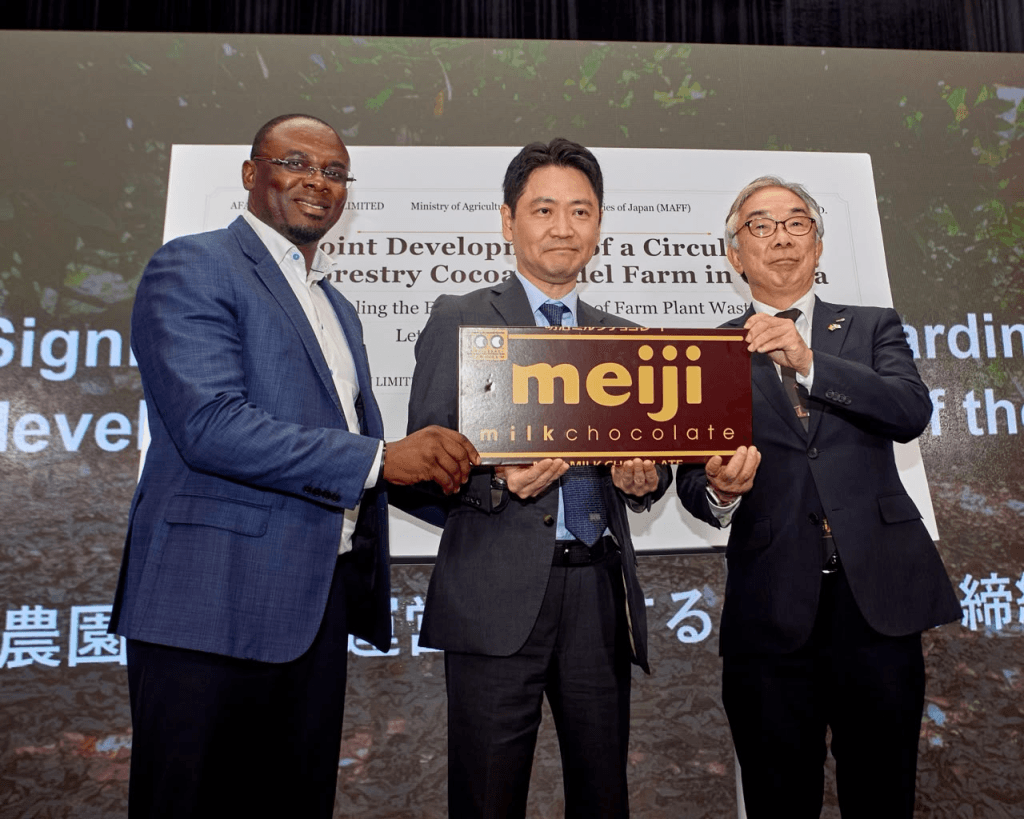
Ghanaian agri-forest restoration company Afarinick Company Limited (ACL) has entered an international partnership with Japan’s Meiji Co., Ltd. to advance sustainability and circularity across Ghana’s cocoa value chain.
The two companies signed a Letter of Intent (LOI) in Accra on Monday, September 14, 2026, during a ceremony marking 100 years of Meiji Milk Chocolate and the company’s longstanding relationship with Ghana. The event brought together representatives of the Government of Ghana, Ghana Cocoa Board, the Embassy of Japan and other stakeholders.
Joe Forson, Executive Chairman of Afarinick, and Bunjiro Yao, President and Representative Director of Meiji, signed the agreement — which lays the groundwork for a joint agroforestry cacao farm in Ghana built around effective use of farm plant waste
The LOI establishes a framework for developing a circular agroforestry cacao model farm — one that combines cocoa production, agroforestry, and the productive reuse of materials generated within the farming system itself.
For Afarinick, it’s a chance to take its Ghanaian expertise in farm management, forest restoration and sustainable agriculture onto an international stage. The company already operates across farm management, reforestation, GIS mapping and forest landscape restoration.
Afarinick owns Ghana’s largest privately held sustainable cocoa plantation — a 2,000-acre commercial farm in the Volta Region built on climate-smart, agroforestry principles. The plantation integrates cocoa with plantain and indigenous trees, supported by irrigation and sustainable land management.
The focus on farm plant waste adds a new dimension to Ghana’s cocoa sustainability agenda: extracting more value from resources the farming system already produces, rather than treating waste as a byproduct to discard.
Importantly, the LOI isn’t about planting another cocoa farm — it’s about building a model. One that fuses agroforestry with circular resource use in a way that could reshape how sustainable cocoa production is done.
For Afarinick, the takeaway is straightforward: Ghanaian sustainability expertise is moving onto a larger international stage, with cocoa at the centre of the conversation.
The Meiji partnership reinforces Afarinick’s position as a Ghanaian company building more resilient agricultural landscapes — while placing the country’s cocoa sector within a broader global conversation on circularity, resource efficiency and the future of food production.
From Ghana’s farms to an international boardroom, Afarinick is treating sustainability not as an add-on to cocoa — but as part of the value chain itself.



