
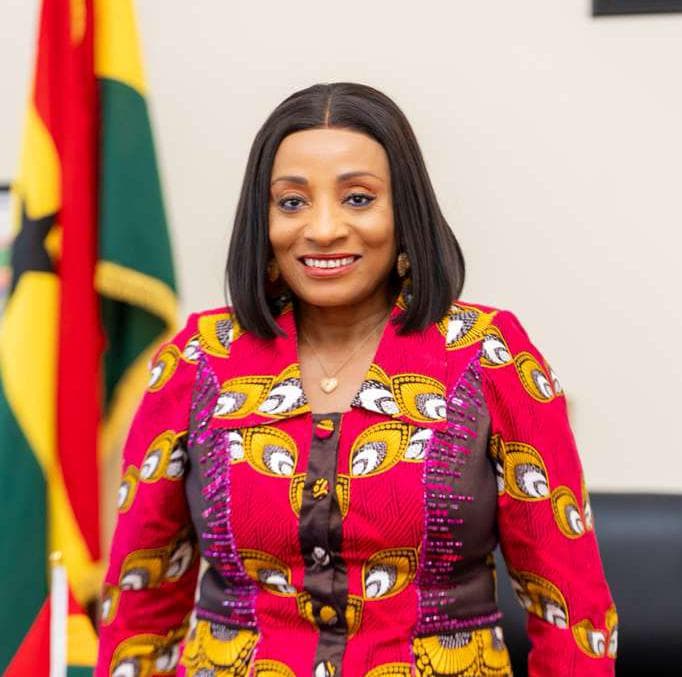
Ghana’s High Commissioner to the United Kingdom, Mrs Sabah Zita Benson, has called for Africa to play a bigger role in the global green economy, arguing that the continent must move beyond simply supplying raw materials and instead build industries that create jobs, skills and long-term prosperity.
Speaking at the 3rd International Conference on African Development (iCAD 2026) at Anglia Ruskin University in Cambridge on Thursday, June 18, Mrs Benson said Africa’s development future depends on linking research, policy and practical action.
Addressing academics, policymakers, business leaders and students gathered for the conference, she said Africa possesses the talent, resources and entrepreneurial energy needed for transformation but often struggles with aligning policy, infrastructure, financing and implementation.
“For Ghana, and for many African countries, the challenge of development has never been a shortage of talent, creativity or ambition,” she said.
“Our continent is rich in natural resources, human capital, cultural intelligence and entrepreneurial energy. What we have often lacked is the full alignment of policy, infrastructure, financing, technology and policy implementation.”
The conference was held under the theme “Green Transitions and Inclusive Industrialisation in Africa: Theory to Policy and Practice.”
Mrs Benson argued that green transition should not be viewed solely as an environmental issue but also as an economic one.
“Green transition must therefore be understood not only as an environmental agenda, but also as an economic transformation agenda,” she said.
She noted that the transition touches key sectors including energy, agriculture, transport, manufacturing, technology, education and housing.
According to her, industrialisation in Africa must focus on creating decent jobs, strengthening local enterprises and ensuring that women and young people benefit from economic growth.
“Growth that destroys the environment cannot be responsible. Development that depends only on exporting raw materials cannot deliver the prosperity our people deserve,” she said.
Mrs Benson warned that Africa risks being relegated to the role of a supplier of critical minerals and other inputs needed by wealthier economies unless deliberate efforts are made to build value chains on the continent.
“Africa must not be positioned merely as a supplier of raw materials for the green economies of others,” she said.
“We must be active participants, innovators, manufacturers, financiers, researchers and policy shapers in the global green economy.”
She added that if the world increasingly depends on Africa’s critical minerals and renewable energy resources, the continent must ensure it captures greater economic value from them.
“Africa must capture value, create industries, develop skills and build prosperity from within,” she stated.
The High Commissioner also highlighted the role of universities in supporting development, saying higher education institutions should focus on producing practical solutions to societal challenges rather than simply awarding degrees.
“Universities have a central role to play. They must not only produce graduates. They must produce problem solvers, who understand the complexity of development,” she said.
Mrs Benson further called for stronger collaboration between governments, industry and academia, arguing that development cannot be achieved by any one group acting alone.
She also urged Ghana to make greater use of its diaspora community, describing Ghanaians living abroad as one of the country’s greatest assets.
“The Ghanaian diaspora remains one of our greatest assets,” she said, noting that Ghanaian professionals, academics and entrepreneurs across the UK and beyond have knowledge and networks that can support national development.
On financing Africa’s green industrial ambitions, Mrs Benson stressed that public resources alone would not be sufficient.
“Ambition without financing remains aspiration,” she said.
She called for greater use of public-private partnerships, diaspora investment, development finance and innovative funding mechanisms while maintaining strong governance and accountability systems.
“While investors need confidence, citizens need accountability and institutions need capacity,” she noted.
The High Commissioner also challenged researchers to ensure their work has a direct impact on policymaking and development outcomes.
“Research must not end only in journal articles, it must also inform legislation, regulation, public investment, business strategy and community action,” she said.
She encouraged participants at the conference to develop practical recommendations that can influence decision-making beyond academia and contribute to Africa’s long-term development goals.
The annual conference brought together scholars, policymakers, industry leaders and development partners to discuss strategies for sustainable and inclusive growth across the African continent.