
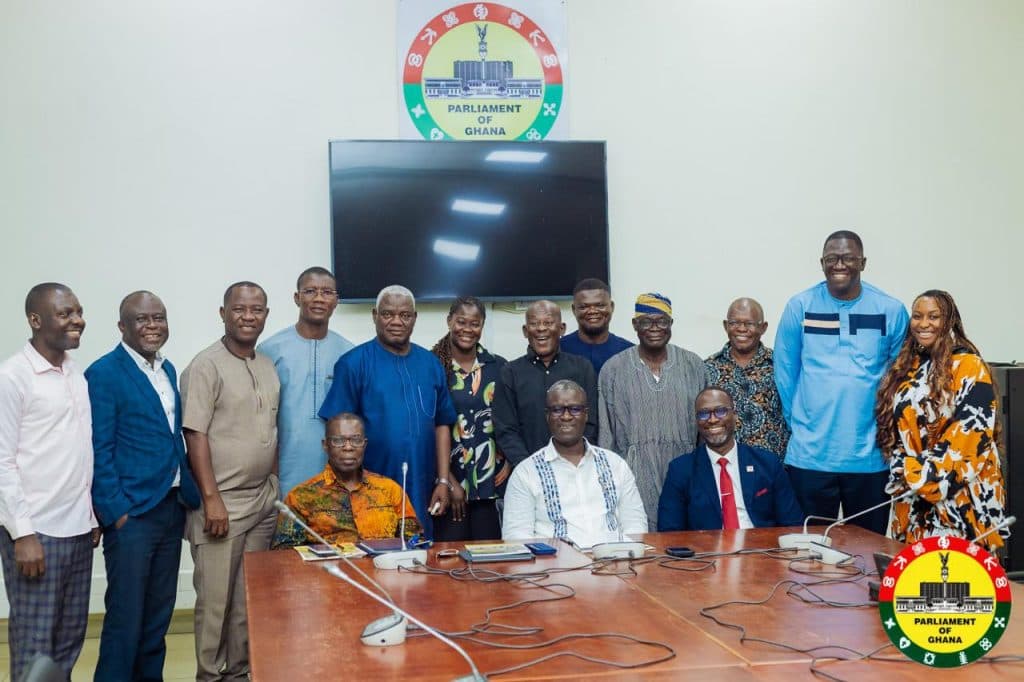
The Chairman of Parliament’s Select Committee on Food and Agriculture, Dr. Godfred Seidu Jasaw, has sounded the alarm over the looming extinction of donkeys in Ghana, stressing their critical role in agriculture, livelihoods, and local economic development.
Dr. Jasaw made the remarks during an engagement with a delegation from Brooke West Africa, who paid a courtesy call on the Committee. He emphasized that donkeys remain indispensable in northern Ghana, particularly the Upper East and North-East corridors, where they support farming, transport, and household economies. He called for urgent legislative and policy measures to safeguard the species.
“Information shared around the table needs immediate action, because there’s a threat of extinction of donkey species — and that will be dangerous for our livelihoods and the sustainability of our local economic development,” he told stakeholders.
He welcomed the African Union’s 2024 moratorium framework, which urges member states to legislate bans on the killing of donkeys for skins destined for export. “Fortunately, the AU has provided a standard framework… recommending member states legislate and take actions to ban killing of donkeys for skins for exports,” he noted, highlighting that external demand, particularly from China, has targeted species found in Ghana.
The Committee Chair further stressed the need to consolidate fragmented legislative arrangements and strengthen regulations under the Veterinary Services law. He underscored enforcement gaps, pointing out that “one gap realized from the conversation is enforcement of even existing legislations, and we think enforcement is a function of information, so capacity building is required.” He acknowledged commitments from Brooke, an animal welfare organization, to support information sharing and stakeholder training, including with the Ghana Revenue Authority Customs and the Animal Production Department.
Brooke West Africa’s Regional Director, Emmanuel Sarr, warned that the donkey skin trade is devastating communities across Africa. He explained that demand from China for Ejiao, a product derived from donkey hides, requires six million donkeys annually. “African countries must stop this trade,” he said, noting that Togo, Côte d’Ivoire, and Burkina Faso have already imposed bans, with Burkina Faso criminalizing the practice in its penal code. He urged Ghana to follow suit, stressing that traffickers exploit the country’s lack of strong regulations despite ECOWAS adopting a regional strategy to protect donkeys by 2030.
Prof. Roger Adamu Lure Lanton, former Chief Research Scientist at the Savannah Agricultural Research Institute, also addressed the Committee, calling for a total ban on the killing of donkeys for hides. He clarified that advocates are not opposed to traditional slaughter for consumption, which has long been practiced in some communities, but condemned large-scale commercial slaughter for trade.
He revealed that Blue Coast Donkey Slaughter Limited was processing 200–300 donkeys daily, while official data between 2014 and 2017 placed Ghana’s donkey population at just 14,000. “At that rate, how many months would it take to clear all the donkeys?” he asked.
Prof. Lanton highlighted the animal’s importance in Ghana’s poorest regions, where donkeys fetch water, carry firewood, and transport farm produce — tasks that would otherwise pull children out of school. He shared testimonies from widows in East Mamprusi who relied on donkeys to farm and support their families, and from children in West Mamprusi who use donkeys to reach school, underscoring the species’ role in sustaining education and livelihoods.
The Committee is expected to deliberate on consolidating legislation, strengthening enforcement, and aligning Ghana’s policies with regional and continental frameworks to protect donkeys from extinction.
By Eric Bekoe (KOB)