
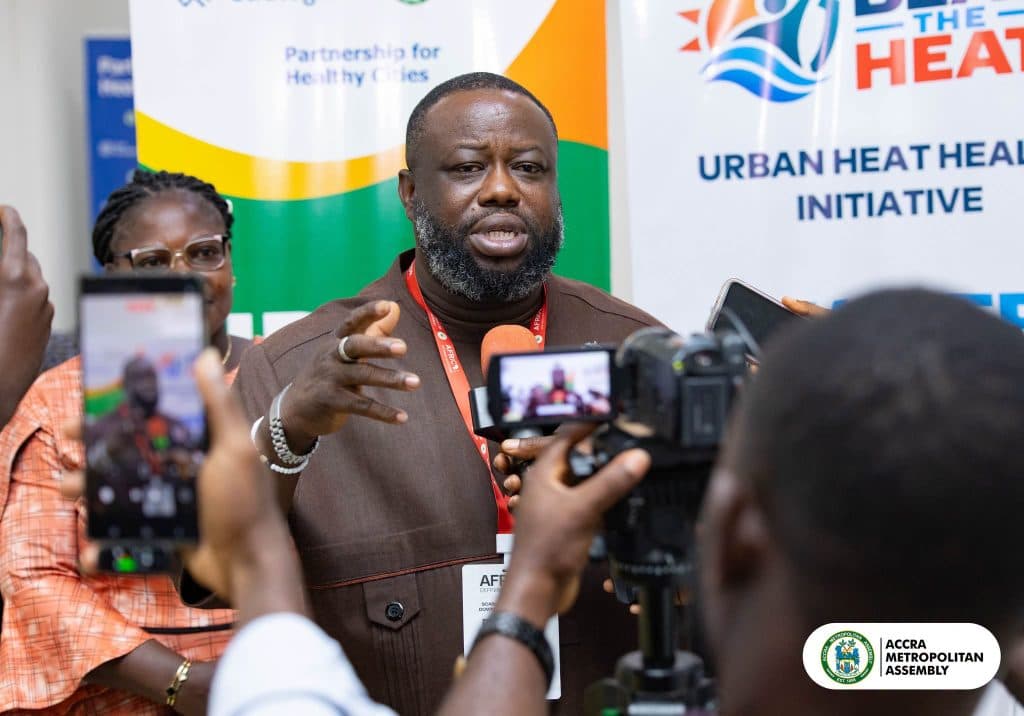
The Mayor of Accra, Michael Kpakpo Allotey, has announced plans to intensify tree planting, green public spaces and introduce a heat early warning system to address rising temperatures in the metropolis.
He said the measures are aimed at protecting residents from the adverse effects of extreme heat.
According to him, the Accra Metropolitan Assembly (AMA) has already initiated discussions with potential development partners to support large-scale tree planting and other urban greening interventions to reduce heat exposure and improve environmental conditions across the city.
Speaking in an interview after the Validation Workshop and Media Launch of the Multi-Stakeholder Coordination Framework for Urban Heat Resilience in Accra on Wednesday, October 28, 2026, Mayor Allotey said the Assembly was committed to implementing practical measures to make Accra cooler, healthier and more comfortable for residents.
He emphasised that increasing tree cover, particularly along major roads, pedestrian walkways, roundabouts and other available public spaces, would help provide shade, reduce excessive heat and improve the city’s overall environmental conditions.
He disclosed that the Assembly intends to transform available open spaces, including roundabouts, into green areas through the planting of trees and other vegetation to moderate temperatures and improve the city’s appearance.
The Mayor also announced that the Assembly is exploring the introduction of heat monitoring indicators to provide residents with timely information about temperature levels and enable them to take necessary precautions against extreme heat.
An independent consultant working with Vital Strategies on the project, Mr. Richard Amfo Otu, disclosed that a comprehensive Urban Heat Action Plan has been developed to guide interventions aimed at reducing heat exposure and strengthening the city’s resilience to rising temperatures.
He explained that the plan outlines several interventions, including tree planting, provision of shade at public transport terminals and other public spaces, promotion of climate-responsive construction materials and establishment of an early warning system for extreme heat.
Mr. Otu said the next phase of the project would include tree planting activities across the city, alongside measures to encourage private sector participation in urban greening and the development of climate-resilient infrastructure.
He cited the provision of shelters at transport terminals as one intervention that could be expanded to other communities, particularly coastal settlements and areas where traders, commuters and pedestrians are regularly exposed to intense sunlight.
Touching on the proposed heat early warning system, Mr. Otu disclosed that the action plan incorporates a colour-coded alert mechanism to communicate the severity of heat conditions to the public and prioritises strengthening the capacity of health facilities to identify, manage and report heat-related illnesses.
The programme concluded with the official media launch of the framework and a commitment-signing exercise involving participating stakeholders, marking a step towards strengthening Accra’s coordinated response to extreme heat and its associated public health risks.