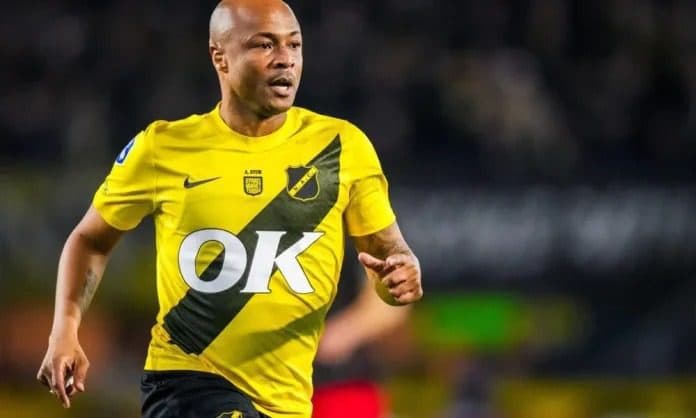
What happens when a man who has spent years answering questions about Ghanaian football from inside the dressing room begins to attract attention as someone who could one day answer for Ghanaian football from inside the boardroom?
André Ayew’s name is now entering a conversation that extends far beyond the pitch. Speculation about a possible run for the Ghana Football Association (GFA) presidency in 2027 has intensified following his appearance on The Obi One Podcast in Accra, where former Nigerian international Mikel Obi openly endorsed the idea.
Ayew has acknowledged receiving calls from stakeholders, but he has not formally declared his candidacy.
That distinction matters.
Yet the discussion itself raises a question Ghanaian football cannot afford to dismiss: Could the solution to Ghana’s football problems come from someone who understands the game as a player, or would the GFA presidency expose the limits of football experience without institutional reform?
This is not simply a story about a former Black Stars captain considering a new chapter. It is a debate about power, credibility, competence and whether Ghana is prepared to rethink who should lead its football.
From carrying the national flag to potentially controlling the football system
For years, Ayew’s responsibility was relatively clear. He was expected to represent Ghana, compete for results and shoulder the expectations that come with wearing the Black Stars shirt.
The GFA presidency is a fundamentally different proposition.
A national-team captain can influence the dressing room, motivate teammates and contribute to decisions on the pitch. A football association president must navigate governance, finances, competitions, development structures, stakeholder relationships and the administration of the entire game.
The skills overlap, but they are not identical.
This is where Ghana must move beyond sentiment.
Ayew’s international experience could provide valuable insight into the realities confronting players. He has experienced the expectations surrounding the Black Stars, the pressures of major competitions and the relationship between national-team football and the wider football environment.
But would that experience translate into the ability to reform an institution?
Can understanding the problems of a player automatically equip someone to understand the financial and administrative structures that shape the player’s career?
Can leadership in a dressing room translate into leadership across an organisation with competing interests, institutional obligations and stakeholders who may not share the same priorities?
These are not arguments against Ayew. They are the questions any serious examination of his potential candidacy must confront.
Ghana should neither crown him because of his name nor dismiss him because his reputation was built on the pitch.
It should examine what he intends to build.
The uncomfortable question: Is Ghana looking for a president or a saviour?
There is a recurring tendency in Ghanaian football to attach extraordinary expectations to individuals.
When the national team struggles, the country searches for the right coach. When administration becomes a source of frustration, attention turns to the right president. When development stalls, supporters look for a personality capable of transforming the entire system.
The danger is that the search for an exceptional individual can distract from the need for exceptional institutions.
Ayew’s potential entry into the GFA presidential conversation may be generating interest partly because he represents a departure from the conventional image of football administration. He is a recognisable former captain with direct experience of the game at the highest level.
But what if the central problem is not simply who occupies the presidency?
What if the problem also lies in how decisions are made, how performance is measured, how resources are allocated and how administrators are held accountable?
A president may arrive with excellent intentions and still struggle if the institution lacks effective systems for implementation and oversight.
Equally, a well-designed system cannot function properly if the people entrusted with leadership lack the courage or competence to use it.
The challenge, therefore, is twofold: Ghana needs capable leadership and an institutional framework that does not depend entirely on the personality of the person at the top.
If Ayew ever decides to contest, the country should ask him not merely what he wants to change, but how he intends to change it, who will help him and what evidence will demonstrate that his plans are working.
The presidency is not a trophy for distinguished service to football. It is a responsibility that must be justified by a credible vision.
FC Nania: A useful test, but not the whole answer
Ayew has pointed to his role as CEO of FC Nania while discussing the need to improve Ghanaian football, including infrastructure, youth development and league standards.
That reference deserves attention.
Club administration can provide insight into the practical difficulties of developing players, managing resources and creating structures that support footballing ambition. It can also reveal the gap between having a vision and possessing the capacity to implement it.
However, a club and a national football association operate at different levels of complexity.
The GFA’s responsibilities extend across the domestic leagues, national teams, refereeing, competitions, development programmes and the broader governance of football in Ghana.
Running a club, therefore, cannot by itself establish readiness to lead the association.
The more useful question is what Ayew has learned from his football administration experience and whether those lessons can be translated into a national development strategy.
What has improved under his leadership at FC Nania? What challenges has he encountered? How does he measure the development of young players? What financial and operational principles guide his decisions?
Those are reasonable questions for any prospective leader with a football-management background.
If he can demonstrate that his experience has produced practical lessons, it could strengthen the case for taking his ambitions seriously. If not, his public profile alone will be insufficient.
Ghana needs evidence of administrative competence, not simply proximity to football.
Why the youth-development question may matter more than the presidential question
Among the issues Ayew has highlighted, youth development could prove the most consequential.
Ghana has long placed considerable importance on producing talented footballers. Yet the existence of talent is not the same as the existence of a functioning development system.
Young players need quality coaching, competitive opportunities, appropriate facilities, reliable pathways into senior football and protection from exploitation. Clubs need incentives to invest in development. Coaches need access to training and continuing education. Domestic competitions need to provide meaningful opportunities for players to improve.
These challenges cannot be resolved through a presidential announcement.
They require a connected system in which clubs, academies, schools, regional football structures and national teams work towards clearly defined objectives.
Consider a question Ghana should be asking: how many promising players are lost between identification and professional development, and why?
Are they receiving adequate coaching? Do clubs have the resources to retain and develop them? Are young players being evaluated according to long-term potential or immediate commercial value? Is the domestic game providing a sufficiently competitive environment for emerging talent?
Without reliable information, youth development can easily become a slogan repeated by successive administrations.
A credible GFA leadership programme would need to establish measurable indicators, publish progress and explain where interventions are failing.
Ayew’s experience as a former international could help him understand the pathway players must navigate. But his potential value as an administrator would depend on his ability to turn that understanding into a national framework.
The question is not whether Ghana needs youth development. It is why the country should continue discussing it without demanding clear evidence of progress.
Infrastructure is not just about building football facilities
Ayew has also highlighted infrastructure, an issue that is often discussed in terms of stadiums and pitches.
But football infrastructure is broader than visible construction.
It includes training facilities, quality playing surfaces, medical support, rehabilitation services, equipment, coaching environments and the systems required to maintain them. It also includes the financial arrangements that allow clubs to operate sustainably.
A facility can be inaugurated with great ceremony and still fail to transform football if there is no adequate maintenance plan, access policy or development programme attached to it.
That leads to another difficult question: should the success of a football administration be measured by the facilities it builds or by the footballing opportunities those facilities create?
The answer should be both, but the second measure is often more revealing.
How many young players benefit? How frequently are the facilities used? Can local clubs afford access? Are coaches equipped to maximise the investment? Are there transparent arrangements for maintenance and accountability?
If Ayew intends to make infrastructure a central pillar of his thinking, he would need to explain how projects would be prioritised, funded, maintained and evaluated.
Ghana does not merely need more football infrastructure. It needs infrastructure that functions, serves a purpose and produces measurable value.
The domestic league: Can the GFA make Ghanaian football worth investing in?
Improving league standards may be the most politically difficult element of the conversation.
A stronger domestic league requires more than marketing campaigns and increased television visibility. It depends on the quality of competition, the credibility of officiating, club finances, player welfare, scheduling, facilities, governance and the willingness of commercial partners to invest.
The central question is whether Ghanaian football can create an environment in which clubs are not merely surviving from season to season but building sustainable sporting and commercial operations.
Can clubs plan several seasons ahead? Can players trust that their contractual rights will be respected? Can sponsors see a credible return on investment? Can supporters experience a competition whose administration commands confidence?
These issues are interconnected.
Better facilities without financially stable clubs may produce limited results. Improved marketing without reliable competition standards may fail to retain sponsors. Greater investment without credible governance may not translate into better football.
This is why any prospective GFA president should be expected to explain how the different elements fit together.
Ayew has referenced Morocco and Algeria as examples from which Ghana could learn. Such comparisons can be useful, but Ghana must go beyond admiring what other countries have achieved.
What precisely should Ghana learn from their football structures? Which policies could be adapted to Ghana’s economic and institutional circumstances? Which approaches would require substantial investment? What should be prioritised first?
International examples should inform a strategy, not substitute for one.
The objective should not be to copy another country’s football system. It should be to understand why certain approaches work and determine how Ghana can apply those lessons effectively.
Mikel Obi’s endorsement: Influence is not the same as a mandate
Mikel Obi’s public support adds an interesting dimension to the discussion.
The backing of a respected former international can help bring attention to Ayew’s possible ambitions. It can also signal that the idea resonates beyond Ghana’s football community.
But an endorsement is not a mandate.
The GFA presidency is not decided by a public popularity contest. Any prospective candidate must navigate the applicable electoral rules and the association’s governance structures.
That distinction creates an important challenge for Ayew, should he decide to run.
Would his campaign be built primarily around public enthusiasm and his international reputation, or would it establish a credible programme capable of persuading football stakeholders that he understands the demands of the office?
Can he articulate a financial model for development? Would he propose reforms to strengthen accountability? How would he address the competing interests of clubs, regional associations, players, coaches and other stakeholders?
And perhaps most importantly, what would he do differently from the existing football administration?
These questions should not be interpreted as hostility towards a potential candidate. They are the minimum demands of serious leadership scrutiny.
A famous name can open the door to public attention. It cannot replace a convincing policy agenda.
The biggest question: Would Ayew change the system or simply inherit it?
This is where the debate becomes particularly important.
The GFA presidency is an institutional office. Anyone who occupies it must operate within established rules, relationships and decision-making structures.
A new president may promise reform, but the actual ability to deliver that reform depends on the authority of the office, the support available, the quality of the administration and the willingness to confront entrenched interests.
Would Ayew seek to change how the GFA operates, or would he focus primarily on improving the outcomes produced by the existing structure?
Would he prioritise transparency in financial decisions and performance reporting? Would he support stronger accountability mechanisms? Would he establish clear targets for the domestic league and youth development? Would he publish progress reports that allow clubs and supporters to assess his administration?
And if reforms proved unpopular with influential stakeholders, would he have the resolve to continue pursuing them?
These are questions that distinguish a campaign built around personal credibility from one built around institutional transformation.
Ghana does not need to assume that the existing system is beyond repair. Nor should it assume that replacing its leader will automatically repair it.
The country needs a serious conversation about which structures are working, which are failing and which reforms would produce the greatest benefit.
If Ayew enters the race, his most important contribution may not be his celebrity or his history with the Black Stars. It may be his willingness to make those questions central to the contest.
Before 2027, Ghana deserves answers
For now, Ayew has acknowledged receiving calls from stakeholders but has not formally declared his candidacy. The speculation should therefore remain speculation until he makes a clear decision.
Nevertheless, the conversation offers an opportunity to reconsider the standards by which Ghana evaluates football leadership.
A prospective president should be judged on a credible development plan, a realistic understanding of the association’s responsibilities, the ability to build competent teams and a willingness to be held accountable.
The same standards should apply to every other potential candidate.
Ghana should not turn the GFA presidency into a reward for footballing fame. But neither should it close the door to people whose playing careers have given them valuable insight into the game.
The relevant question is not whether a former Black Stars captain can become a football administrator. It is whether he can demonstrate the competence, judgement and institutional vision required to lead one.
If Ayew decides to contest, the country should demand a programme that goes beyond infrastructure, youth development and league standards. It should ask for priorities, timelines, funding models, accountability mechanisms and measurable targets.
If he does not contest, the issues he has raised should still remain on the agenda.
That is the ultimate test of whether this debate is about one man or the future of Ghanaian football.
Because Ghana’s next GFA president should not merely promise to make football better. The candidate should explain why the system has struggled to deliver, what must change and how the country will know when that change has finally happened.
The most important question is no longer whether André Ayew wants to lead Ghana football.
It is whether Ghana football is ready to demand more from whoever does.
By Kemi Keys