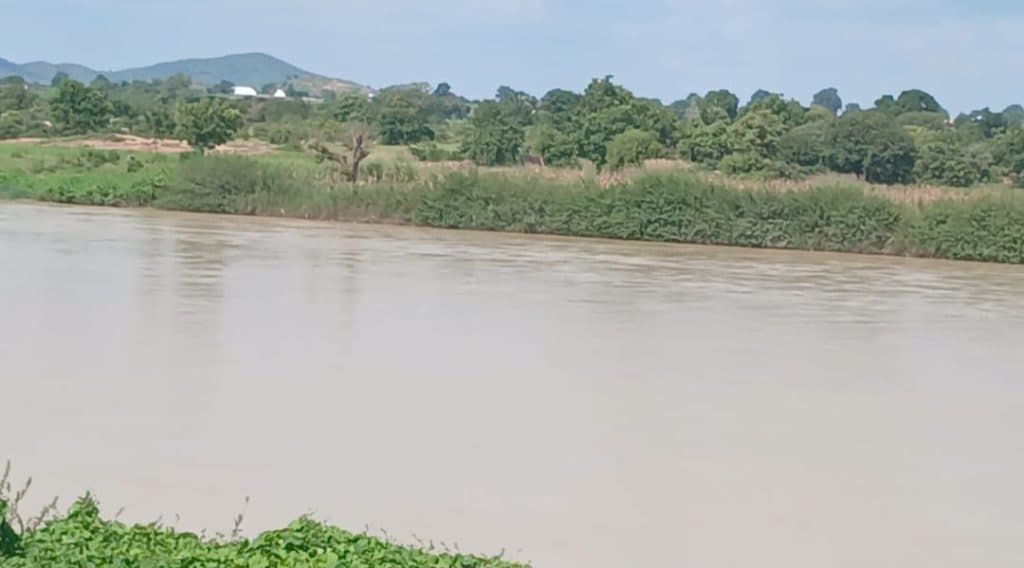
The Bagre Dam, whose annual spillage has often contributed to flooding along the White Volta in parts of northern Ghana, has not resulted in flooding in the usual farming communities this year.
As of September 11, 2026, the Kubore enclave along the White Volta in the Binduri District remained largely unaffected by flooding, with the river maintaining relatively low water levels.
The absence of flooding has allowed farmers to continue working on their farms along the riverbanks. Crops observed in the area appeared to be developing well, in contrast to previous years when flooding destroyed farms and displaced farmers.
For some farmers, however, the situation has brought mixed feelings. Farmers who decided not to cultivate along the river because they feared the usual floods are now regretting their decision.
Agriculture
The absence of flooding has provided favourable conditions for farmers who cultivated along the White Volta.
The Binduri District Director of Agriculture, Abugri Razak Abangiba, says the district is likely to record high agricultural yields this year because farmers have been spared the farm destruction usually caused by flooding.
During a visit to the Kubore area, two female farmers were found working on their rice farms.
The farmers said cultivating along the river at the beginning of the farming season was a gamble because they were uncertain whether the river would eventually overflow its banks.
They said they went ahead with planting while hoping that the river would not overflow its banks or that any flooding would not be severe enough to destroy their crops.
For farmers who stayed away from the riverbanks, the absence of flooding has become a source of regret.
One of them, Moses Amolif Asunka, a resident of Nafkoliga in the Binduri District, said:
“We have regretted not farming there this year. It is a loss to us. Those farming there are going to make it.”
The situation illustrates the difficult choices farmers along the White Volta have to make each farming season, balancing the potential benefits of fertile riverbank farmland against the risk of losing their crops to flooding.
Water, Sanitation And Hygiene (WASH)
The absence of flooding has also provided relief for sanitation facilities in communities along the White Volta.
Flooding has historically affected household latrines and other sanitation facilities in parts of the Binduri District. When floodwaters and groundwater saturate latrine pits, the structures can weaken and collapse, forcing residents to resort to open defecation.
According to Paul Atubiga, an Environmental Health Officer at the Binduri District Assembly, flooding remains one of the major challenges affecting sanitation facilities in communities in the district.
He said the destruction of latrines during flooding has contributed to a reversal of progress made in the fight against open defecation.
“About 70% of the communities we declared open defecation-free have gone back to open defecation due to this challenge,” he said.
With water levels in the river remaining relatively low this year, some sanitation facilities that would normally be exposed to flooding have remained intact.
The flood-free period therefore offers communities an opportunity to maintain sanitation facilities and avoid the disruption caused by the destruction of household latrines.
Climate Change
The situation along the White Volta is also raising questions about climate variability and the growing uncertainty surrounding weather patterns and farming seasons.
For communities that have traditionally prepared for the possibility of flooding associated with heavy rainfall and the spillage of the Bagre Dam, the relatively low water levels this year have created an unusual situation.
Farmers who previously avoided riverbank farming because of the fear of losing their crops to floods have watched others cultivate and potentially benefit from the fertile land without experiencing the expected flooding.
However, one flood-free year does not necessarily mean that the threat of flooding has disappeared.
Climate variability can affect the timing, intensity and distribution of rainfall, making it increasingly difficult for farmers and communities to predict conditions from one season to another.
For farmers along the White Volta, this means they face a dual challenge: flooding can destroy crops and sanitation facilities in one season, while inadequate or unpredictable rainfall can threaten agricultural production in another.
The experience at Kubore therefore highlights the need for communities along the White Volta to strengthen climate adaptation measures, including access to reliable weather and seasonal forecasts, flood early-warning information, climate-resilient farming practices and improved water management.
The challenge for farmers is no longer simply to prepare for the possibility of the Bagre Dam spilling. They must also adapt to increasingly uncertain weather conditions that can bring either excessive water or insufficient rainfall.
The Binduri district director of Agriculture Abugri Razak Abangiba indicated that they have intensified advocacy for farmers to adapt to planting early maturing varieties of crops in order face the climate instability.
“We have increased our campaign for the adoption of early maturing crops. If farmers adopt to that, it would reduce the risk of destruction to flooding and unstable rainfall pattern” he stated.
This measure is largely going to assist reduce the risk of destruction of farmlands in event of flooding, unstable rainfall or drought.
By: Ibrahim Abode | Metrotvonline.com | Ghana