Tonight, football will celebrate individual greatness. But as the world turns its attention to the 70th Ballon d’Or ceremony in London, one question deserves more attention than the identity of the eventual winner: What does it really mean to be the best footballer in the world?
Is it about scoring the most goals? Winning the biggest trophies? Delivering when the pressure is greatest? Or being the player whose influence transforms an entire team?
The Ballon d’Or has spent seven decades trying to answer that question. Yet, every year, the debate returns — and perhaps that is precisely what makes the award so compelling.
The 2026 ceremony takes place at the London Palladium on Monday, 26 October, marking the first time the prestigious event has been staged in London. It also pays tribute to the award’s inaugural winner, Sir Stanley Matthews, who claimed the honour in 1956. UEFA
Seventy editions later, the trophy remains football’s most prominent individual prize — but deciding who deserves it has never been as simple as counting goals or medals.
THREE CONTENDERS, THREE DIFFERENT ARGUMENTS
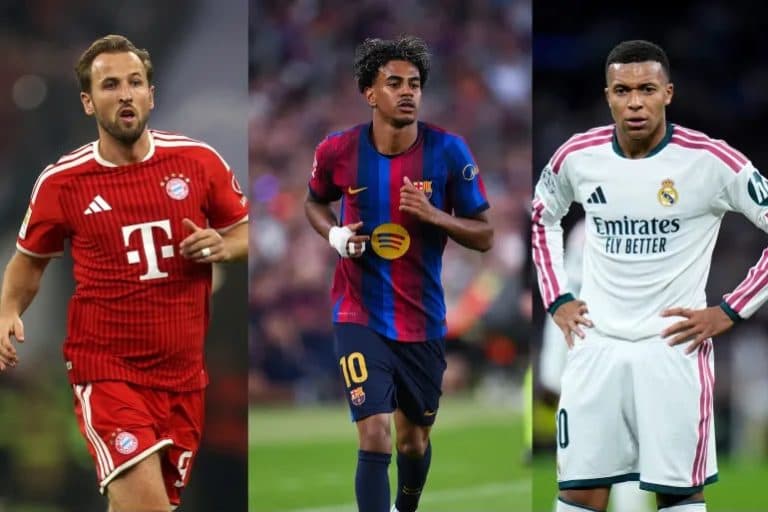
This year’s men’s race brings three compelling names into the conversation: Harry Kane, Kylian Mbappé and Lamine Yamal. Each represents a different argument about individual excellence.
For Kane, the case is built around relentless production and the pursuit of a long-awaited recognition at the highest individual level. His goalscoring output for Bayern Munich and England has made him a serious contender, while a Ballon d’Or victory would carry enormous significance for English football.
But should a prolific season automatically make a striker the world’s best player? Goals are decisive, yet the game involves far more than the final touch. There is movement, link-up play, pressing, chance creation and the ability to influence matches when scoring opportunities are scarce.
Mbappé presents another powerful argument. His pace, directness, finishing and capacity to change a game in moments make him one of football’s most dangerous attacking players. Supporters of his candidacy can argue that individual brilliance should be judged by a player’s output, influence and ability to decide major contests — not simply by the number of trophies in his cabinet.
Then there is Yamal, whose rise has challenged traditional ideas about age and experience. His creativity, confidence and influence in the final third have made him a central figure in conversations about football’s present and future. A major individual award for a player so young would not merely celebrate a season; it would signal the arrival of a new generation.
But youth should neither inflate nor diminish a player’s case. The question is whether the performances justify the recognition.
THE TROPHY PROBLEM: CAN THE BEST PLAYER LOSE?
One of football’s most persistent arguments is whether team success should determine an individual award.
Football is a collective sport. Even the most gifted player depends on teammates to defend, create space, win possession and convert opportunities. A brilliant individual can have an outstanding season without winning the biggest trophies, while another player can enjoy a historic campaign because his team is stronger across every position.
If trophies become the dominant measure, the Ballon d’Or risks becoming a prize for the most successful team rather than the most outstanding individual.
But if team achievements are ignored entirely, the award risks overlooking the importance of performing when the stakes are highest.
The official Ballon d’Or criteria attempt to balance these competing demands. Individual performances and decisive impact come first, followed by collective achievements and trophies, then class and fair play. France Football’s regulations
That order matters. It suggests that winning trophies should strengthen a player’s case, not automatically settle the argument.
The difficult question for voters is how to separate an individual’s contribution from the success of the system around him.
THE NUMBERS ARE IMPORTANT — BUT WHAT DO THEY TELL US?
Modern football has become obsessed with statistics. Goals, assists, expected goals, chances created, successful dribbles and progressive passes now dominate conversations about performance.
These numbers can reveal what the eye misses. They can also help challenge reputations built on popularity rather than consistent production.
However, statistics require context.
A striker who scores against the strongest opponents may have a different claim from one whose goals arrive mainly in comfortable victories. A midfielder may control matches without registering goals or assists. A defender may prevent danger before it becomes a highlight, while a goalkeeper’s contribution may be measured in saves that never appear in a season-ending montage.
The real challenge is not choosing between statistics and the eye test. It is understanding how both explain a player’s influence.
A Ballon d’Or debate that considers only goals risks reducing football to its final action. One that ignores measurable performance risks turning the award into a popularity contest.
DOES THE WORLD VOTE FOR GREATNESS — OR FOR A NARRATIVE?
There is another uncomfortable factor: perception.
A player’s reputation, club, nationality, media visibility and previous achievements can influence how supporters discuss his candidacy. A compelling story can make a player’s season feel more memorable, even when another candidate’s performances may be equally or more impressive.
Kane’s pursuit of individual recognition, Mbappé’s global superstar status and Yamal’s extraordinary rise each offer a powerful narrative. But a compelling narrative should invite scrutiny, not replace it.
The award is decided by an international jury of specialist journalists, who rank their top ten nominees using a points system. That process is intended to bring structured judgment to a debate that is otherwise dominated by emotion. UEFA’s guide to the 2026 ceremony
Still, no voting system can completely remove subjectivity from a sport in which different positions, tactical roles and competitive circumstances make direct comparisons difficult.
That is why the most meaningful question is not whether every fan agrees with the winner. It is whether the reasoning behind the decision can withstand scrutiny.
THE REAL TEST OF THE 2026 BALLOON D’OR
As the nominees prepare for tonight’s ceremony, the debate should be bigger than who finishes first, second or third.
If Kane wins, will it be because his individual output made him the most outstanding player of the season? If Mbappé wins, will the argument rest on his goals, decisive performances and overall influence? If Yamal wins, will his impact and achievements demonstrate that age is irrelevant when the performances are exceptional?
Each outcome would tell a different story about what football values.
And that is the point: the Ballon d’Or is not merely a celebration of a player. It is a reflection of the standards by which football judges greatness.
Perhaps the fairest winner is not necessarily the player with the most goals, the most trophies or the loudest supporters. It is the player whose full-season performances make the strongest case when individual brilliance, decisive impact, team achievements and sportsmanship are considered together.
Tonight, one name will be called. The argument, however, will continue.
Because in football, the question is never simply who is the best. It is what we choose to measure when we decide.
By: Kpeglo Yao Elikem | Metrotvonline.com | Ghana