
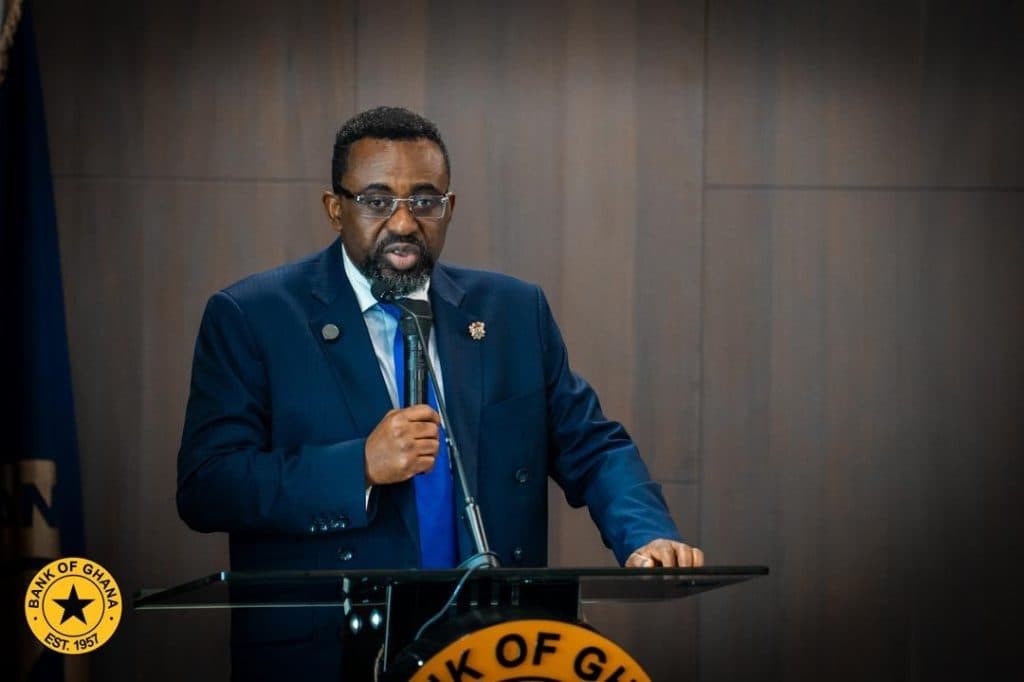
Governor of the Bank of Ghana Dr. Johnson Pandit Asiama has assured members of the UK-Ghana Chamber of Commerce that Ghana’s improving economic conditions will be sustained through disciplined monetary and regulatory policies.
Speaking at an engagement with the Chamber at the Bank of Ghana on Monday, February 23, 2026, Dr. Asiama said the central bank remains committed to protecting recent gains in inflation control, exchange rate stability, and investor confidence.
“It is with deep sense of pleasure that I welcome the UK-Ghana Chamber of Commerce to the Bank Square today,” he said, noting that the Chamber has, for nearly a decade, served as “a strong bridge between the two economies.”
According to him, the relationship between Ghana and the United Kingdom has helped strengthen commercial ties and opened doors for partnerships that benefit both sides.
Dr. Asiama stressed that businesses play a key role in shaping economic policy and should not be seen as passive recipients of central bank decisions.
“Businesses are not merely passive recipient of monetary policy impulses but crucial actors who, in turn, shape monetary policy decisions,” he said.
He explained that engagements such as the meeting with the Chamber were meant to help the Bank better understand market realities while allowing businesses to appreciate regulatory requirements.
A major focus of the meeting was the Bank’s foreign exchange guidelines issued under the Foreign Exchange Act, 2006.
“The objectives of these guidelines and directives are clear, to improve transparency and compliance, as well as reinforce macroeconomic stability,” Dr. Asiama said.
He, however, admitted that policies must also support business growth.
“We are conscious of the fact that policy implementation must be pragmatic and supportive of business environment,” he added.
The Governor said the central bank was ready to listen to concerns from UKGCC members and work with them to ensure smooth implementation of the new rules.
“The purpose of this meeting is to clarify the intent and application of the guidelines, listen to feedback from your members, and explore areas of collaboration,” he noted.
Dr. Asiama pointed to recent economic data as evidence that the country is on a recovery path.
“Inflation has declined sharply from 23.8 percent in December 2024 to 3.8 percent in January 2026,” he revealed.
He added that lending rates were falling and private sector credit was beginning to recover, reflecting improved financial conditions.
“These policies and initiatives have laid a robust foundation to anchor stability and created a congenial environment for businesses to thrive,” he said.
The Governor assured investors and business leaders that the Bank would not relax its efforts.
“We are determined to consolidate these gains,” he said, adding that a stable economy would lead to “a better business environment, greater consumer confidence, and improved trade and services.”
He also pledged to sustain ongoing regulatory and structural reforms to protect long-term stability.
Dr. Asiama described the UKGCC as a key player in Ghana’s private sector, noting that it has over 230 member companies across various industries.
“The UKGCC therefore represents a significant and influential segment of Ghana’s private sector,” he said.
He called for closer cooperation between policymakers and businesses.
“The Bank of Ghana is open to working with UKGCC and the member companies to ensure that our policies are geared towards long-term stability, competitiveness, and common prosperity,” he said.



