
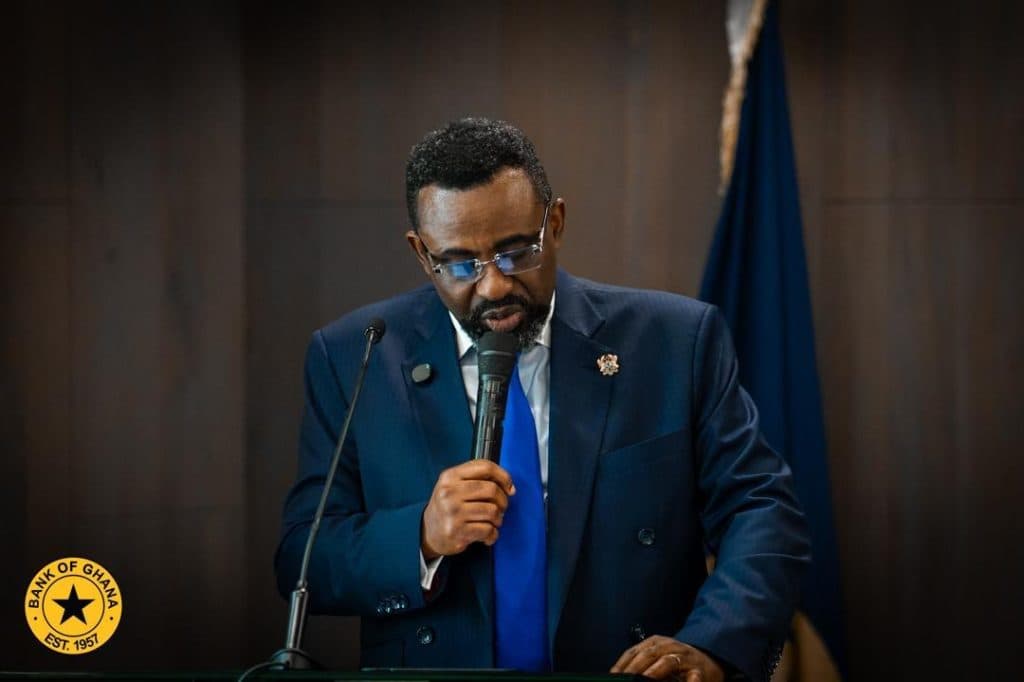
Dr. Johnson Pandit Asiama, governor of the Bank of Ghana, has called on members of the UK-Ghana Chamber of Commerce to play a more active role in shaping the country’s monetary and foreign exchange policies.
He said feedback from the private sector remains critical to effective decision-making at the central bank.
Speaking at an engagement in Accra on Monday, February 23, 2026, Dr. Asiama stressed that businesses are not outsiders in policy formulation.
“Businesses are not merely passive recipient of monetary policy impulses but crucial actors who, in turn, shape monetary policy decisions,” he said.
According to him, policies work best when they reflect real market conditions and are understood by those who must operate under them.
“We recognise that sound policy is most effective when it is well understood, responsive to market realities, and implemented in collaboration with key stakeholders,” he added.
Dr. Asiama explained that the meeting with the Chamber was meant to create room for open discussion on the Bank’s foreign exchange guidelines and other regulatory measures.
“The purpose of this meeting is to clarify the intent and application of the guidelines, listen to feedback from your members on anticipated challenges and opportunities,” he said.
The Governor said the Bank welcomed constructive criticism from the business community, especially in relation to the Foreign Exchange Act, 2006.
“The objectives of these guidelines and directives are clear, to streamline foreign exchange market operations, improve transparency and compliance, as well as reinforce macroeconomic stability,” he noted.
However, he admitted that regulations must be realistic.
“We are conscious of the fact that policy implementation must be pragmatic and supportive of business environment,” he said.
Dr. Asiama also highlighted the importance of trust between the central bank and the private sector, particularly between businesses in Ghana and the United Kingdom.
“Your presence here today is an indication of the trust, faith and mutual respect that exist,” he told members of the Chamber.
He praised the UKGCC for its role in linking investors and companies from both countries.
For almost a decade, he said, the Chamber has supported businesses and served as “a strong bridge between the two economies.”
With more than 230 member companies, Dr. Asiama described the Chamber as an important voice in Ghana’s private sector.
“The UKGCC therefore represents a significant and influential segment of Ghana’s private sector,” he said.
He assured participants that the central bank remains open to regular dialogue.
“We believe that sustained engagement, openness to feedback and constructive criticism, as well as collaboration between policymakers and the private sector are essential,” he said.



