
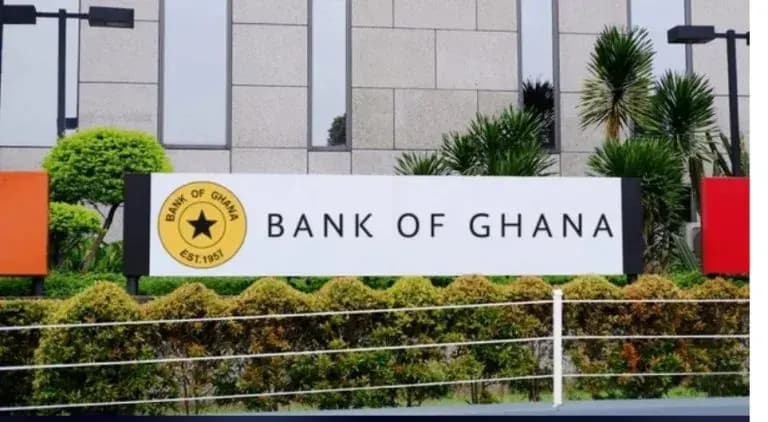
The Governor of the Bank of Ghana, Johnson Pandit Asiama, has defended the decision by the Monetary Policy Committee (MPC) to maintain the policy rate at 14 per cent, citing ongoing geopolitical tensions in the Middle East as a major threat to Ghana’s inflation outlook and overall economic stability.
Speaking at the 130th MPC press briefing in Accra, Dr Asiama described the Middle East conflict as the “elephant in the room” influencing the central bank’s cautious approach despite signs of improving domestic economic conditions.
According to him, although current economic indicators suggested there was room for further monetary easing, the MPC opted to hold the rate steady to closely monitor global developments and their potential impact on inflation.
“The committee evaluated other forms of risks. The elephant in the room here is the Middle East crisis,” Dr Asiama stated.
“Up to this time, one is not sure whether it is temporary or whether it is going to be long-lasting. If we assume that it will be a longer-lasting one, then you can imagine the impact on inflation expectations and the so-called second-round effects,” he added.
The Governor explained that while real interest rate trends pointed toward possible cuts, the MPC considered both domestic gains and external vulnerabilities before reaching its decision.
“That is why, in the wisdom of the committee, it was decided to pause and evaluate all incoming data so that at the next MPC round, the committee would take an appropriate decision,” he said.
Dr Asiama also addressed concerns over the slow decline in commercial bank lending rates despite falling benchmark interest rates. He noted that the low-interest-rate environment remained relatively new to banks, forcing them to gradually adjust lending portfolios and risk strategies.
“When interest rates are falling, it may take a while. You don’t just rush into giving loans. There have to be adequate bankable projects and you don’t compromise your credit appraisal standards,” he explained.
He indicated that banks were acting cautiously to avoid excessive credit risks but assured that lending rates would eventually reduce once the low-interest-rate environment becomes more sustained.
The Governor further justified the MPC’s decision to revise the dynamic cash reserve ratio to a uniform 20 per cent reserve requirement in domestic currency, effective June 4, 2026. According to him, the measure would strengthen liquidity management and support the Bank’s open market operations.
“In the wisdom of the committee, we think this will go a long way to complement our open market operations,” he noted.
Dr Asiama disclosed that the central bank would engage Chief Executive Officers of commercial banks next week to explain the implications of the new policy measures.
On the recent oversubscription of Treasury bill auctions, the Governor declined to directly comment on government borrowing strategies, saying such matters were better addressed by the Ministry of Finance.
“You know it’s a market; it’s an auction. The banks and treasuries make those decisions based on market conditions and what they forecast going forward,” he said.
Touching on exchange rate concerns, Dr Asiama stressed that Ghana operates a managed floating exchange rate regime rather than a fixed exchange rate system.
“The cedi is expected to move. It can depreciate or appreciate. Our concern is to avoid excessive volatility,” he stated.
He attributed recent depreciation pressures mainly to rising foreign exchange demand triggered by higher crude oil prices and dividend repatriation by multinational firms during the April-May reporting season.
“The same volume of crude oil is costing about twice more by way of foreign exchange,” he explained.
Despite the pressures, the Governor assured the public that the central bank had sufficient foreign exchange reserves to maintain stability in the market. He revealed that Ghana’s Net International Reserves had risen from US$10.9 billion in April to US$12.43 billion currently.
“The good part of it all is that we have the buffers. We are building them on a daily basis,” he stressed.
“We should be able to do what we have to do. What we will ensure is that we won’t see a return to the kind of volatility we saw in previous years,” he added.
On credit distribution, Dr Asiama said the commerce sector continued to receive the largest share of bank credit but noted that all sectors would benefit if private sector lending growth is sustained.
He also disclosed that the central bank was advancing plans for a regulated digital credit framework that would allow individuals and businesses to access small loans through mobile phones.
“So very soon, no matter which sector you are involved in, you can just raise a loan on your mobile phone,” he revealed.
The Governor further announced that Ghana could witness the establishment of its first non-interest banking institution before the end of the year, noting that the regulatory framework was being developed in line with international best practices.
“That is something dear to my heart,” he stated.
On the banking sector’s non-performing loans (NPLs), Dr Asiama said the central bank had already directed commercial banks to reduce bad loans by the end of 2026. He disclosed that while the gross NPL ratio stood at 18 per cent, the net figure after provisions was around eight per cent.
“We don’t just erase fully provisioned loans because of moral hazard,” he explained, urging banks to continue pursuing loan defaulters to recover outstanding debts.
Regarding concerns about disruptions to Ghana’s gold exports arising from the Middle East conflict, the Governor said temporary challenges affecting shipments to the United Arab Emirates had been resolved through alternative export arrangements.
“The Gold Board has been able to find a way around it,” he said. “Shipments are ongoing.”



