
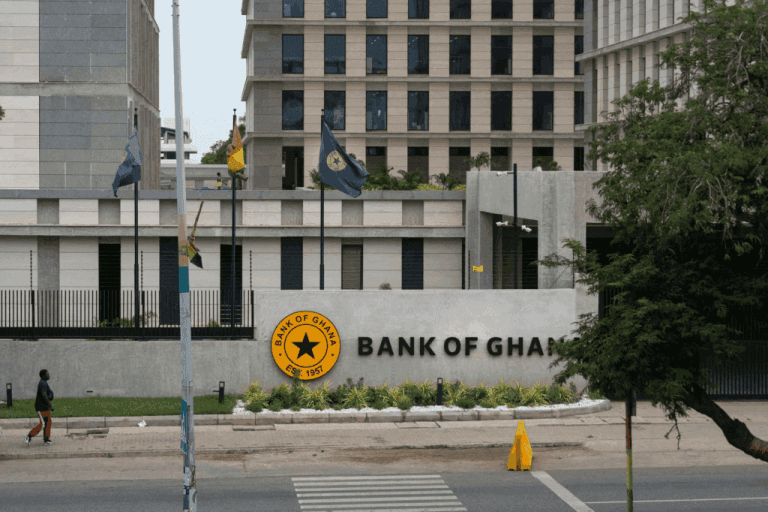
The Bank of Ghana has posted a loss of GH¢15.63 billion for the 2025 financial year, deepening its financial challenges despite a significant rise in operating income.
According to its 2025 Financial Statements, the central bank’s loss widened from GH¢9.49 billion in 2024 to GH¢15.63 billion in 2025.
The report noted that total operating income more than doubled to GH¢22.28 billion in 2025 from GH¢9.40 billion in the previous year, driven largely by gains from gold-related transactions and other income streams.
However, this was outweighed by a sharp increase in operating expenses, which surged to GH¢37.91 billion from GH¢18.89 billion in 2024.
A major cost driver was the “cost of open market operations,” which rose significantly to GH¢16.73 billion, alongside losses on gold dealings and exchange rate-related revaluation losses.
The financial position of the central bank remains under strain, with the report revealing that it recorded a negative equity of GH¢93.82 billion at the end of 2025, compared to GH¢58.62 billion in 2024.
The Board attributed the situation largely to the impact of Ghana’s Domestic Debt Exchange Programme and recent monetary policy operations.
It explained that “the Bank of Ghana recorded negative equity as a consequence of the Domestic Debt restructuring… and the monetary policy operations of 2024 and 2025.”
Despite the losses and negative equity, the central bank maintained that it remains operationally sound.
The report indicated that the Bank recorded “a strong policy solvency position, improving markedly over the 2024 outturn,” supported by increased income from reserve management, fees, and gold sales.
Operating income less the cost of open market operations stood at GH¢5.5 billion in 2025, up from GH¢793.5 million in 2024.
To address its financial position, the government has committed to recapitalising the central bank over the medium term.
The report disclosed that a phased programme between 2026 and 2032 will involve transfers of financial instruments or cash to restore the Bank’s capital base.
“The recapitalization inflows… are expected to result in positive net equity by 2032,” the report stated.
Looking ahead, the central bank expressed optimism about its recovery prospects, citing improving macroeconomic conditions.
It projected that declining inflation, a lower policy rate, and improved external sector stability would enhance profitability over time.
The Board added that it “has no reason to believe that the business will not be a going concern,” underscoring confidence in the Bank’s ability to sustain operations.
The Directors did not recommend the payment of dividends for the 2025 financial year, consistent with the Bank’s loss position.



