
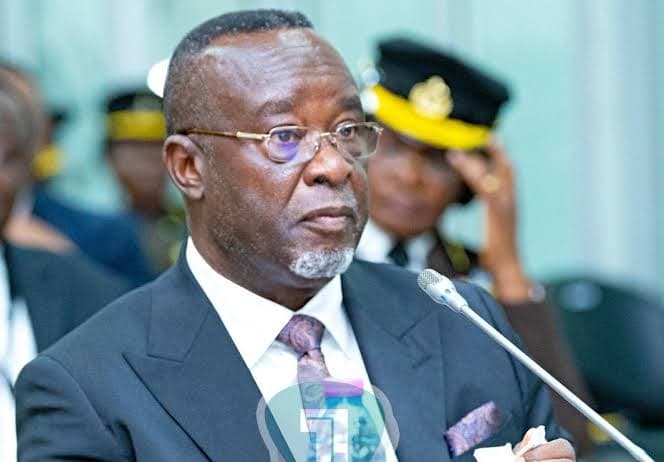
The Ghana Catholic Bishops’ Conference has cautioned Chief Justice Paul Baffoe-Bonnie to exercise greater restraint in his public comments to protect public confidence in the Judiciary.
The Bishops said remarks made by the Chief Justice during visits to the Social Security and National Insurance Trust (SSNIT) and the Minerals Income Investment Fund (MIIF) on September 2, 2026, could create the perception that he was making a partisan comparison between the current administration and its predecessor.
In a statement, the Conference said there was nothing wrong with the Chief Justice visiting public institutions and commending improvements in their operations.
It, however, took issue with his reference to the “past eight years”, arguing that the phrase could reasonably be interpreted within Ghana’s political context as a comparison between the present government and the previous administration.
“The difficulty lies not in the visits themselves, but in the political character that some of his remarks, in particular his reference to the ‘past eight years’, can reasonably be understood to have acquired,” the Bishops said.
“In our national context, such a phrase is readily heard as a comparison between the present administration and its predecessor.”
The Conference said the comments therefore risked taking on “the character of a partisan judgment”, even if that was not the Chief Justice’s intention.
The Bishops noted that similar concerns had already been raised by the Ghana Centre for Democratic Development (CDD-Ghana), which warned that the remarks could create an impression of political endorsement and undermine confidence in judicial impartiality.
They also acknowledged the Judicial Service’s subsequent clarification that the Chief Justice’s observations were made in good faith and were not intended to compromise judicial independence.
The Conference said it had received that explanation in good faith but maintained that the incident raised broader questions about judicial ethics and public trust.
“The office of Chief Justice is not that of an ordinary public commentator,” the statement said.
According to the Bishops, the courts could at any time be called upon to determine disputes involving the government, political parties or public institutions.
They therefore stressed that citizens must have confidence that the head of the Judiciary is insulated from partisan political considerations.
“Judicial independence is not only a matter of actual impartiality; it also depends on the visible, unmistakable appearance of impartiality,” the Conference said.
“A judge, and especially the head of the Judiciary, must be, and must be seen to be, above the partisan contest.”
The Catholic Bishops were, however, careful not to accuse the Chief Justice of being partisan or suggest that the Judiciary had been compromised.
They said such conclusions would go beyond the available evidence and described calls for his resignation over the remarks as disproportionate.
“We wish to be clear that none of this amounts to a suggestion that the Chief Justice is partisan, or that the Judiciary has been compromised,” they stated.
The Conference said the key issue was whether the Chief Justice’s conduct could create reasonable doubts about his political neutrality.
“The question is not whether he may hold [his convictions], but whether his public conduct in office should ever create room for reasonable doubt about where he stands,” the Bishops said.
They suggested that the Chief Justice could have commended SSNIT and MIIF for their achievements without comparing their performance with that of a previous administration.
“The same positive message could have been delivered without inviting the very perception now at issue,” they said.
The Bishops also appealed to both the governing party and the opposition to avoid using the controversy for partisan advantage.
They urged the government not to interpret criticism of the Chief Justice as an attack on its record, while cautioning the opposition against treating the remarks as evidence that the courts had been captured.
“The same standard of restraint must be asked of every public office holder, regardless of who occupies it or which party is in government,” the Conference said.