
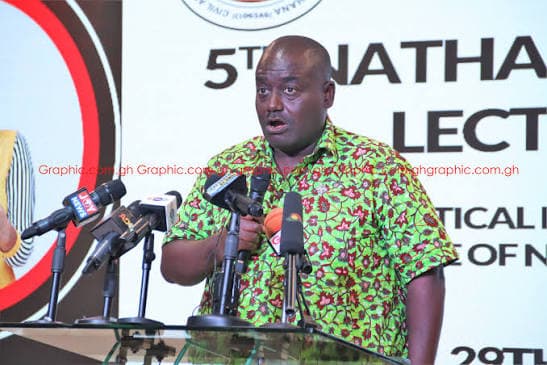
Dr Isaac Bampoe Addo, the Executive Secretary of the Civil and Local Government Staff Association of Ghana (CLOGSAG), has died.
Dr Bampoe Addo is said to have died on Friday, August 21, 2026, after a brief illness.
His death brings to an end a long career at the centre of labour relations, public sector negotiations and advocacy for the neutrality and professional independence of Ghana’s Civil Service and Local Government Service.
Dr Bampoe Addo had served as CLOGSAG’s Executive Secretary for several years and became one of the association’s most prominent voices on issues affecting public sector workers.
He was particularly vocal on the need to protect the Civil and Local Government services from political interference.
In 2020, he warned that political interference in promotions, postings, transfers, recruitment and other administrative processes was undermining effective service delivery and creating challenges within the public service.
He maintained that position in subsequent years, repeatedly calling for the strict observance of the constitutional principle of political neutrality in the Civil Service.
In December 2024, for instance, Dr Bampoe Addo warned that CLOGSAG would “strongly resist” partisan appointments into the Civil Service and Local Government Service, arguing that public servants must be allowed to operate without political interference.
His advocacy also extended to the welfare and conditions of service of CLOGSAG members.
He played a leading role in negotiations over salaries, allowances, pensions and other conditions of service, including the association’s push for a unique salary structure for its members.
In 2022, he announced the suspension of a nationwide CLOGSAG strike after the government reached an agreement with the association over outstanding allowances.
The issue of a unique salary structure remained a major concern for CLOGSAG during his final years. In February 2026, Dr Bampoe Addo announced a nationwide strike over delays in implementing the structure, saying negotiations had begun as far back as 2019 and that government had subsequently agreed to implementation dates that were not met.
The strike commenced on March 9, 2026, with CLOGSAG directing members across the Civil Service and Local Government Service to stay at home until further notice.
Dr Bampoe Addo was also involved in broader discussions on public administration and decentralisation.
In January 2025, he advocated a review of Ghana’s decentralisation framework to allow Metropolitan, Municipal and District Chief Executives to be elected and made accountable to the people rather than appointed by the President.
His influence within the public service extended beyond CLOGSAG. The 2023 Civil Service Annual Progress Report listed him as CLOGSAG’s representative on the Civil Service Council.
He was still actively representing the association in the months preceding his death. In July 2026, he addressed newly elected CLOGSAG executives in the Ashanti Region, urging them to work professionally and diligently to promote the welfare of members and the association.
Over the years, Dr Bampoe Addo also took strong positions on pension reforms, the role of political appointees in the public service and the involvement of party activists in the administration of government institutions.
In 2022, he accused political actors of interfering in the Civil Service and warned against the use of personal assistants, consultants and party functionaries to perform duties that should ordinarily be handled by career civil servants.
At a 2023 CLOGSAG congress, then Employment and Labour Relations Minister Ignatius Baffour-Awuah even referred to Dr Bampoe Addo’s role in securing the controversial neutrality allowance, saying jokingly that he did not know what the CLOGSAG Executive Secretary had done to him before he signed the agreement.
Dr Bampoe Addo’s passing is therefore a significant loss to Ghana’s organised labour and public administration landscape, particularly at a time when CLOGSAG remains engaged with government over conditions of service and the professional independence of the Civil and Local Government services.