
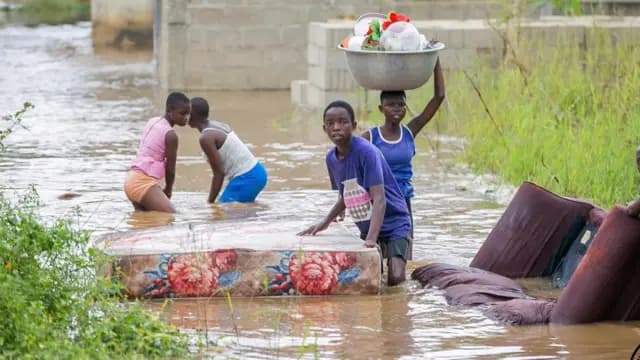
The Centre for Social Innovation and Democratic Thought (CSIDT) is calling for the establishment of a national flood management standard, arguing that Ghana’s response to flooding remains largely reactive despite recurring disasters.
Executive Director of the Centre, Eugene Boadu, said the country needs a comprehensive framework to coordinate institutions responsible for flood prevention and emergency response instead of relying on contingency measures after disasters occur.
Speaking on Good Afternoon Ghana on Metro TV on Monday, July 27, Mr. Boadu said recurring floods have made it necessary to adopt a structured national approach.
“The response to our disasters in general, flood not being an exception, is that often it is contingency-driven as opposed to having a national comprehensive framework or standard,” he said.
“I think floods have become part and parcel of urban life to the extent that we now need a national standard.”
According to him, such a framework would improve coordination among institutions including local assemblies, the Ghana Meteorological Agency and emergency response agencies.
He cited the national clean-up exercise announced after the June floods as an example of where better coordination was needed.
While commending the initiative, Mr. Boadu said assessments by his organisation showed it was only “about 63% successful.”
He explained that in several areas, silt removed from drains was left along the edges of gutters, creating the risk of it being washed back into the drainage system if it rained shortly afterwards.
“If it had rained that same night, the chances that the silt would have been washed right back into the gutters would have been high,” he said.
“That is what we mean by coordination.”
Mr. Boadu argued that many of Ghana’s flood management challenges are not necessarily due to a lack of funding but poor organisation among state institutions.
“The capacities exist,” he said. “We’re able to get men and women into the gutters to remove the filth… but by having a national command that deals with flooding, it can better organise these things so that we can optimise the work that is done.”
He also proposed making national clean-up exercises mandatory several times a year, particularly in the months leading up to the rainy season, saying a more coordinated and preventive approach would reduce the devastating impact of floods across the country.