
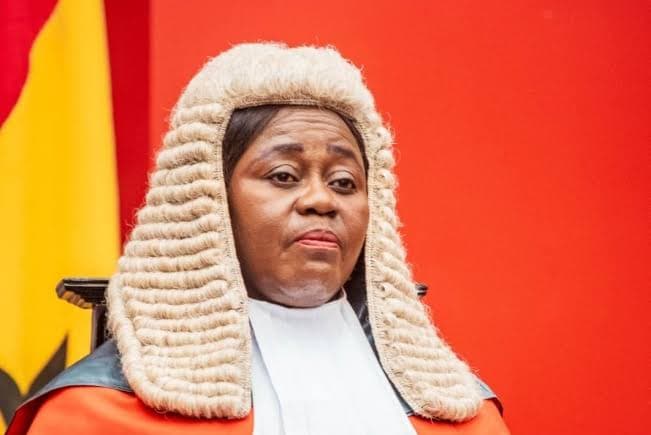
The ECOWAS Community Court of Justice has dismissed all claims brought by former Chief Justice Gertrude Torkornoo against the Republic of Ghana, ruling that her rights were not violated during the process that led to her removal from office.
In its judgment, the court rejected all seven claims advanced by Justice Torkornoo and declined to award the US$10 million in damages she had sought.
The court held that because it found no violation of any of the applicant’s rights under the African Charter on Human and Peoples’ Rights, there was no basis for considering reparations.
The case was argued on behalf of Ghana by Deputy Attorney General, Dr Justice Srem Sai, while Justice Torkornoo was represented by prominent Nigerian lawyer Femi Falana.
The court found that the suspension of the former Chief Justice did not violate her right to work and rejected her claim that the action was arbitrary or motivated by bad faith.
It also ruled that her removal from office followed due process and could not be considered arbitrary.
Addressing her argument that she remained a member of the Supreme Court, Court of Appeal and High Court even after her removal as Chief Justice, the court disagreed. It held that her membership of those courts flowed directly from her position as Chief Justice and could not exist independently once she no longer held that office.
The court further dismissed her contention that the removal process was unlawful because the committee investigating the petitions focused primarily on the first petition rather than the second and third petitions. According to the court, the committee acted prudently and in the interest of judicial economy.
On allegations that she was subjected to undignified treatment during the proceedings, including security searches, restrictions on family attendance and concerns over the choice of venue, the court found that the measures adopted were lawful and proportionate to the circumstances.
The judges also rejected the claim that the committee acted improperly by continuing the proceedings while an application for provisional measures was pending before the ECOWAS Court.
In addition, the court found no violation of Justice Torkornoo’s right to information. It held that although she was entitled to receive the full report and records of the proceedings, she had not demonstrated that she formally requested those documents before initiating legal action.
The court’s decision effectively ends Justice Torkornoo’s challenge before the regional court and represents a significant legal victory for the Government of Ghana.
Following the ruling, counsel for Justice Torkornoo, Femi Falana, reportedly expressed dissatisfaction with the judgment. According to proceedings in court, he suggested that the decision should be made available across the sub region so judges would know they could not rule against their governments.
The court described the remarks as unacceptable and indicated that it did not expect such comments from a lawyer of his standing.