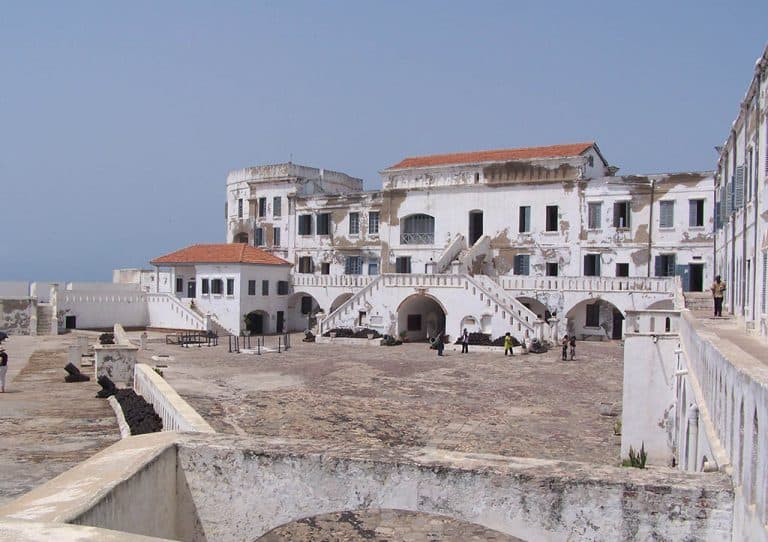
During his working visit to the Central Region of Ghana on 26th June 2026, Ghana’s president, John Dramani Mahama, held a durbar in the courtyard of Cape Coast Castle.
The castle is one among many forts and castles listed as a UNESCO World Heritage Site in 1979. These sites are managed by the Ghana Museums and Monuments Board, which operates under the Ministry of Tourism and Creative Arts.
Before the speeches, there was a slavery reenactment performed by the School of Performing Arts, University of Ghana, serving as a memorialisation of European enslavement in West Africa.
This performance revived longstanding debates about European enslavement, questioning why not only Europeans alone could have enslaved Africans and challenging the narrative that Europeans were civilising Africans.
The question, ‘Was enslavement civilisation?’ remained unanswered.
The speeches from the Minister of Tourism and the President mainly addressed the threat of UNESCO removing the forts and castles from the World Heritage List.
Ms Abla Dzifa Gomashie, the Minister, stated, “UNESCO has listed this facility, and as a people, it is important that we obey the framework that UNESCO has listed the facility”.
She added that UNESCO has advised that the buffer zone around the castle must be cleared; otherwise, it will be delisted.
She appealed to Osabarimba Kwesi Atta II, the paramount chief of the Oguaa traditional area, for assistance in meeting UNESCO’s demands.
President Mahama confirmed that the tourism minister had presented the report to his cabinet on 24th June 2026.
Consequently, the “restoration” of the castle is scheduled for budgeting and implementation next year.
The urgency of restoring the castle appears clear to the President, especially since the forts and castles served as tangible evidence in mobilising support for the UN Resolution A/80/L.48, which designated African enslavement as the gravest crime against humanity.
Both the Minister and the President emphasised the importance of the buffer zone and castle restoration.
What the President describes as restoration aligns with the concept of heritage conservation, which falls entirely within Ghana’s response-ability as the state party UNESCO.
Although the tourism minister has not yet published the cabinet report regarding the UNESCO threat, UNESCO visitation reports from 2019 to 2024 clearly indicate Ghana’s failure to utilise technical expertise to promptly address conservation concerns raised by UNESCO’s Reactive Monitoring teams.
This article aims to highlight the urgency and significance of this threat, the need for community education about the buffer zone, and the contrasting perspectives on conservation, proposing that an innovative approach using bricks and mortar may resolve the conflict.
The significance of UNESCO’s threat to delist the Forts and Castles from the World Heritage List
While there are fine globalisation debates to be had on why a global organisation should appear to be dictating what a sovereign country does, a phenomenon known as ‘rolling back the nation-states’, the technical issues raised in the UNESCO expert Reactive Monitoring reports move the debate away into pure conservation issues, at least for now.
Secondly, the elite unbridled desire to appropriate national properties for individual gains, another phenomenon known as state-capture, has motivated archaeologists, historians and heritage students like myself to support the UNESCO management framework. Yet another view is about having private ownership to encourage accountability. Such views come under the management concept of Public-Private Partnership. The core of the argument is that when there is private ownership, it leads to accountability.
The rationale for the argument stems from Thomas Harding’s controversial theory about the tragedy of the commons.
Harding’s theory can only effectively apply here if there were no rules.
In this case, there are UNESCO rules, and this is why the Minister says Ghana has to obey the UNESCO framework.
But what I want to touch on in this section is the significance of the threat which lays in the integrity of the Forts and Castles and in what is known as UNESCO’s Outstanding Universal Value (OUV), which also forms part of the UNESCO framework.
The integrity and OUV underlay the reasons why UNESCO listed the Forts and Castles in the first place.
In this respect, they are historical but a constant contemporary attempt to conserve the visual appeal of the Forts and Castles, the area view, and the tactile appeal, as much as possible, to equal how they looked and felt to the enslaved that they passed on to their descendants and what the descendants in turn have memorialised in their contemporary documentations as they gained more means to write and document using modern objects.
This is a relational memory transmitted from one generation to another.
The descendants in this case are Africans living in Africa and Africans in the diaspora.
The reason for the integrity and OUV is to ensure no one doubts, denies, dismisses, defames or belittles the atrocities of the trans Atlantic enslavement of Africans, and unconsciously contemplates a repetition of same.
It is much the same reason that a descendant of an enslaved African who has memories of the atrocities of the ancestor must continually recognise the material remains and the conservation of the same to match the memory of the ancestor.
Now that the UN has agreed that enslavement of Africans is the gravest crime against humanity, there will be critical examinations by those who think otherwise to match the material evidence against the criterion of the gravest crime against humanity.
Already, there are modernist and development-oriented viewpoints that claim development is more important than being frozen in history.
The holders of these viewpoints do not factor in the consideration that one of the aims is to avoid the repetition of history.
But such modernist development viewpoints are the ones pushing for gentrification, the building of nice hotels around the beach fronts to attract tourists and hence create jobs.
These seemingly altruistic viewpoints can inadvertently erase history and create conditions for forgetting, and the repetition of past atrocities against humanity.
A clear example is Liverpool Waterfront in the United Kingdom.
Both Africans like Anton Wilhelm Amo and European slavery abolitionists had pushed the question about African enslavement to be against religious teachings and Roman law of the dignity of a person, and as a moral burden on the conscience of Europeans since the 1720s.
This moral burden took a modernist and developmental dimension in the city of Liverpool.
Similar to Ghana, UNESCO had listed Liverpool as a Maritime Mercantile City in 2004 as a World Heritage site.
There were enslaved Africans in Liverpool, and the maritime industry was embedded in the trans Atlantic slavery.
From 2012, the city authorities were more inclined to raising glamorous high-rise buildings to fulfil the city’s modernist and development aspirations.
The local archaeologists, historians and conservationists agreed with UNESCO’s value of integrity and OUV.
Against all protestations, the Liverpool city authorities ignored the threats, and consequently, UNESCO first put the Liverpool World Heritage site on the danger list.
Consequently, the cultural property was deleted from the World Heritage List in 2021.
It was clear that the high-rise buildings would create doubt in the minds of people.
Thus, the first impression anyone would get is not the visual and the tactile feel that there were inhuman practices like enslavement taking place there.
For any contemporary visitor to the Liverpool Waterfront, the visual appeal is the first stage of enslavement memorial encounter and at the same time, a stage of doubt in view of the construction of modern buildings and gentrification.
When such a doubt shapes the mind of what a person reads in the historical books, the objectives of the texts could be lost, and there may be nothing left to remind the person of, in the words of Walter Benjamin, the barbarism that has tinted all civilisations and which is transmitted to succeeding generations. Here, modernist and development objects and thinking would have subtly reintroduced barbarism, the atrocities of enslavement. This is the significance of the UNESCO threat that lack of respect for the buffer zone or reneging on conservation can bring about. In the specific case about the buffer zone and UNESCO’s threats in the speeches of both President Mahama and the Minister for Tourism and Creative Arts above, UNESCO had made available technical support in the UNESCO’s Reactive Monitoring report from 2019 to 2024.
Similarly, there are numerous heritage impact assessment reports at the Department of Archaeology and Heritage Studies, University of Ghana.
The next step, which is not in anyone’s interest, is that UNESCO will put the Forts and Castles on the list of World Heritage properties in danger. The terminology, danger, can very easily be misconstrued, but it is danger with respect to the integrity and the OUV as demonstrated in the Liverpool Waterfront example. In Ghana’s case, and as Ms Dzifa Gomashie indicated, it is the buffer zone that seems to be the issue.
Community education about the buffer zone
The issue of concern here is who the community members are. What is their interest in the Forts and Castles? What is the buffer zone all about? These are very simple questions, but their political connotations will be obvious soon.
To start with, the buffer zone is normally a perimeter around the heritage sites. The concept was adopted from ecological conservation, and natural heritage such as forests and parks. The buffer zone concept was adopted into cultural heritage to protect the integrity and OUV, as I have demonstrated in the Liverpool example. The problem has been that it was not enforced at the time of listing the Forts and Castles in 1979.
The enforcement of the buffer zone intensified from the 1980s. Especially for the Forts and castles along the coast of Ghana, the competing economic interests of the community members have intensified. A casual observation shows that new buildings, hotels, restaurants and fishing activities are competing for space. These are legitimate economic activities of the community members. Unfortunately, those who get the short end of the stick from such a competition are the fisher folks.
When the hotel and the private beachfront owners make it hard for the local people to access the beachfronts for fishing purposes, the fisher folks have a tendency to move closer to the World Heritage sites, thereby entering the buffer zones.
These are the people from whom the government derived its power. This is where the issue becomes political all of a sudden, and a global organisation would appear to be dictating to a sovereign state.
The fear of losing political power means the government would turn a blind eye to the threats to the buffer zone. One of the commonly repeated solutions has been that the government has provided landing beaches.
A landing beach does not work in all situations; the movement of fisher folks depends on the movement of the Atlantic Ocean, and they can therefore not be tied to a specific location. As part of the solutions, the government should encourage easy access to all the beach fronts for fishing purposes. That way, there would not be pressure on the buffer zones.
There is yet another section of community members, the diaspora returnees. Since the abolition of the slave trade, there has been what the historian Kwame Essien terms return-migration to West Africa and, in this case, Ghana.
The Tabon people are a case in point.
Since 2016, the government of Ghana has made it easy for descendants of enslaved Africans in the diaspora to take up Ghanaian citizenship. Increasingly, a number of them are returning and settling in Ghana.
Though the aim is that they should see themselves as Ghanaians, perspectives on conservation have not been the same with the Ghana Museums and Monuments Board. Given the posture I adopted in explaining the integrity and the outstanding universal values as a relation memory, the views of all the descendants of trans Atlantic slavery should count.
This is the clash of perspectives on the terminology and conservation issue I discuss below. A clash of perspectives on conservation and how an innovative use of brick and mortar can resolve the clash
Since listing the Forts and Castles as a World Heritage property, there was a debate on the use of the terminology, Forts and Castles. Those who disagree argue that it amounts to whitewashing history since the terms forts and castles connotes a place of funfair which shows up in fairy tales. The specific spots, the dungeons where the enslaved Africans were detained does not appear in the titles.
A seemingly counterargument has been that, though there were atrocities, the Forts and Castles should not be interpreted in a way that would scare people from visiting. This debate directly connects to the white paint that is used to conserve the facade. Is it only white paint that can be used to conserve the facade?
This is where the innovative technical response-ability of the community members can be used to resolve the debates. From my casual observation, cement, sand and water are mixed to patch a few parts of the facade which are peeling off. The next is to paint the facade with white paint.
After years of exposure to the seawater and breeze, the paints peel off again, and the process is repeated.
This is where a sustainable innovative method can be ascertained from building and technology disciplines in the technical universities in Ghana. Where expertise is lacking, UNESCO should partner with any of the technical universities.
The students from the technical universities would receive the training so that their expertise can be transferred to other heritage buildings in Ghana and in West Africa.
To conclude, from UNESCO’s threat comes the opportunity to imagine something new to resolve old debates around the conservation of the Forts and Castles in Ghana. In view of my interpretation of UNESCO’s integrity and outstanding universal value from the standpoint of the descendants of enslaved Africans, conservation should not be outsourced to a company detached from the community members. Conservation should be part of continuous memorialisation tied to the community members. That is a concrete way to make the memorialisation a relational memory.
The Ghana Museums and Monuments Board, the chiefs, the respective technical universities in the communities and the Department of Archaeology and Heritage Studies, University of Ghana, should innovate a technical solution where crafts of conservation are done in honour of the ancestors continually.
The ancestral memory and heritage must live. As the Anlo ancestors have said, it is at the end of the old ropes that new ones are woven. Each generation must renew the conservation of the Forts and Castles in honour of the Ancestral heritage.”
The author of this piece is Jonathan Bill Doe. He is a student of World Heritage and Technoscience Studies, Brandenburg University of Technology