
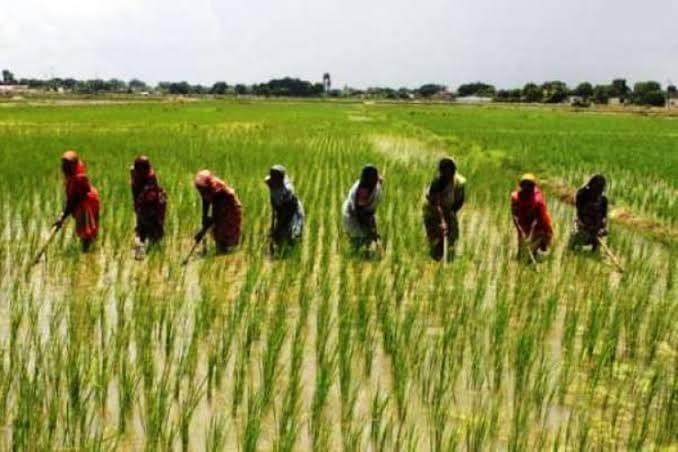
When many rice farmers were staying away from their fields after suffering heavy losses, Robben Asare saw a different possibility.
He expected the reduced planting to eventually create a shortage, and instead of pulling back, he decided to expand his own production.
That decision has turned what looked like a difficult period for rice farmers into an opportunity for the founder of Aspassion Ltd.
Mr Asare said the previous year’s losses had discouraged many farmers, particularly in northern Ghana, from returning to their fields.
“You go to north and the valleys are there. Why? Because they made huge loss last year, and no one is interested in going into it,” he disclosed this during the virtual Ghana Agrifood Youth Dialogue held on Friday, August 28, under the theme “Growing Opportunities: How Young People Are Transforming Ghana’s Agrifood System.”
The situation was made worse by flooding, which prevented some farmers from using tractors to prepare their fields.
Rice is normally grown in waterlogged conditions, but Mr Asare said the extent of the flooding made it difficult for farmers to get machinery into their fields.
Rather than wait for conditions to improve, he began thinking about what the reduced production could mean for the market.
“So quickly, I have to move in, turn these huge losses into an opportunity. What do I do if farmers are not farming? It means definitely there’s going to be a shortage from next year,” he said.
That calculation prompted him to increase his own production at a time when others were cutting back.
Machinery made the difference
To make the move possible, he secured a crawler rotavator from Born Agro Ghana.
The machine, he said, was capable of working through muddy fields without getting stuck, allowing him to prepare land under conditions that had made conventional machinery difficult to use.
He said he was able to obtain the equipment without making an upfront payment because of the relationship and trust he had built with the company.
“I met them, took the machine without paying anything because they know me, because they know I’m a man by my words,” he said.
According to him, maintaining credibility in business is therefore just as important as having access to equipment.
“I always say, I buy with integrity,” he said.
The result was a significant expansion of his rice farming operation during a period when many farmers were reluctant to plant.
“This year that farmers were not able to farm, farmers were discouraged, is the year that I’m farming big. Is the year that I’m producing big,” he said.
Diversification to manage risk
Mr Asare is not relying on rice alone.
His business activities now cover maize production, rice production and processing, mechanisation and farm management.
That diversification, he said, helps him manage the risks associated with agriculture.
“I mean, divert some of the resources to minimize the risk. We have to also look into that diversion, not only focusing on one particular commodity,” he said.
The strategy also extends into processing, which he said he is introducing alongside his increased production.
The thinking is to ensure that the business has several sources of income rather than depending entirely on the performance of one crop.
At the heart of his approach is the belief that agricultural losses should not automatically mean the end of a business.
Earlier in the discussion, the 2025 National Best Youth Farmer said technical knowledge was important in reducing the risks associated with farming.
He also said he had prepared himself mentally for the challenges before entering the sector.
“But me in particular, I mean, before I ventured in farming, I also heard a lot about the challenges, the losses, and all that. And I braced myself before going, and I told myself, no matter the challenges, no matter the situation is, I’m going to face it and conquer it,” he said.
His experience offers a different way of looking at agricultural risk.
A failed season can wipe out a farmer’s investment, but it can also create gaps in the market for businesses that are able to adapt.
In his case, fewer farmers planting rice presented a potential supply problem. He responded by increasing production, investing in machinery and adding processing to his operations.
He believes young people entering agriculture should be prepared to do the same: study the market, understand the risks and look for opportunities within the problems they encounter.



