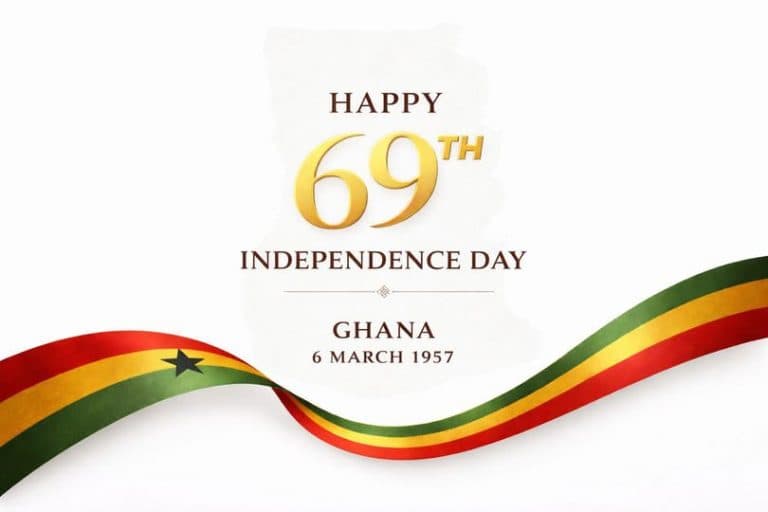
Sixty-nine years after breaking free from British colonial rule, Ghana is marking Independence Day not only with celebration but also with reflection on the country’s cultural heritage, political journey, and the challenges that remain.
On March 6, 1957, Ghana became the first country in sub-Saharan Africa to gain independence from colonial rule, a milestone that ignited a wave of liberation movements across the continent.
The struggle for freedom was driven by political activism, diplomatic engagement, and mass protests led by nationalist leaders including Kwame Nkrumah.
The independence movement gathered momentum in the 1940s with the formation of the United Gold Coast Convention (UGCC). The party initially pushed for constitutional reforms under British rule. When progress stalled, Nkrumah broke away to establish the Convention People’s Party, calling for immediate self-government.
Public pressure intensified through strikes, boycotts, and demonstrations across the colony then known as the Gold Coast. The unrest reached a turning point during the 1948 Accra Riots, which drew global attention and forced the British administration to reassess its position. The British government responded by setting up the Watson Commission to investigate the disturbances and propose reforms.
Constitutional changes soon followed. In 1951, limited self-government was introduced with elections for a legislative assembly. Nkrumah’s CPP won a decisive victory, and he became Prime Minister in 1952, setting the stage for full independence five years later.
At midnight on March 6, 1957, Ghana emerged as a sovereign nation, with Nkrumah declaring that the country’s freedom would be meaningless unless it was linked to the total liberation of Africa.
A nation shaped by culture
Beyond politics, independence helped revive and strengthen Ghana’s cultural identity. The country’s rich heritage is reflected in its traditional foods, clothing, languages, and customs.
Across the country, dishes like Jollof rice, Tuo Zaafi, Ga kenkey, Fante kenkey, Gob3, Ampesi, Tubaani, Fufu, and Banku remain staples at family gatherings and national celebrations.
Traditional clothing also stands as a symbol of pride. The vibrant patterns of Kente, historically worn by royalty among the Akan people, are now widely recognized as a national emblem of identity and dignity.
Ghana’s cultural landscape is equally defined by its diverse ethnic groups and languages. Communities such as the Akan, Ewe, Ga, and Dagomba continue to preserve unique traditions, festivals, and dialects that contribute to the country’s cultural mosaic.
These traditions have remained central to Ghana’s identity since independence, shaping how the nation sees itself and how it presents its heritage to the world.
A turbulent path after freedom
Despite the promise of independence, Ghana’s early decades were marked by political instability. Military coups, economic mismanagement, and shifts in governance created uncertainty in the years following Nkrumah’s administration.
The country’s political trajectory began to stabilize in the late twentieth century under the leadership of Jerry John Rawlings. Rawlings first came to power through a military uprising but later led the transition to constitutional democracy.
In 1992, Ghana adopted a new constitution that reintroduced multiparty politics and laid the foundation for the democratic system that continues today. Since then, the country has gained international recognition for peaceful elections and political stability.
Progress and unfinished business
Nearly seven decades after independence, Ghana stands as one of Africa’s more stable democracies. Its institutions have grown stronger, and its young population is increasingly active in shaping the country’s future through innovation, entrepreneurship, and civic engagement.
Yet many challenges remain. Economic inequality, youth unemployment, and development gaps between urban and rural areas continue to test the nation’s ambitions.
Still, the spirit that fueled Ghana’s independence struggle remains evident in the determination of its people. Each Independence Day offers a moment to celebrate both the country’s freedom and the cultural heritage that binds its diverse communities together.
For many Ghanaians, the anniversary is not only a remembrance of the past but also a reminder that the promise of independence is still unfolding.
Eddy Acquah writes
0541159191