For decades, owning a home in Ghana has been more than a financial milestone – it has been a cultural expectation. From the familiar phrase “build your own house” to the pride associated with land ownership, property has long symbolised stability, success, and legacy. But for Ghana’s Generation Z, that dream is becoming increasingly difficult to realise.
Across urban centres like Accra, a growing number of young people are confronting a harsh economic truth: the traditional path to homeownership may no longer be viable.
The Income-Cost Divide
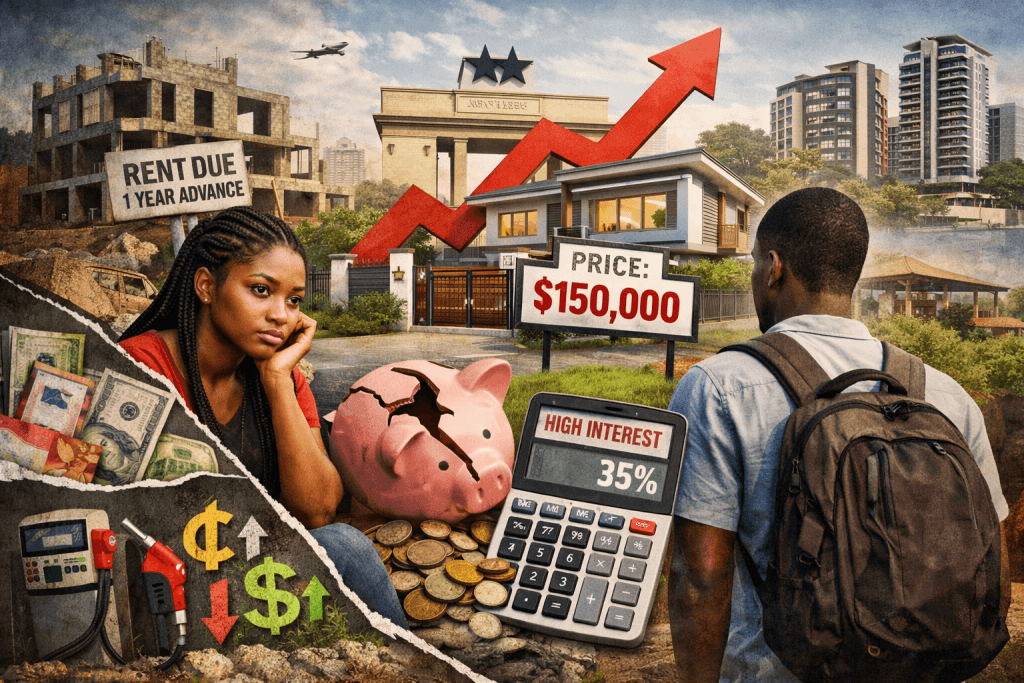
At the heart of the issue is a widening gap between income levels and the cost of living. Many young professionals earn modest entry-level salaries that struggle to keep up with rising expenses. Rent alone – often demanded in one- or two-year advance payments – can consume years of savings. Add transport costs, utility bills, and persistent food inflation, and the idea of setting aside money for a house begins to feel unrealistic.
At the same time, property prices continue to climb. Even modest homes are frequently priced in US dollars, placing them far beyond the reach of the average young worker. In effect, the more the Ghanaian cedi weakens, the further the goalpost for ownership is pushed.
A Dollarised Housing Market
Ghana’s real estate sector is deeply tied to the dollar. Developers rely heavily on imported materials, and currency volatility has encouraged pricing in foreign denominations. For Gen Z earners paid in cedis, this creates a structural disadvantage: salary increases rarely keep pace with exchange rate shifts.
Property, in this context, increasingly serves as a store of value for investors and the wealthy, rather than a realistic purchase for first-time buyers.
Limited Access to Mortgages
In many parts of the world, mortgages provide a pathway into homeownership. In Ghana, however, access to affordable mortgage financing remains limited. High interest rates, short repayment periods, and steep deposit requirements make it difficult for young people to qualify.
Institutions such as Ghana Home Loans have expanded access somewhat, but the broader system still excludes a significant portion of the population – especially those without stable, formal employment.
The Informal Economy Factor
A considerable number of Ghanaian Gen Z workers operate within the informal or semi-formal economy – freelancers, gig workers, and small business owners. While this offers flexibility and entrepreneurial opportunity, it also introduces income instability. Without consistent payslips or formal employment records, securing long-term financing becomes even more challenging.
Cultural Expectations vs Changing Realities
Despite these economic constraints, societal expectations remain largely unchanged. Homeownership is still widely viewed as a necessary life achievement, often tied to marriage and family formation. Yet Gen Z is beginning to push back against these norms.
Many are delaying major life decisions, prioritising career mobility, and rethinking what financial success looks like. Renting for longer periods once frowned upon is gradually becoming more accepted, particularly in urban areas.
The Urban Pressure
The situation is especially acute in Accra, where rapid urbanisation has driven up land and property prices. New developments often cater to high-income buyers, leaving a shortage of affordable housing for middle- and low-income earners. As a result, young people are increasingly priced out of central locations and pushed toward the city’s peripheries.
Signs of Adaptation
Yet, amid these challenges, Ghana’s Gen Z is not standing still. New strategies are emerging:
Some are purchasing land in developing areas such as Kasoa, Dodowa, and Nsawam, betting on future growth. Others are adopting incremental building approaches – constructing homes in stages over several years.
There is also a noticeable shift toward alternative income streams. Remote work, digital entrepreneurship, and global freelancing are enabling some young Ghanaians to earn in foreign currencies, partially offsetting local economic pressures.
Collective investment models are also gaining traction, with groups of friends or family pooling resources to acquire land or property.
A Redefined Dream
The notion that “Gen Z may never be able to buy” may be overstated, but it captures a deeper truth: the pathway to ownership in Ghana is changing fundamentally.
For this generation, buying a home will likely happen later in life, require multiple income sources, and often take place outside prime urban centres. It will demand not just hard work, but strategic financial planning and adaptability.
More importantly, the shift raises broader questions about inequality and opportunity. If property ownership continues to drift out of reach for a large segment of young people, the long-term implications for wealth distribution and social mobility could be significant.
In the end, the dream of owning a home in Ghana is not disappearing, but it is being reshaped. And for Gen Z, achieving it may require navigating a landscape far more complex than the one their parents once knew.