
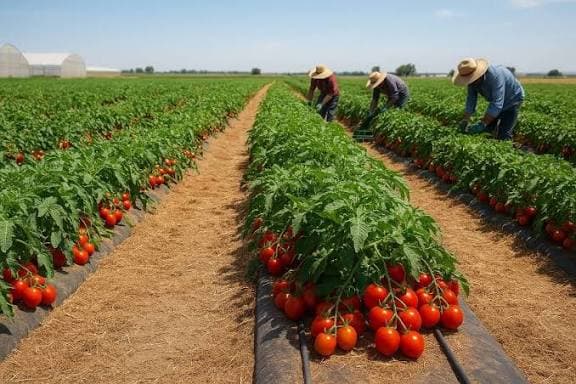
Ghana has the land, climate, and farmers capable of producing enough tomatoes to feed the country and even export to the sub-region – if only government policy and infrastructure keep pace, according to Wepia Awal Adugwala, President of the Peanut Farmers Association of Ghana.
Speaking on Good Afternoon Ghana on Tuesday, February 24, 2026, Mr Adugwala said Ghanaian farmers are ready to grow tomatoes at scale, but challenges like irrigation, roads, and research are holding them back.
“For us as farmers in Ghana, we produce and then women and other traders come to buy the tomatoes,” he said.
“But as for Ghanaian traders moving to Burkina Faso to buy tomatoes, it has been there for a very long time. There is no need for Ghanaian traders to cross the border and risk their lives to buy tomatoes and come and sell in this country.”
The farmers’ leader stressed that tomatoes often go to waste because farmers cannot get their produce to market.
“We even have tomatoes in certain rural areas getting rotten on farms,” he said.
“The issue is that we are not able to transport the tomatoes to the market centres. Infrastructure is very key to us. We have to look at the road network, bringing farming communities to the market centres.”
Mr Adugwala said relying on rain-fed agriculture is no longer viable. He pointed to the need for major irrigation projects, including the proposed KwaLugu Multipurpose Dam, which he said could prevent flooding from upstream spills in Burkina Faso while enabling year-round cultivation.
“When the Bagri Dam spills in Burkina Faso, the water comes into Ghana and damages farms and houses,” he said.
“All that water can be collected into the dam and used for cultivation.”
Another factor limiting Ghana’s tomato production is the lack of research on varieties that thrive in local soils but meet market preferences.
Mr Adugwala noted that tomatoes from Burkina Faso are sometimes preferred because Ghanaian varieties have not been developed to match them.
“If the varieties they are growing in Burkina Faso are doing well, they can also do well here,” he said.
“The question is, have we invested in research? Our soil scientists and research institutions must come on board.”
He pointed to Kwame Nkrumah University of Science and Technology and other research bodies as capable of developing the right varieties if given government support.
Mr Adugwala said farmer groups have been in discussions with the Ministry of Food and Agriculture and are already receiving some support, including irrigation pumps allocated to farmers.
“But more must be done,” he said. “Government must invest in irrigation infrastructure and fund key projects like the Pwalugu dam. That will go a long way to help Ghana grow enough vegetables to feed its population.”
“With the right policy direction and support, Ghana can cultivate enough tomatoes to feed its population and even export. We are ready to make it happen,” he noted.



