
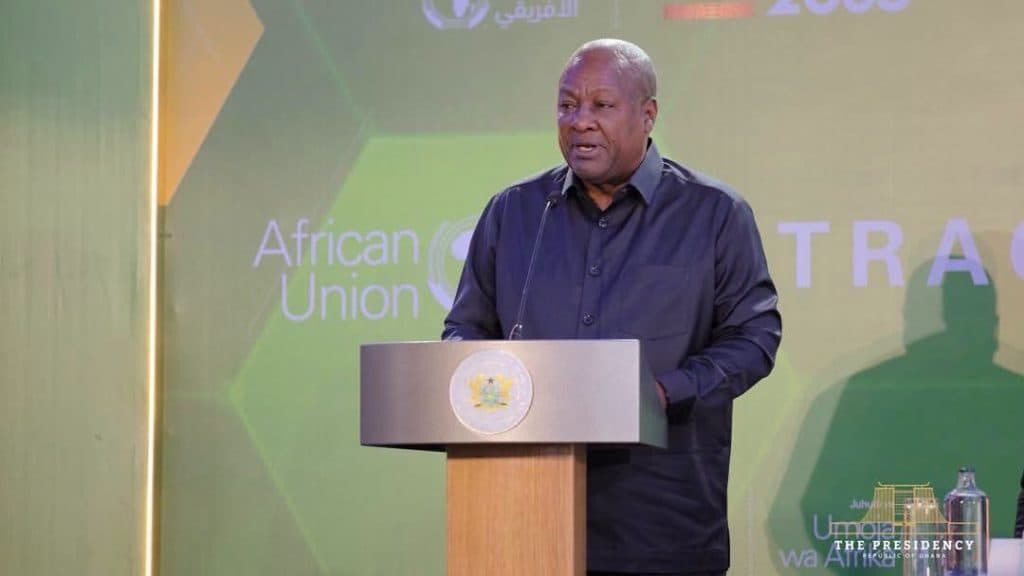
President John Dramani Mahama has rejected the idea that the Non-Aligned Movement’s commitment to non-alignment should translate into neutrality when countries face injustice, conflict or violations of international law.
Addressing the Non-Aligned Movement in Belgrade, President Mahama said the movement must remain willing to take a position on issues that threaten peace, human rights and the rules governing the international system.
“However, Ghana reaffirms that non-alignment must never be understood as neutrality in the face of injustice, conflict, or the erosion of international law,” he said.
President Mahama said the Non-Aligned Movement remains relevant despite having emerged during the Cold War, noting that its role has evolved to respond to contemporary political, economic and developmental challenges.
He said NAM continues to provide an important platform for advancing the interests of the Global South and pushing for a fairer and more equitable international economic order.
He earlier recalled the foreign-policy philosophy of Ghana’s first President, Dr Kwame Nkrumah, who championed an independent path for newly independent nations during the Cold War.
Nkrumah’s position, President Mahama said, was captured in his declaration: “we neither face east or west, we face forward”.
Ghana, he explained, sought to maintain constructive relations with all countries while refusing to be drawn into the rivalry between competing power blocs.
President Mahama said that principle remains relevant in today’s multipolar world, although the challenges confronting developing countries have changed.
He identified renewed geopolitical competition, economic vulnerabilities, unequal access to finance and technology, climate change and inadequate representation of the Global South in international decision-making as some of the pressures facing developing countries.
He therefore urged NAM to become a stronger collective voice on matters affecting international peace, development and justice.
President Mahama said member states must neither become silent spectators of global developments nor allow themselves to become instruments of competing geopolitical interests.
Instead, he called for an independent and collective voice capable of influencing the international system and advancing a more representative and equitable global order.
He cited conflicts and humanitarian crises as areas where the international community must not remain silent.
On Sudan, President Mahama said the scale of suffering requires sustained political attention, humanitarian support and a commitment to peace.
He also called for the protection of civilians and full, unhindered humanitarian access in Gaza, while rejecting what he described as the selective application of the principles of the United Nations Charter.