
Ghana is positioning itself to make the most of the newly extended African Growth and Opportunity Act (AGOA), as government and United States officials signal a new phase in bilateral trade relations that could lean more toward reciprocity.
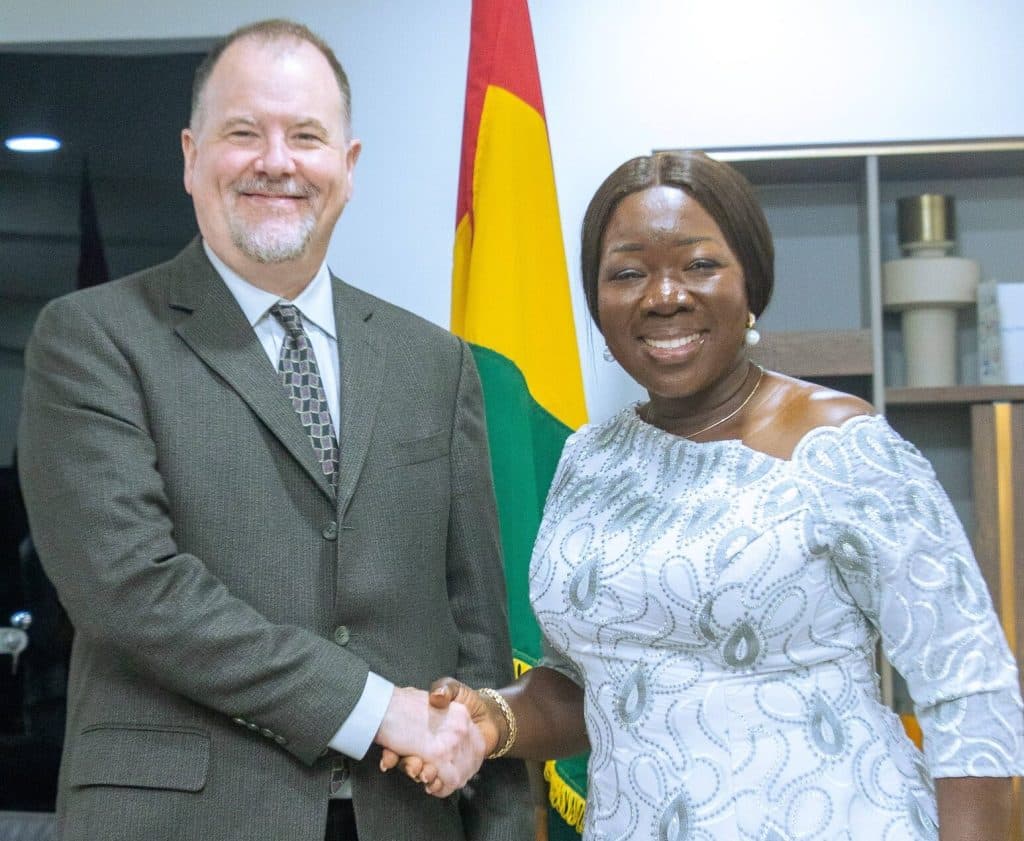
The Minister for Trade, Agribusiness and Industry, Elizabeth Ofosu-Adjare, reaffirmed Ghana’s commitment to deepening commercial ties with the United States during talks on Wednesday with Rolf Olson, Chargé d’Affaires at the U.S. Embassy in Accra.
The meeting focused on Ghana’s strategy under the extended African Growth and Opportunity Act, widely known as AGOA. Although commonly described as a one-year renewal, the extension effectively runs for 15 months, from October 1, 2025, to December 31, 2026, due to its retroactive application.
Mr. Olson said the current U.S. administration is placing strong emphasis on commercial engagement and expanding opportunities for American businesses abroad. While acknowledging AGOA’s benefits over the past 25 years, he noted that future trade discussions are likely to reflect a more reciprocal approach, with greater attention to market access for U.S. firms.
He also clarified that AGOA’s duty-free preferences remain intact, despite the announcement of a 15 per cent benchmark tariff under a separate U.S. legal provision following recent judicial developments. Products eligible under AGOA, he stressed, will continue to enjoy duty-free access to the American market.
For Ghana, the stakes are high. Minister Ofosu-Adjare pointed to the garment and textile sector as a clear example of AGOA’s impact, noting that a single factory can employ up to 5,000 workers, many of them women. Beyond wages, she said, the industry provides inclusive opportunities for pregnant women and young mothers, offering stable jobs in communities where options are often limited.
She cautioned that preserving competitiveness in textiles and garments is critical, particularly as new industrial enclaves emerge outside Accra. Additional tariff burdens, she warned, could slow job creation and weaken momentum in the sector.
The minister also linked trade to migration, arguing that stronger local industries help reduce irregular migration by expanding economic opportunity at home.
On AGOA eligibility, Mr. Olson noted that governance standards and the handling of business disputes remain key considerations in Washington’s periodic reviews. He raised concerns about outstanding payments owed to some U.S. entities, explaining that unresolved arrears can draw attention in Washington and influence perceptions of Ghana’s investment climate.
In response, the minister said inherited financial obligations are being scrutinised and, once validated, arrangements would be made to settle legitimate debts. She reiterated Ghana’s commitment to honouring its obligations and maintaining its reputation as a stable democracy with strong governance credentials.
Public procurement practices also came under discussion. The U.S. side encouraged broader use of competitive tendering to allow American firms to participate more fully in bidding processes, noting that sole-sourcing arrangements limit competition. While agreeing that competitive procurement ensures value for money, the minister explained that sole-sourcing is legally permitted in urgent national circumstances.
In a development welcomed by the Ghanaian side, Mr. Olson disclosed that the U.S. Export-Import Bank has reinstated short-term private sector financing facilities for Ghana, a move he linked to recent macroeconomic progress. He said the reopening could support purchases of U.S. goods and services, particularly in infrastructure and private sector expansion.
Minister Ofosu-Adjare described access to patient financing as a major constraint for local industry and stressed the need for clear communication so businesses can take advantage of available facilities.
Agricultural trade was also on the table. The U.S. delegation highlighted high tariffs on certain imports such as wheat and corn used as industrial inputs, arguing that such barriers limit access for American producers. The minister indicated that these issues would be addressed in future discussions, reiterating Ghana’s openness to dialogue aimed at mutually beneficial outcomes.
Both sides described the relationship as longstanding and broad, spanning trade, education, health and social services. Further communication is expected from the Office of the United States Trade Representative on possible reciprocal trade arrangements, after which formal negotiations could begin.
For now, the 15-month AGOA window offers Ghana an opportunity to consolidate export gains, safeguard jobs and shape the next phase of its trade partnership with the United States in a shifting global environment.



