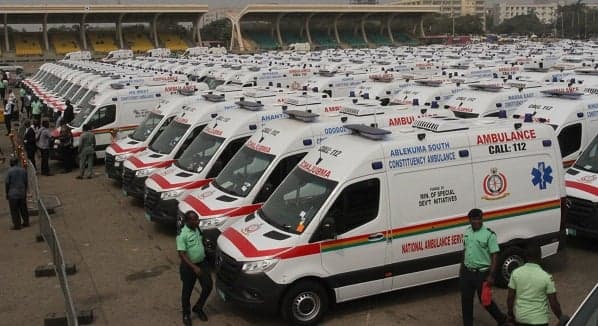
Ghana’s emergency healthcare system is facing a significant crisis as nearly 40 percent of the National Ambulance Service (NAS) fleet is currently out of commission.
With 318 ambulance stations nationwide, only 191 vehicles are operational, leaving a staggering 127 vehicles grounded. This shortage has raised serious concerns about the country’s ability to provide timely emergency medical services, especially as the fleet continues to age without adequate replacements.
The revelation came in an interview with Channel One TV, where Martin Ewuah Amoah, Clinical Auditor for the Southern Zone of the National Ambulance Service, confirmed the troubling statistics. According to Amoah, ambulances typically have a five-year lifespan, after which they begin to suffer from mechanical issues, leading to costly repairs and frequent breakdowns. Without the timely procurement of new vehicles, the fleet’s operational efficiency continues to decline, exacerbating the already strained healthcare system.
The situation is critical, as the impact on emergency response times is becoming more evident. The National Ambulance Service has been grappling with a rising number of breakdowns, particularly in high-demand areas like Accra. These breakdowns delay response times, jeopardizing lives in need of immediate medical attention. As the number of inoperative ambulances grows, the strain on the remaining vehicles increases, leading to further delays in life-saving interventions.
This growing crisis in the ambulance service comes in the wake of the tragic death of 29-year-old Charles Amissah, an engineer at Promasidor Ghana Limited, who was involved in a hit-and-run accident at the Circle Overpass in Accra on February 6, 2026. After being stabilized by Emergency Medical Technicians at the scene, Amissah was rushed to three major hospitals—Ridge Hospital, Korle Bu Teaching Hospital, and the Police Hospital. However, he was unable to secure a bed space at any of the facilities and tragically passed away.
The delay in securing timely medical care for Amissah has intensified public debate on the preparedness of both emergency medical services and hospitals. While the ambulance service has been criticized for its delayed response, the inability of hospitals to accommodate patients due to a lack of available beds highlights systemic issues across the healthcare sector. Many citizens are now questioning whether Ghana’s healthcare system is adequately equipped to handle emergencies, especially in urban centers like Accra, where population density and road traffic make timely medical intervention critical.
Amoah acknowledged that the shortage of operational ambulances is a major factor in the country’s emergency response capacity. “We need to replace the ambulances as soon as possible,” he said. “Otherwise, these breakdowns will continue, and our ability to respond to emergencies will only become more compromised.” The aging fleet is not only a logistical issue but a public safety concern, as more people depend on emergency services for life-saving care.
In response to the crisis, the Ministry of Health has promised to prioritize fleet renewal and the procurement of new vehicles. However, financial constraints and bureaucracy have slowed down efforts to replace outdated ambulances. In the meantime, the National Ambulance Service is doing its best to maintain the current fleet, though the risks of further breakdowns loom large.