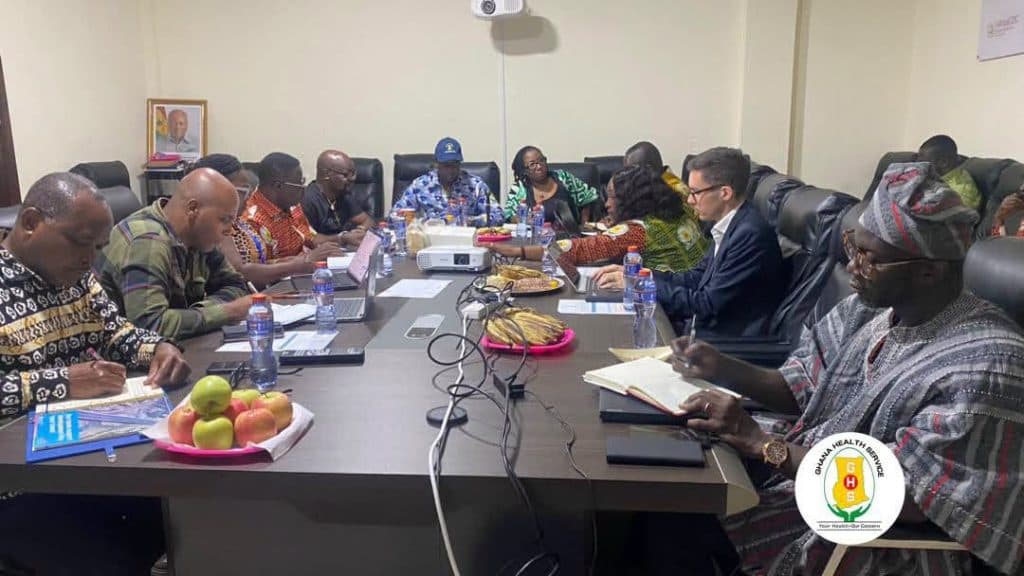
The Ghana Health Service (GHS) has established a 26-member implementation committee to provide technical and operational oversight for the rollout of the Government’s Free Primary Health Care (FPHC) programme across 135 implementing districts.
Director-General of the GHS, Dr Samuel Kaba Akoriyea, has charged the committee to ensure effective coordination, identify gaps early and address emerging challenges to keep the programme on course.
Dr Akoriyea made the call at Pantang when he inaugurated the committee and introduced the newly appointed FPHC Programme Coordinator, Dr Salamatu Attah Nantogma, Deputy Director of the Institute of Medical Excellence (IME) at the Policy, Planning, Monitoring and Evaluation Directorate (PPMED).
The committee will be convened by the Director of PPME, Dr Samuel Boakye Boateng, and forms part of the governance structure established by the GHS to coordinate the Service’s contribution to the implementation of the FPHC programme.
Speaking at the meeting, Dr Akoriyea said the committee would serve as a high-level coordinating body, with responsibility for monitoring implementation and determining whether identified challenges should be resolved at its level or escalated for further action.
“For the proper functioning of this programme, there is the need for a high-level implementation coordinating team. The team is to have oversight responsibility on the implementation so that if there are gaps, the team will decide whether to escalate them or handle them at their level,” he said.
He identified the training of national-level coordinators and engagement with development partners as immediate priorities ahead of the commencement of the programme.
The committee brings together directors and representatives from relevant GHS divisions and departments, as well as key partners, including the World Health Organization (WHO), which has supported preparations for the initiative.
Dr Akoriyea stressed the importance of collaboration among the various institutions and partners to ensure that interventions at the primary healthcare level were properly integrated and that resources were not wasted on duplicating similar activities.
“There is too much that we can do together,” he said, urging partners to work with the GHS Headquarters to jointly plan activities and synchronise interventions where possible.
He said stronger coordination would help minimise duplication and allow available resources to be channelled to areas of greater need, particularly support for frontline health workers operating under difficult conditions.
Dr Akoriyea also welcomed innovations that could strengthen the programme but cautioned that any new solutions must be compatible with existing GHS systems.
He said interoperability was important to ensure that information generated through different interventions could be brought together and used effectively for planning and decision-making.
To support the main committee, three operational sub-committees have been established to handle Finance and Logistics; Service Delivery; and ICT, Health Information and Research.
The sub-committees, made up of representatives from relevant GHS divisions and departments, will undertake detailed technical and operational work and submit their reports to the main implementation committee for consideration. They will be chaired by the Deputy Director-General of the GHS.
As Programme Coordinator, Dr Nantogma will coordinate the plans of the various technical divisions and departments and facilitate activities at the national, regional and district levels.
She will also follow up on decisions taken by the Director-General and the implementation committee, while coordinating field visits, monitoring, supervision and technical support missions related to the FPHC programme.
Her responsibilities will include consolidating reports from the regions and districts, tracking progress against agreed milestones and indicators, identifying implementation bottlenecks and facilitating their resolution.
She will also maintain the programme’s implementation dashboard, prepare regular briefs for the Director-General and the committee, serve as Secretary to the committee and facilitate the flow of information between the national and subnational structures.
The inauguration forms part of preparations by the Ghana Health Service for the official rollout of the Free Primary Health Care programme and establishes a central mechanism for coordinating the Service’s role in delivering the initiative across the 135 implementing districts.