
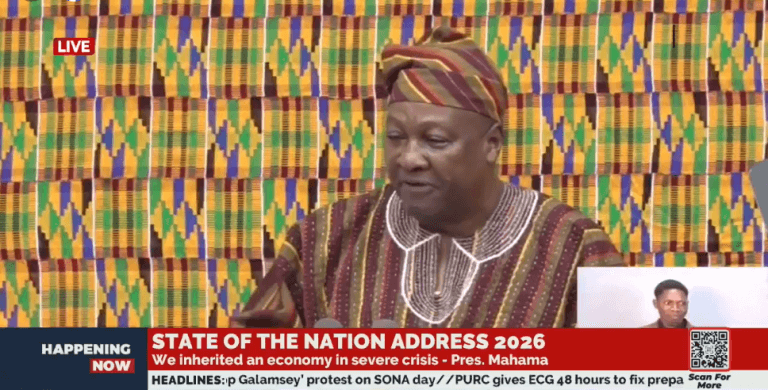
President of the Republic of Ghana, John Dramani Mahama, has announced that government has fully repaid a $500 million World Bank guarantee facility and cleared outstanding gas supply debts, describing the moves as critical steps in restoring confidence in Ghana’s energy sector.
Delivering his address to the nation on Thursday, February 27, President Mahama said the country’s declining crude oil production between 2019 and 2024 – from 71.4 million barrels to 48.2 million barrels – had negatively affected investor confidence and strained the energy sector.
He, however, said swift policy interventions had reversed the trend and strengthened Ghana’s credibility among international partners.
“As of December 31, 2025, government has fully repaid and restored the entire $500 million World Bank guarantee, including interest. This has reinstated the facility in full and reaffirmed Ghana’s standing as a credible and reliable partner on the global stage,” the President stated.
He said government was now fully current on its gas payment obligations, stressing that, “We are paying for every gas we are consuming today.”
Between January and December 2025, government settled outstanding gas invoices amounting to about $500 million owed to Eni and Vitol, bringing Ghana up to date with payments to the Sankofa partners.
President Mahama noted that adequate budgetary provisions had been made in the 2026 Budget to ensure timely payments for all liquefied natural gas consumed going forward.
He said engagements with Tullow Oil and the Jubilee Field partners had also produced a comprehensive payment roadmap to support stable nationwide electricity generation and remove constraints on industrial growth.
On power sector reforms, the President disclosed that renegotiations with nine Independent Power Producers (IPPs) had yielded immediate savings of $250 million and led to the restructuring of $1.1 billion in legacy debt for repayment between 2026 and 2028.
The revised agreements, he said, would be submitted to Cabinet and subsequently laid before Parliament for ratification.
Touching on reforms at the Electricity Company of Ghana (ECG), President Mahama said the operationalisation of its Single Account system was aimed at reducing revenue leakages and strengthening payment capacity.
He expressed concern, however, about persistent system losses.
“It is worrying that ECG continues to experience high power losses, with around 25 per cent of generated power lost,” he said, adding that private sector participation in billing and collection was being considered as a key strategy to reduce losses.
Cabinet has, therefore, approved a multiple-lease concession model for electricity distribution utilities, he disclosed.
On renewable energy, the President said the Bui Power Authority had completed an additional 15 megawatts of solar power, while rooftop solar installations had contributed 30 megawatts, bringing Ghana’s total installed solar capacity to 250 megawatts – about five per cent of the national generation mix.
He announced that construction had begun on a 200-megawatt solar power project at the Dawa Industrial Zone, with the first 100 megawatts expected by December 2026.
The Ministry of Energy and Green Transition, he said, was also constructing 35 mini-grids to supply electricity to 47 island and lakeside communities in the Oti, Savannah and Bono East Regions.
Additionally, government plans to deploy 12,000 smart net meters beginning in the first quarter of 2026 to improve monitoring and efficiency.
Under the off-grid solar programme for public institutions, materials for 350 solar systems had already been delivered.
“Public institutions are going to be fitted with solar to reduce their power consumption,” President Mahama stated.
Towards achieving universal access, he said 200 out of 400 targeted communities had been connected to the national grid under the Rural Electrification Programme, with another 100 at various stages of completion.
National electricity access now stands at 89.05 per cent, he said.
“We are committed to ensuring that every Ghanaian has access to reliable, affordable electricity,” President Mahama noted.



