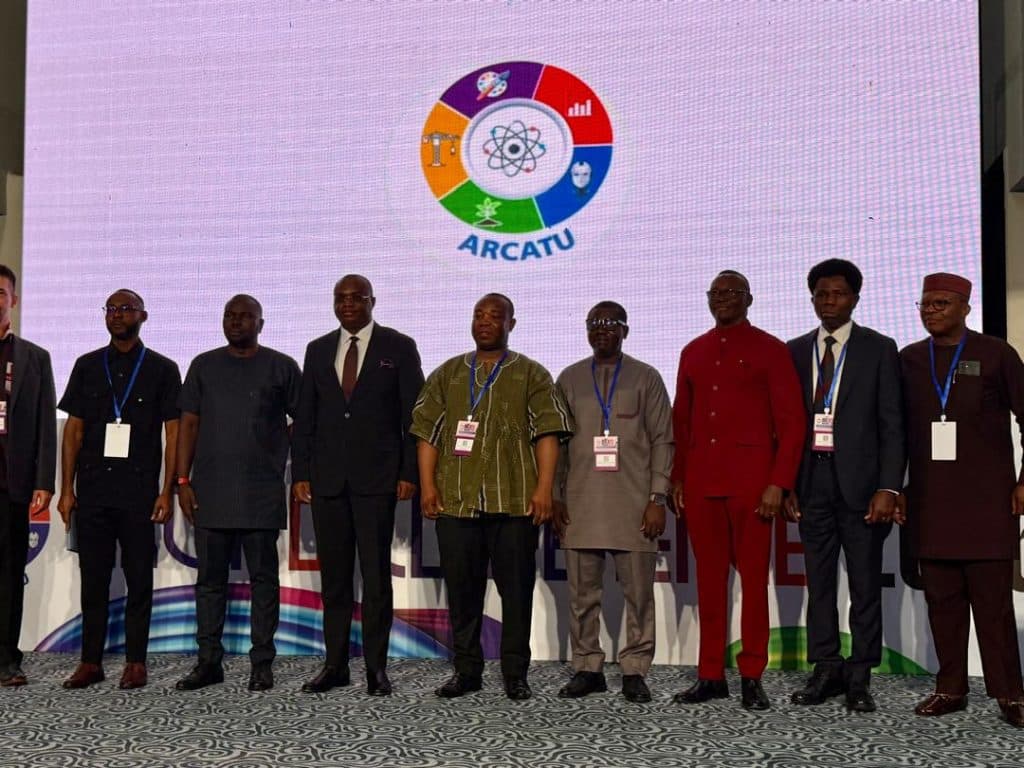
Government has called for stronger collaboration between universities, industry and policymakers to ensure research and innovation are translated into practical solutions that support Ghana’s national development.
The call was made at the launch of the 2026 Applied Research Conference of Accra Technical University (ARCATU 2026), held under the theme: “Applied Research and Innovation for Sustainable and Resilient Development in the Era of AI.”
Delivering the keynote address on behalf of the Chief of Staff, Presidential Advisor on National Resilience and Emergency Preparedness, Ernest Brogya Genfi, said Ghana’s challenge was not a shortage of ideas or knowledge, but the difficulty of implementing research outcomes.
He said applied research must go beyond academic knowledge creation and focus on developing solutions that respond to clearly identified national needs.
“Ghana does not lack ideas, but implementation.”
According to him, research should begin with a well-defined problem and result in solutions that can be applied to improve lives, strengthen systems and contribute to national development.
The government’s call places emphasis on closer cooperation among academic institutions, businesses and policymakers.
Such collaboration, the government argues, can help ensure that research conducted in universities moves beyond laboratories and academic publications into practical applications.
The approach is also expected to strengthen the contribution of universities to solving challenges in areas such as technology, industry, public services and economic development.
A representative of the Ghana Tertiary Education Commission (GTEC) also urged the country to generate and make greater use of Ghanaian data to support the development of artificial intelligence systems that reflect local realities.
The call comes amid growing interest in the use of AI across sectors, with concerns about the relevance of systems trained predominantly on data from other parts of the world.
Meanwhile, the Pro-Vice-Chancellor of Accra Technical University, Professor Felix Y.H. Kutsanedzie, disclosed that the 2026 edition of the conference attracted 331 abstracts from across the globe.
Of the submissions, 138 came from the international community, while 250 papers are scheduled for presentation during the conference.
The figures, according to the university, demonstrate the growing interest in applied research and innovation as tools for addressing development challenges.
ARCATU 2026 is bringing together researchers, academics, industry players, policymakers and other stakeholders to examine how research and innovation can contribute to sustainable and resilient development in an era increasingly shaped by artificial intelligence.