
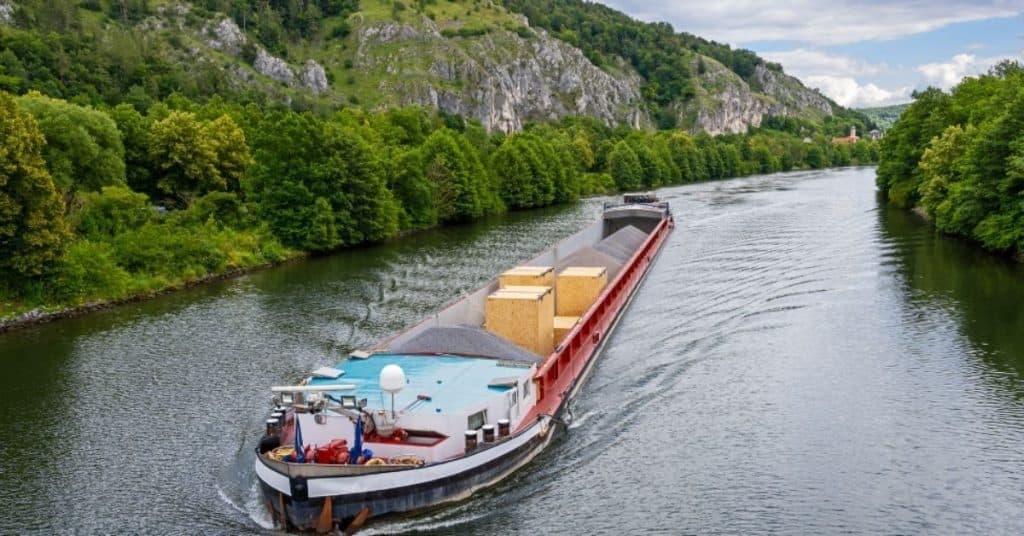
The John Dramani Mahama government is set to develop a coastal water transport system along Ghana’s coastline as part of efforts to ease pressure on roads and promote sustainable mass transportation.
According to the Deputy Minister for Transport, Dorcas Affo-Toffey, the procurement process for selecting a consultant to undertake a feasibility study for the project is nearing completion.
She disclosed this at the 7th edition of the Africa Ports Forum 2026 in Accra, an event held as part of government’s broader vision to transform Ghana’s ports and maritime sector.
“When we look out at the Gulf of Guinea, we do not just see water; we see the lifeblood of our national economy,” she stated, noting that more than 90% of Ghana’s international trade is conducted by sea.
She stressed that Ghana’s ports serve not only as transit points but also as strategic gateways for national transformation and economic growth.
Madam Affo-Toffey, who is also the Member of Parliament for Jomoro, said the government under President John Dramani Mahama is pursuing a clear vision to position Ghana as “the leading, most efficient, secure and sustainable maritime logistics hub in West Africa.”
According to her, the government’s maritime agenda is focused on infrastructure modernisation, cost reduction, enhanced security, and the sustainable development of the Blue Economy.
She cited the Tema Port Expansion Project as a major milestone in that effort, explaining that the first two phases of the $1.5 billion project were commissioned last November through a partnership between Meridian Port Services and the Ghana Ports and Harbours Authority.
“Through this partnership, we have created one of the most advanced deep-water berths in sub-Saharan Africa,” she said, adding that the expansion has significantly reduced vessel turnaround times and increased container throughput at the Tema Port.
On the government’s proposed 24-hour economy policy, the deputy minister said the Port Authority had fully implemented a 24-hour operational model to improve efficiency.
“Since trade does not sleep, neither should our gateways,” she remarked.
She added that the Takoradi Port is also being upgraded to become a major oil and gas services hub and bulk cargo terminal.
Madam Affo-Toffey further revealed that Ghana was working with private sector partners to roll out a structured coastal marine transport service linking Ghana, Togo, Benin and Nigeria.
“To fully leverage the economic potential of our Exclusive Economic Zone, the government intends to develop a coastal water transport system along the coast of our country,” she noted.
She also reaffirmed government’s commitment to completing the Boankra Integrated Logistics Terminal Project in Kumasi, describing it as a critical economic catalyst that would extend port services to northern Ghana and strengthen Ghana’s position as a transit corridor for Burkina Faso, Mali and Niger under the framework of the African Continental Free Trade Area.
Touching on digitisation, the deputy minister said Ghana was investing heavily in AI-driven customs and risk assessment systems to improve port operations and reduce corruption.
“We will ensure that technology serves as a bridge to eliminate corruption and speed up clearance, not an obstacle to legitimate business,” she assured.
On maritime security, she announced that Ghana had attained 100% compliance with the International Ship and Port Facility Security Code and upgraded its Vessel Traffic Management System to monitor activities up to 200 nautical miles offshore.
Madam Affo-Toffey also underscored Ghana’s commitment to environmental sustainability, stating that the country was moving toward green shipping corridors in line with global maritime standards and the United Nations Sustainable Development Goals.