
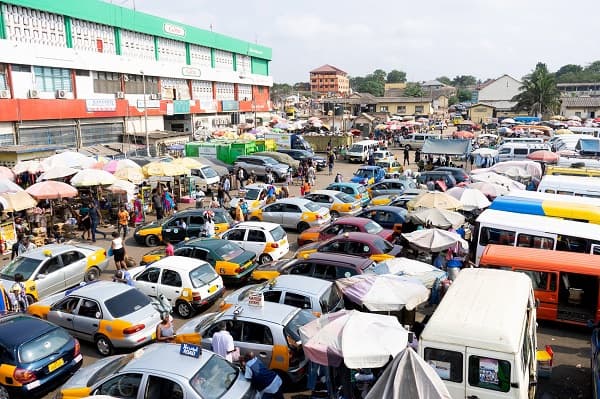
The Ghana Private Road Transport Union (GPRTU) says it will take a decision on whether transport fares should be adjusted as fuel prices are expected to rise in the next pricing window.
Senior Industrial Relations Officer of the Ghana Private Road Transport Union, Abbas Ibrahim Imoro, said the union was meeting Monday afternoon to deliberate on the development.
Speaking in an interview on News Beat on Metro TV on Monday, March 16, Abass Imoro said the union would communicate its decision after the meeting.
“We are meeting this afternoon at 1 pm. and we are going to iron all those differences. So I plead with the general public to take it easy until we are through with that meeting,” he said.
He added that the union would immediately inform the public once a decision is taken.
“So at the meeting, whatever decision we take, we will immediately communicate to all of you,” he noted.
Abass Imoro also disclosed that the union has had to restrain some drivers who attempted to increase fares on their own following speculation about rising fuel prices.
“Oh yes, that was something some of the drivers took it upon themselves and we had to fight it out. Fortunately, we were able to stop them from doing that,” he explained.
According to him, allowing drivers to increase fares without official approval could create difficulties in regulating the sector.
“If we don’t, it will come to a time that it will be very difficult for us to control that,” he said, adding that the union sometimes relies on law enforcement agencies to ensure compliance.
Beyond fuel prices, Abass Imoro said transport operators continue to grapple with other operational costs.
“We have so many operational costs. The vehicles we are using and spare parts have not been reduced,” he said.
He noted that although the cedi has strengthened against the dollar in recent months, prices of lubricants and other inputs have not seen a corresponding reduction.
“We were thinking lubricants and other items would come down, but they are still where they were, so we have little challenges,” he added.



