
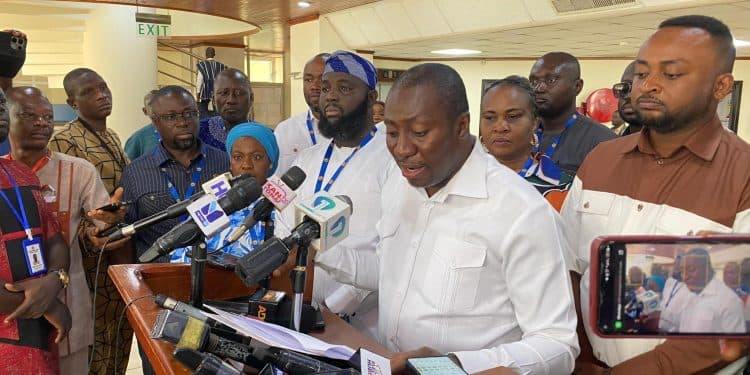
Minority Leader in Parliament, Alexander Afenyo-Markin has called for stronger support for indigenous businesses while cautioning against the misuse of state-backed opportunities by local entrepreneurs.
Speaking with Moro Awudu on Metro TV’s Good Morning Ghana on April 6, the Effutu MP stressed that he is not opposed to foreign investment, noting that it remains critical to Ghana’s economic growth.
However, he argued that greater emphasis must be placed on nurturing Ghanaian-owned enterprises to ensure wealth creation stays within the country.
“Whoever invests in Ghana owns the source and will repatriate profits,” he said. “But when a Ghanaian business succeeds, the value largely remains here and creates jobs.” He told Metro TV
Despite advocating for local business growth, Afenyo-Markin expressed concern about what he described as a pattern of abuse among some Ghanaian entrepreneurs who benefit from government support schemes.
He warned the governing National Democratic Congress against repeating past mistakes, where politically connected individuals received financial backing but failed to use it productively.
“It is expected that governments will support business-oriented individuals within their ranks,” he said, referencing similar efforts under former President John Agyekum Kufuor and former President Nana Addo Dankwa Akufo-Addo. “The problem is the abuse of these opportunities.”
He criticised instances where funds intended for business development were diverted into personal consumption, such as purchasing luxury homes or vehicles, instead of being invested into productive ventures.
“If you are given capital to build a business, you must not misuse it. Otherwise, you undermine the very government you claim to support and ultimately harm the country,” he said.
The Minority Leader also highlighted the importance of “patient capital”, long-term, low-interest financing that allows businesses time to grow—but noted that access to such funding depends on strong planning, governance structures, and succession strategies.
He pointed out that financial institutions are unlikely to commit long-term capital without confidence in a company’s sustainability, especially where leadership continuity is uncertain.
Beyond financing, Afenyo-Markin raised concerns about attitudes toward work and productivity, calling for a national reset in mindset and discipline.
He urged the government led by President John Dramani Mahama to consider reintroducing a national orientation programme similar to initiatives under the Kufuor administration.
According to him, such a programme would help rebuild trust, patriotism, and a shared national vision.
“We need a collective mindset shift. Without that, we will keep repeating the same problems,” he said.
He also criticised the overemphasis on white-collar education at the expense of technical and vocational skills, warning that Ghana risks losing job opportunities to foreign labour due to a shortage of skilled local workers.
He cited ongoing efforts under the Akufo-Addo administration to promote Technical and Vocational Education and Training (TVET), urging the current government to expand and sustain those initiatives.
“A country like Switzerland has deliberately invested in apprenticeship and skills training. We must do the same,” he said.
Afenyo-Markin noted that many construction and technical jobs in Ghana are increasingly being filled by foreign workers, not because opportunities do not exist, but due to gaps in local skills development.
He called for a cultural shift where vocational careers are respected equally, arguing that young people should feel confident pursuing trades such as carpentry without societal pressure to attend university.
“We must reach a point where a parent is proud when their child chooses a skilled profession,” he said.
He concluded that building a resilient economy will require a combination of disciplined entrepreneurship, targeted government support, and a renewed national mindset focused on productivity and collective progress.



