
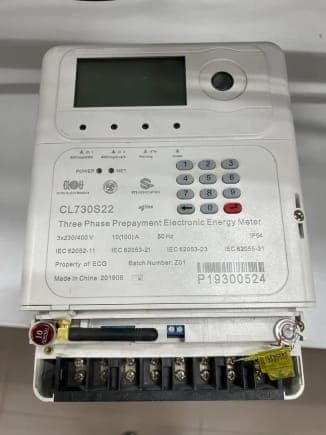
The Ghana Standards Authority (GSA) has directed that all electricity meters used in Ghana must be tested, verified and certified, warning that the installation or use of an uncertified meter is an offence.
The directive covers both new meters and those already in service, with the Authority setting December 31, 2028, as the deadline for all existing meters to undergo the required testing and certification.
According to a public notice issued by the GSA on Wednesday, August 26, the requirement applies to electricity meters regardless of their technology, ownership or billing arrangement.
This includes single-phase, three-phase, transformer (CT/VT), high-tension and low-tension meters, as well as postpaid, prepaid and smart meters.
It also covers bulk-supply and check meters, sub-meters used to apportion or recover energy costs, and export, import and net-metering installations, including solar photovoltaic systems.
The GSA said the directive is in line with Regulation 24 of the Public Utilities Regulatory Commission (Consumer Service) Regulations, 2020 (LI 2413), which mandates the Authority to approve meters intended for use by public utilities and subject them to testing and certification.
The Authority said no meter may be installed, energised or used for measurement unless it has been pattern-approved, tested, verified, stamped and sealed by an Inspector of Weights and Measures, with a valid Certificate of Verification.
The meters must also be marked in SI units and operate within the permissible margin of error.
Existing meters given until 2028
The GSA said every meter already installed and in service must be submitted for testing, verification and certification under the National Electricity Meter Testing Programme.
It said the process will follow a phased submission schedule to be issued by the Authority, but all meters must be certified no later than December 31, 2028.
“A meter not certified by then shall not be used for measurement and shall be liable to seizure and forfeiture,” the notice stated.
The GSA also stressed that the exercise is free of charge.
“Any person who demands payment for this service shall be reported to the Authority,” it added.
No grace period for uncertified new meters
The Authority said the directive takes immediate effect for meters that have not yet been installed.
It said no person may “sell, offer for sale, supply, accept, install, connect or energise” a meter that does not meet the prescribed requirements.
Meters being kept in warehouses, project stores or in transit, as well as those awaiting installation, will not benefit from any grace period.
The directive affects electricity distribution companies, bulk suppliers, independent power producers, embedded generators, meter manufacturers, importers and suppliers.
It also covers meter installation, calibration and repair contractors, electrical contractors, estate and property developers, landlords, facility and mall managers operating sub-meters, industrial and mining self-generators, vending and prepayment operators, and homeowners.
Repairs and relocation also require re-certification
The GSA further directed that meters that have been repaired, refurbished, reconditioned, removed and re-installed or relocated must be re-verified, re-sealed and re-certified before they can be used again.
The same requirement applies where a meter’s metrological registers, calibration constants, firmware or configuration have been altered.
The Authority said broken, missing or tampered seals must be reported within seven days and the affected meter withdrawn from service.
It also warned that foreign type approvals, calibration reports or conformity certificates do not amount to a GSA Certificate of Verification.
“Only an Inspector of Weights and Measures may verify, stamp and certify,” the notice said.
Consumers urged to check GSA seal
The GSA has urged consumers to take an active role in ensuring that meters installed on their premises are properly certified.
“Before accepting a meter, ask for and inspect the GSA seal and Certificate of Verification,” the Authority advised.
It also cautioned consumers against allowing anyone to install, open, adjust or replace their meter without evidence of authorisation from the GSA.
The Authority said distributors, developers and landlords must keep a register of meters under their control and provide the Certificate of Verification when a property is sold, let or handed over.
Offenders face fines and other sanctions
The GSA warned that individuals and companies that breach the requirements could face administrative penalties, fines or imprisonment depending on the nature of the offence.
The Authority said it has the power to enter premises, demand the production of meters and seize equipment being used in contravention of the law.
Non-conforming meters may also be forfeited to the Republic and destroyed.
The GSA said the enforcement of the notice will be carried out in collaboration with the Public Utilities Regulatory Commission (PURC), Energy Commission, Customs Division of the Ghana Revenue Authority, Electricity Company of Ghana (ECG) and security agencies.