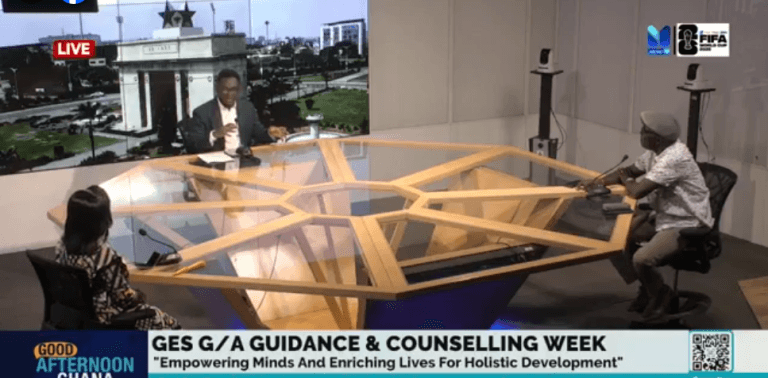
The Ghana Education Service Guidance and Counselling Association Greater Accra Chapter is calling for stronger support and recognition for trained counsellors in schools, saying their role is often misunderstood and undervalued.
Speaking on Good Afternoon Ghana on Metro TV on Thursday, February 26, 2026, President of the Association, Kofi Yeboah Dadzie, said guidance and counselling is a core mandate of the Ghana Education Service and must be treated as such.
“Guidance and counselling is one of the core mandate of Ghana Education Service,” he said. “We teachers in guidance and counselling, we need to come together. We have math teachers association, English teachers, so we need to come together because we have an important role we play in upbringing of the children.”
Mr Dadzie explained that counsellors do not simply give advice, but offer professional guidance to help students reach their full potential.
“Counsellors are professionals who direct children or people to achieve their aim or to reach their self actualisation. But advice, everybody can advise,” he said, drawing a clear distinction between professional counselling and casual advice.
His Vice President, Sally Mbia-Coleman, addressed concerns about whether students, especially girls, feel comfortable seeking help.
“The females actually come to us because as a counsellor, trained counsellor, your attitude and how you establish rapport with those girls allow them to come to you for counselling,” she said.
She added that while some schools have trained counsellors, others rely on facilitators who may not have formal training.
At the senior high school level, trained personnel serve as guidance and counselling coordinators, while at the basic level, facilitators operate under the supervision of district coordinators who provide periodic training.
The Association is currently marking its week-long celebration across the Greater Accra Region under the theme: “Empowering minds and arranging lives for holistic development, the role of the counsellor.”
The activities began on Monday with a launch across the region’s 29 municipalities and districts. Schools have since organised seminars, clean-up exercises, sports activities and talks. The week will climax with a regional gathering at PRESEC Legon on Friday.
Mrs Mbia-Coleman said the theme reflects the broad role counsellors play in students’ academic, social and psychological development.
“When you look at academic, social, even their psychological makeup, it’s all those with a counsellor,” she noted, adding that counsellors should even support students participating in sports so they understand that “it’s a game of chance” and avoid violent reactions.
The Association is also using the week to engage parents, particularly on career guidance.
“During the career, a lot of parents choose a career that has not suited their children’s intellectual ability,” she said.
“Someone may be a nurse, but that job is not what he wanted to do because he was forced into it.”
Mr Dadzie added that parent-teacher meetings provide opportunities to counsel parents against imposing their own professions on their children.
“Somebody will just push the child to go because he’s a doctor, he’s a banker. So the child should be a banker. The child needs to be maybe a musician or whatever it is,” he said.
On the question of whether counselling adolescents, especially Gen Z students, is difficult, Mr Dadzie maintained that the process becomes challenging only when people resort to advising rather than counselling.
“It becomes difficult when you are advising them, but counsellors don’t advise. You are guiding them,” he explained.
“The client comes to you with his or her problems. So you are helping to navigate those challenges.”
Despite their work, the Association says it faces challenges, particularly with sponsorship and public perception.
“Sometimes when we are doing programmes we need sponsors. You write other companies, I don’t know whether they don’t see the essence,” Mrs Mbia-Coleman said.
Mr Dadzie also raised concerns about untrained individuals assuming the role of counsellors.
“It becomes a challenge when every advisor sees himself as a counsellor,” he said, pointing to churches and other institutions that claim to offer counselling services without trained professionals.
Using a driving analogy, Mrs Mbia-Coleman said professional training cannot be replaced by informal experience.
“You have licence B, licence C. I drive maybe a 4×4, a saloon car. I cannot just turn up and drive a truck because I don’t have the licence for that,” she said.
“But people think they have done just a fraction of guidance and counselling and so they take on the job.”
The Association is urging stakeholders to recognise the professional nature of counselling and provide the necessary support to strengthen services in schools across the country.