
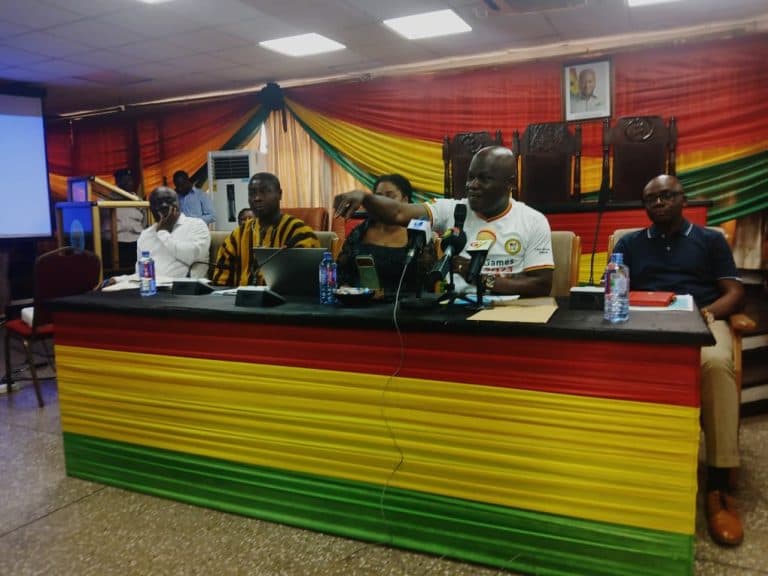
The Minister for Local Government, Chieftaincy and Religious Affairs, Ahmed Ibrahim, has issued a stern warning to Metropolitan, Municipal and District Assembly officials as he leads the Government Accountability Series and Regional District Accountability Tours across the country.
The initiative, which seeks to scrutinize the performance of local authorities and the utilization of decentralized funds, comes at a time when government has, for the first time in the country’s history, significantly decentralized resources to Metropolitan, Municipal and District Assemblies (MMDAs) to undertake development projects and improve service delivery.
The accountability exercise is focused on assessing the performance of local authorities, tracking the use of development funds such as the District Assemblies Common Fund (DACF) and the District Performance Assessment Tool (DPAT), evaluating infrastructure projects, and monitoring sanitation management systems across the country.
Addressing officials during a stop at the Tema Metropolitan Assembly, the Minister expressed disappointment over the absence of some assembly heads and officials expected to account for the utilization of public funds and implementation of projects within their jurisdictions.
“If you go to lots of the assemblies, the staff strength may be about 120, but the assemblies are being run by only three people,” he lamented.
Mr. Ibrahim stressed that the era of routine administrative practices without accountability was over, insisting that public officers entrusted with authority must be prepared to answer questions regarding their stewardship.
“Those who have the power and authority will come and be begging for information. I am a member of Cabinet, but when it comes to the things happening in Tema, I need to ask permission and seek information. It is not business as usual,” he stated.
The Local Government Minister indicated that preliminary reports and documents collated on the utilization of funds disbursed to assemblies had raised concerns about accountability and project execution.
According to him, the accountability tours are intended to interrogate how public resources have been utilized and whether assemblies have delivered value for money to the people they serve.
He cautioned officials against complacency and corruption, emphasizing that accountability begins with those directly responsible for managing public institutions.
“In Ghana, nobody knows no one. If you are corrupt, others will be corrupt. You work with the people every day, so the buck stops with you,” he said.
Mr. Ibrahim further reminded assembly officials that public office is a privilege rather than an entitlement.
“It should be a privilege to serve the people. If you’re here and you’re not competent, then you don’t deserve to be here,” he declared.
The Government Accountability Series and District Accountability Tours are expected to examine the implementation of critical projects including schools, Community-based Health Planning and Services (CHPS) compounds, water systems, market infrastructure and sanitation facilities.
The exercise also aims to strengthen transparency, improve local governance and ensure that resources allocated to assemblies translate into tangible development outcomes for citizens.
The Local Government Minister maintained that assemblies would be held accountable for every cedi received, stressing that government remains committed to ensuring transparency, efficiency and responsible management of public resources at the local level.
By: Vanessa Edotom Boateng | Metrotvonline.com | Ghana