
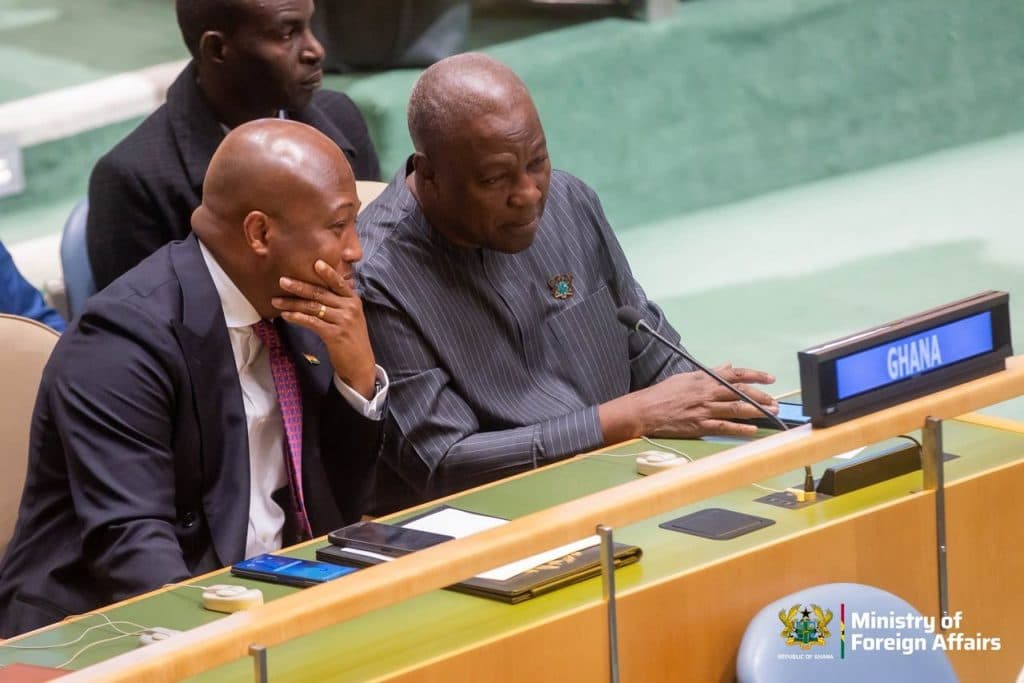
President John Dramani Mahama has praised Foreign Affairs Minister, Samuel Okudzeto Ablakwa for his “stellar leadership” in guiding Ghana to a landmark victory at the United Nations General Assembly, despite intense last-minute pressure from allies to delay the vote.
Mahama credited Ablakwa’s coordination and resolve at a critical moment when doubts emerged over whether the resolution could secure enough support.
“When I gave notice of this motion, I knew it would be difficult. We needed to build a broad coalition to get it through,” he said.
According to the president, several countries including some within the coalition urged Ghana to postpone the vote, warning it risked failure without wider consensus. Others pushed for softer language to attract more backing.
He disclosed that on the eve of the vote, he consulted Samuel Okudzeto Ablakwa amid mounting pressure to defer the process. Despite concerns over the numbers, the minister insisted Ghana move forward, arguing the opportunity might not come again.
Backed by a carefully built cross-regional alliance, Ghana proceeded and secured what Mahama described as an “emphatic victory.”
The resolution recognises the transatlantic slave trade and its legacy as a grave crime against humanity, a key outcome in Ghana’s push for reparations and historical justice.
The resolution was backed by 123 countries, while the United States, Israel and Argentina voted against it. A bloc of 52 European countries, including the United Kingdom, abstained.
In a media interview, Ablakwa said countries that opposed or abstained had “missed a golden opportunity” to acknowledge historical injustices, though he noted room remains for future engagement.
The successful passage strengthens Ghana’s leadership in global discussions on reparatory justice, particularly across Africa, the Caribbean and Latin America, and signals a growing willingness within multilateral institutions to confront the enduring legacy of the transatlantic slave trade.
Story by Desmond Okraku Danso



