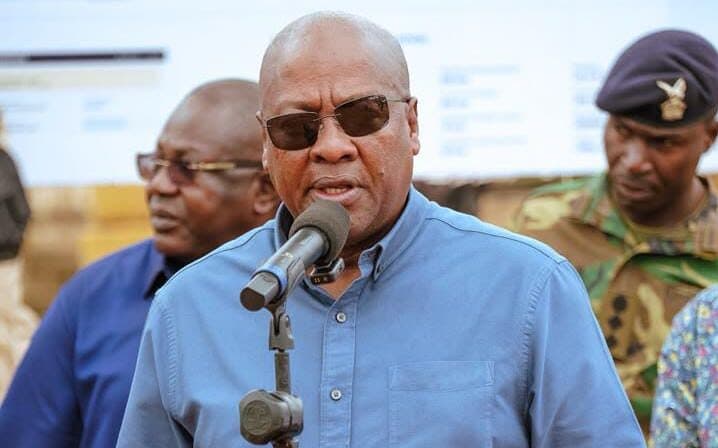
President John Dramani Mahama has pledged sustained investment in the University of Health and Allied Sciences (UHAS), saying government will work over the next few years to address the institution’s infrastructure needs after inspecting a laboratory complex that took 12 years to complete.
Speaking during a visit to the university, the President expressed disappointment over the delays in completing the project, saying the prolonged construction significantly increased its cost.
“I do not really know where to start because this is a project that began in 2014, and we are now in 2026. That means this project has taken 12 years to complete,” he said.
Mr Mahama noted that the project should have been delivered within its original timeline.
“One of the consequences of such delays is that the project will now cost much more than it would have if it had been completed on schedule. If we had completed this project on time, we would have spent far less resources in bringing it to completion. But as they say, better late than never.”
Despite the delay, the President said the new laboratory complex marks an important step in strengthening medical research in Ghana.
He said government wants UHAS to grow into a leading health sciences institution in West Africa, driven by research and innovation.
“Our vision is for the University of Health and Allied Sciences to become a centre of excellence in the sub-region. We want UHAS to become a university that is strong in innovation, research and the development of solutions that respond to the needs of Ghana and Africa.”
According to him, strong research facilities are essential if universities are to produce solutions to public health challenges.
“I am therefore pleased that UHAS now has what is probably the biggest laboratory complex in the sub-region,” he said.
President Mahama was particularly excited about a specialised laboratory within the complex that will support pathogen research and vaccine development.
He said the facility would work closely with the National Vaccine Institute and help strengthen Ghana’s capacity to respond to disease outbreaks.
“This laboratory will work closely with the National Vaccine Institute and will contribute greatly to Ghana’s ability to conduct research into diseases, develop vaccines and strengthen our health security,” he said.
Mr Mahama recalled that vaccine trials in the Volta Region had previously faced resistance from some members of the public.
“It is interesting that years ago, when we attempted to conduct vaccine trials in the Volta Region, there was resistance from some sections of the public, and we were asked to stop. Today, we have reached a point where we are building advanced research facilities in the same region to study pathogens and contribute to vaccine development.”
He added that research had played a key role in the development of vaccines, including the Ebola vaccine, and said UHAS was well placed to contribute to similar breakthroughs.
Furthermore, President Mahama acknowledged concerns raised by the university over student accommodation, lecture halls and library facilities.
He said inadequate hostel space remains a challenge across many public universities and promised that UHAS would receive support through revised education funding arrangements.
“We have also uncapped GETFund to allow more resources to flow into education infrastructure development,” he said.
“Going forward, the needs of UHAS will be addressed year by year, and every funding formula will capture important requirements of this university.”
Mr Mahama said he expects many of the university’s outstanding infrastructure needs to be addressed within the next four to five years.
He also announced plans to improve the university’s internal road network.
According to him, government is already working on a bypass project near the campus and is considering extending the contractor’s work to cover roads within the university.
“Our objective is to ensure that UHAS has the infrastructure required to support teaching, research, innovation and the overall development of a world-class university,” he said.
President Mahama said fulfilling the vision behind UHAS remains a priority, expressing hope that the institution would become one of Africa’s leading health sciences universities as envisioned by its founder, former President John Evans Atta Mills.