
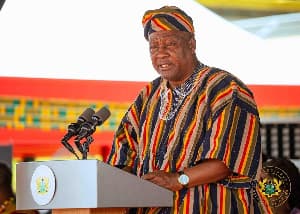
President John Dramani Mahama has called for deliberate investment in local agricultural technology, saying Ghana cannot transform its agriculture while relying heavily on imported machinery and systems.
Speaking at the opening of the Ghana Agrotech Fair 2026 on Tuesday, March 17, 2026, President Mahama said the country must build its own capacity to design, fabricate and maintain agricultural technologies.
“No nation can transform its agricultural economy while indefinitely depending on imported machinery, processing lines and technological systems at every stage of production,” he said.
He noted that supporting local manufacturers of agricultural equipment is not just an industrial policy decision but “a strategic economic necessity.”
According to him, investing in local agri-tech production will strengthen Ghana’s industrial base, create jobs and reduce import dependence.
“When we support local agri-tech manufacturing, we are strengthening Ghana’s industrial base, we are creating skilled employment for young people and we are reducing import dependence,” he stated.
President Mahama said agriculture must be seen beyond subsistence, describing it as a key driver of economic transformation.
“Agriculture is not merely about cultivation. Agriculture is also about productivity. It is about value addition. It is about industrial development. It is about jobs and exports,” he said.
He added that the sector is increasingly becoming technology-driven and requires innovation to remain competitive.
Mahama also announced plans to roll out Farmer Service Centres across the country to support agricultural production.
“I’m pleased to announce that I’m going to break the ground for the first Farmer Service Center this Friday… Government intends to build 50 of these centers nationwide,” he revealed.
He explained that farmers registered with the centres will have access to mechanisation services, inputs and training.
“They will get mechanization support in terms of tractors, plowing, harrowing, transporting, fertilizers and shellers… There will be extension officers who will give them advice on their production,” he said.
President Mahama further disclosed that scientists from the Council for Scientific and Industrial Research have made progress in local wheat production, which could help reduce imports.
“The first demonstration farms… produced between four to five tons of wheat per hectare. This will help us in import substitution, because Ghana imports almost $400 million worth of wheat every year,” he noted.
Touching on the broader vision, Mahama said government’s agriculture agenda aims to boost productivity, expand processing and position Ghanaian agribusiness to compete globally.
“A productive, technology-driven agricultural sector can feed our people, supply our industries, and generate precious foreign exchange for our economy,” he said.
He urged farmers, investors, researchers and the youth to take advantage of opportunities in the sector, insisting that agriculture is no longer a field of the past but a growing space for innovation and enterprise.
The Ghana Agrotech Fair brings together stakeholders in agriculture, technology and agribusiness to showcase innovations and explore opportunities within the sector.



