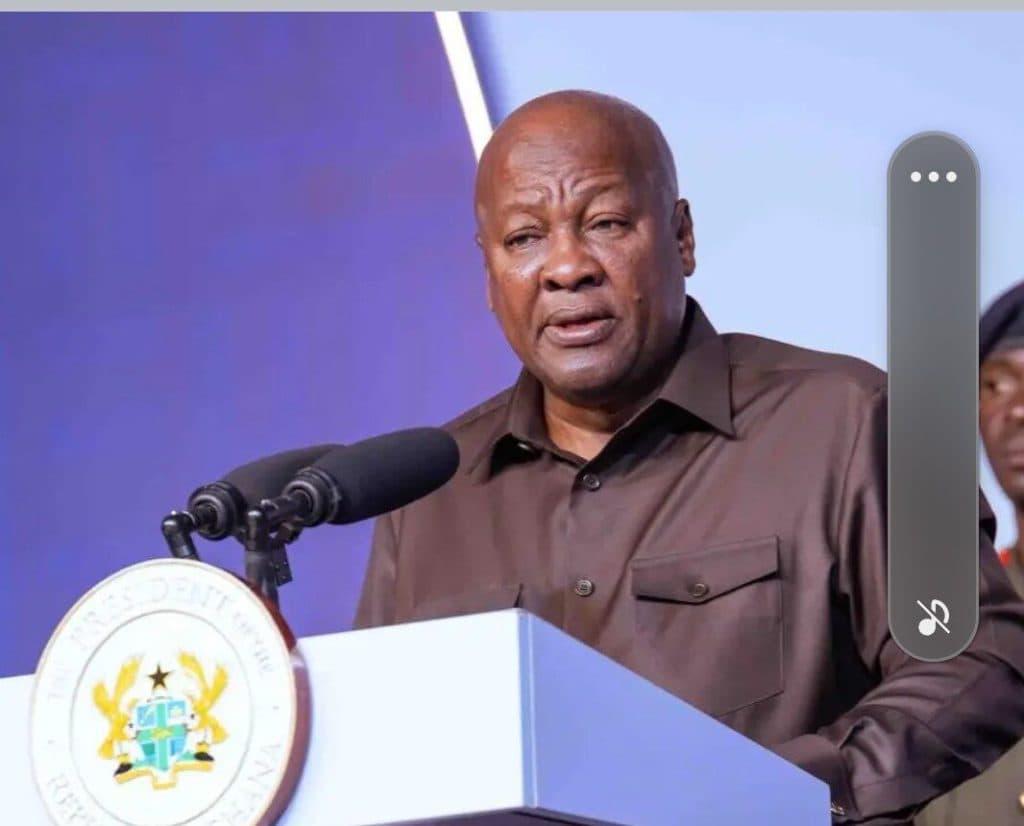
President John Dramani Mahama has lamented the 12-year delay in completing a major laboratory complex at the University of Health and Allied Sciences (UHAS), saying the prolonged construction significantly increased the project’s cost.
Inspecting the facility as part of his tour of the Volta Region on Thursday, July 16, President Mahama said what should have been completed within its original timeline dragged on for more than a decade, forcing the state to spend more money than necessary.
“I do not really know where to start because this is a project that began in 2014, and we are now in 2026. That means this project has taken 12 years to complete,” he said.
He described the delay as costly, noting that timely completion would have saved the country substantial resources.
“One of the consequences of such delays is that the project will now cost much more than it would have if it had been completed on schedule. If we had completed this project on time, we would have spent far less resources in bringing it to completion. But as they say, better late than never.”
Despite his concerns over the delays, Mr Mahama welcomed the completion of the laboratory complex, describing it as a major addition to Ghana’s medical research infrastructure.
He said the facility positions UHAS to play a leading role in scientific research and innovation.
“I am therefore pleased that UHAS now has what is probably the biggest laboratory complex in the sub-region,” he said.
President Mahama said one section of the facility had been built specifically to support pathogen research and vaccine development.
According to him, the laboratory will collaborate with the National Vaccine Institute to strengthen Ghana’s disease surveillance and vaccine research capacity.
“This laboratory will work closely with the National Vaccine Institute and will contribute greatly to Ghana’s ability to conduct research into diseases, develop vaccines and strengthen our health security.”
He reflected on the public resistance that greeted attempts to conduct vaccine trials in the Volta Region years ago.
“It is interesting that years ago, when we attempted to conduct vaccine trials in the Volta Region, there was resistance from some sections of the public, and we were asked to stop.”
President Mahama said the completion of the new research facility shows how attitudes and priorities have evolved.
“Today, we have reached a point where we are building advanced research facilities in the same region to study pathogens and contribute to vaccine development.”
He noted that scientific research had been responsible for the development of life-saving vaccines, including those for Ebola, and expressed confidence that UHAS would make meaningful contributions in that area.
He also responded to requests from the university for more hostels, lecture halls and a modern library, saying government had taken note of the institution’s needs.
President Mahama said changes to the administration of the Ghana Education Trust Fund (GETFund), including the removal of its funding cap, would allow more resources to be directed towards critical education infrastructure.
“We have also uncapped GETFund to allow more resources to flow into education infrastructure development,” he said.
He assured the university that its infrastructure needs would be addressed gradually.
“Going forward, the needs of UHAS will be addressed year by year, and every funding formula will capture important requirements of this university.”
President Mahama also announced plans to improve the university’s internal road network.
He said government would assess the possibility of extending the contract for a nearby bypass project to include roads on the UHAS campus.
“Our objective is to ensure that UHAS has the infrastructure required to support teaching, research, innovation and the overall development of a world-class university,” he said.