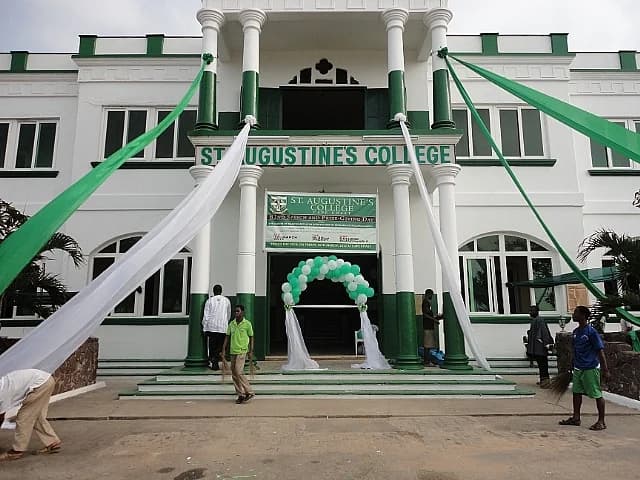
Across nearly two decades, a quiet but powerful transformation has been unfolding at St. Augustine’s College —not driven solely by public policy or funding, but by the enduring commitment of its alumni.
Through the coordinated efforts of successive year groups within the St. Augustine’s College Past Students Union (APSU), what began as individual acts of giving has evolved into a structured tradition of annual legacy projects; each one responding to a pressing need, each one advancing the school’s development.
This is not just a story of projects. It is a story of continuity, foresight, and collective responsibility.
A Timeline of Transformation: Projects That Built the Present
These legacy projects are delivered by year groups on the 25th anniversary of their graduation. Through them, each APSU year group has left a distinct imprint by together forming a continuous arc of development:
- 2009 — APSU 1984: Construction of the first gatehouse, improving campus security and institutional identity.
- 2011 — APSU 1986: Donation of computers and furniture to the ICT department, strengthening digital learning foundations.
- 2012 — APSU 1987: Rehabilitation of the administration block with PVC window installations, enhancing durability and functionality.
- 2013 — APSU 1988: Refurbishment of the twin classroom block near the school field, improving foundational academic spaces.
- 2014 — APSU 1989: Rehabilitation of the Assembly Hall, restoring a central space for gatherings and school events.
- 2015 — APSU 1990: Renovation of the Geography Block, enhancing a key instructional area.
- 2016 — APSU 1991: Rehabilitation of the dining hall and retrofitting of tables, improving student feeding conditions.
- 2017 — APSU 1992: Upgrading of the Biology Lab and Arts Block, strengthening both science and creative education.
- 2018 — APSU 1993: Rehabilitation of science laboratories and dedication of an NSMQ class, promoting academic excellence.
- 2019 — APSU 1994: Refurbishment of the school dispensary, improving access to student healthcare. Also constructed a new basketball court for the school.
- 2020 — APSU 1995: Rehabilitation of the college library, enhancing access to academic resources.
- 2021 — APSU 1996: Renovation of the pantry and installation of modern cooking equipment, boosting operational efficiency.
- 2022 — APSU 1997: Expansion of the ICT laboratory, responding to increasing demand for digital learning.
- 2023 — APSU 1998: Construction of a four-unit, two-bedroom staff accommodation, supporting faculty retention and welfare.
- 2024 — APSU 1999: Rehabilitation of an 18-unit classroom block and conversion of some into smart classrooms, integrating technology into teaching.
- 2025 — APSU 2000: Upgrade of the Junior Science Lab and lecture theatre, strengthening early science education and large-scale instruction. Also renovated washrooms for various dormitories and dug four mechanised boreholes to resolve the school’s water supply issues.
- 2026 — APSU 2001: Construction of a modern student cafeteria and canteen, significantly improving student welfare and dining experience.
Taken together, these projects reflect not isolated generosity, but a deliberate, sustained investment in the school’s future.
Identifying the Pattern
Get APSU 2002 Year Group’s stories in your inbox
Join Medium for free to get updates from this writer.Subscribe
Remember me for faster sign in
When viewed collectively, a clear developmental pattern emerges:
- Restoration and Stability: Early projects focused on rehabilitating core infrastructure such as classrooms, administrative blocks, and assembly space, ensuring the school remained functional and dignified.
- Student Welfare: Attention then expanded to the quality of student life, with investments in dining, healthcare, and essential services.
- Academic Strengthening: A strong shift toward improving teaching and learning followed, through laboratories, libraries, and specialised academic spaces.
- Digital and Future Readiness: Recent projects reflect the demands of a modern education system, with ICT expansion, smart classrooms, and upgraded science facilities.
- Capacity Expansion: More recent interventions have gone beyond refurbishment to include new construction that support increased enrolment and institutional growth.
This progression highlights a maturing, forward-thinking alumni body that continuously adapts to the school’s evolving needs.
The Hidden Challenge: Coastal Impact
Maintaining infrastructure at St. Augustine’s College comes with a unique challenge: its proximity to the sea.
Constant exposure to saline air and high humidity accelerates corrosion and structural wear. Buildings, metal fixtures, roofing, and fittings deteriorate faster than they would in inland environments. As a result, maintenance cycles are shorter, costs are higher, and the need for regular rehabilitation becomes unavoidable.
In such conditions, infrastructure is not a one-time investment. It requires continuous renewal.
The Free SHS Effect and Resource Pressure
The introduction of the Free Senior High School Policy Ghana in 2017 significantly expanded access to secondary education across Ghana. While this has been transformative for national development, it has also increased pressure on school infrastructure. Classrooms are fuller, facilities are more heavily used, and demand for resources continues to grow.
At the same time, government funding must be distributed across a rapidly expanding system, thus placing limits on how quickly infrastructure can be upgraded or expanded.
Why Legacy Projects Are Indispensable
It is within this context that alumni legacy projects prove critical. Without them, infrastructure development and maintenance in many schools would be severely constrained. In environments like St. Augustine’s College — where coastal conditions accelerate wear — the absence of alumni support would mean visible decline over time. Through these alumni legacy projects, Ghanaian high schools are able to tap into tradition, passion, and belonging to:
- Counteract accelerated deterioration caused by environmental exposure.
- Bridge funding gaps in an overstretched public education system.
- Enable timely upgrades and expansion in response to growing student populations.
- Sustain standards of excellence in both learning and living environments.
In a developing economy like Ghana, they are not optional — they are essential!
More Than Buildings
Beyond the physical structures, these projects reinforce a culture of responsibility and belonging. They remind every student that being an Augustinian is lifelong; that one day, they too will be called upon to contribute to the institution that shaped them.
This is how legacy is built: not in a single act, but through a chain of commitment spanning generations.
A Model Worth Emulating
The APSU legacy model demonstrates what is possible when alumni communities organise with purpose and consistency. We have seen similar success stories from other high schools. For St. Augustine’s College, it has meant sustained progress despite environmental and financial constraints. For Ghana, it offers a powerful blueprint — one where alumni are not spectators, but active partners in educational development.
Project by project, year by year, the impact is clear. This is legacy: not imagined, but built piece by piece, year by year, group by group.