
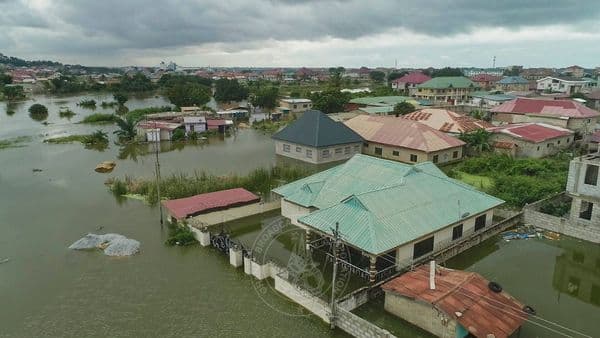
The National Disaster Management Organisation (NADMO) has disclosed that at least 105 people have been displaced following flooding caused by the ongoing spillage of the Weija Dam and heavy rainfall in parts of the Greater Accra Region.
Speaking on Metro TV’s Good Afternoon Ghana on Friday, May 29, 2026, Director of NADMO’s Inspectorate Unit, Richard Amo Yartey, said affected residents have been moved to safe locations while authorities continue to monitor the situation.
“As I speak to you now, the levels are receding and then the communities are returning to normal. And then those who were displaced, we identified about 105 persons who were displaced, and then they are being kept in some safe places,” he said.
According to him, the flooding in communities within the Densu Basin was triggered by intense rainfall upstream, which significantly increased inflows into the Weija Dam.
He explained that all five spillway gates have been opened to protect the structural integrity of the dam.
“As I speak to you now, Weija Dam is filling. All five gates are open. Yesterday it was heavier, so the gates had been opened above 13 inches each. As of today, they are open at 24 inches each,” he stated.
Mr Amo Yartey noted that although the spillage has affected some downstream communities, it remains necessary to prevent a potentially more serious disaster.
“It is the lesser of the two evils. If you spill, there will be communities downstream being inundated. If you don’t spill, upstream communities will be inundated and then the integrity of the dam itself may collapse,” he explained.
He added that authorities had anticipated the increased water levels and worked through the night to open an additional estuary to facilitate faster water flow.
“We completed that exercise by 5:30 to 6am yesterday because we worked throughout the night, hoping that in about two to three hours the water levels were going to recede. Unfortunately, the rains also came in,” he said.
The NADMO official said the organisation had taken several precautionary measures ahead of the rainy season, including public sensitisation campaigns, preparation of safe havens and the identification of flood-prone communities.
“The heavier rains were expected. We were ready for the heavy rains. We did all that we needed to do in anticipation of it, like sensitising flood-prone communities and ensuring that our safe havens are ready,” he noted.
Mr Amo Yartey also urged Ghanaians to take greater responsibility for disaster prevention by complying with planning regulations and avoiding activities that increase flood risks.
“We think that citizens have to do more. Compliance is disaster risk reduction,” he said.
He stressed that while enforcement agencies face resource constraints, public cooperation remains critical in reducing the impact of disasters.
“We must preach for the citizens to be more responsible and comply because all the regulations for development control are to ensure the safety of citizens and communities,” he added.