
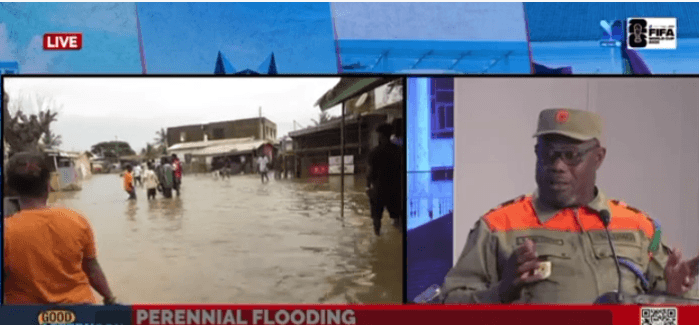
The National Disaster Management Organisation (NADMO) has called on Ghanaians to play a more active role in preventing disasters, arguing that compliance with regulations is just as important as enforcement by state institutions.
Speaking on Metro TV’s Good Afternoon Ghana, Director of NADMO’s Inspectorate Unit, Richard Amo Yartey, said many disasters could be avoided if citizens adhered to planning and development regulations.
According to him, the country’s disaster management framework places some responsibility on individuals to ensure their own safety and reduce risks within their communities.
“One of the findings was that citizens have to take responsibility. There are certain demands that should be made of citizens because at the end of the day, everybody is entitled to ensuring their own safety before other people can come in to help,” he said.
Mr Amo Yartey explained that this thinking informed the passage of Act 927, which replaced the legislation that originally established NADMO and introduced greater responsibilities for citizens in disaster risk management.
He argued that public discussions on flooding and other disasters often focus heavily on enforcement while overlooking the role of individual actions.
“We are fond of calling for enforcement, enforcement, enforcement. Why should there be enforcement when you can do the right thing?” he questioned.
The NADMO official maintained that adherence to regulations governing land use, construction and development remains one of the most effective ways to minimise disaster risks.
“Compliance is disaster risk reduction,” he stressed.
He acknowledged that enforcement agencies face significant capacity challenges, making it difficult to police every violation across the country.
“We all know that our enforcement capacity is not up to the standards required internationally,” he said.
Mr Amo Yartey noted that while authorities continue to carry out public education and enforcement exercises, including the removal of structures from wetlands and waterways, stronger public cooperation is needed to reduce the impact of flooding and other disasters.
“So we must preach for the citizens to be more responsible and comply because all the regulations for development control are to ensure the safety of the citizens, the community and everything,” he added.