
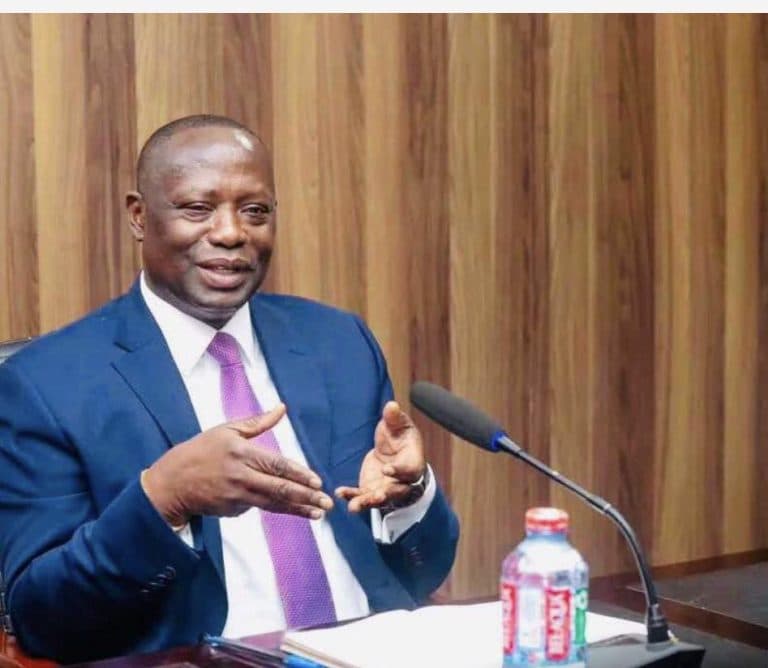
The Minister for Lands and Natural Resources, Emmanuel Armah Kofi-Buah, has declared that the government is determined to revive the Volta Aluminium Company Limited (VALCO), insisting that the state-owned aluminium smelter will not be sold under the administration of President John Dramani Mahama.
Speaking during a working visit to VALCO in Tema to familiarise himself with the company’s operations, the minister assured hundreds of workers that reports suggesting the government intends to privatise or auction the company are false.
“Nobody will sell VALCO under President Mahama,” he said, adding, “We will revive VALCO. Nobody can stop it.”
Mr. Armah Kofi-Buah said the government plans to attract strategic investors to help restore the company to full operation, describing VALCO as a key driver of Ghana’s industrialisation agenda. According to him, reviving the smelter would also stimulate economic activity within the Tema Industrial Area and create thousands of jobs.
He dismissed concerns raised by some workers over the company’s future, describing claims that government had already decided to privatise VALCO as misinformation intended to derail efforts to restructure the company.
He stressed that no agreement had been concluded with any investor and assured workers that the process would be transparent.
“If people genuinely have facts, they should bring them. It is our collective responsibility. Nobody has closed any deal here,” he said.
The minister acknowledged the financial and operational challenges confronting the company, noting that years of debt accumulation and ageing equipment have affected productivity.
“You accumulate debt and ask the taxpayer to pay for it. The ultimate responsibility to make sure this plant works is not employees. This organisation has a code of conduct and ethics,” he said.
Mr. Armah Kofi-Buah said the decline of VALCO has had a ripple effect on several downstream industries that depend on the company for raw materials, causing many businesses in the Tema industrial enclave to struggle.
“The effectiveness of the value chain is not happening because of the challenges facing this company. The refineries, the smelter and all. It all starts from a profitable VALCO,” he stated.
He appealed to workers to support the government’s reform agenda, assuring them that the objective is to restore the company to profitability while protecting existing jobs and creating new employment opportunities.
“We want to make sure we turn this place around, and we are in this together. We have to work together,” he told the workers, who responded with applause.
According to the minister, Cabinet has already outlined the broad direction for VALCO’s revival but remains open to ideas from stakeholders.
“We are open to any idea to turn around VALCO,” he said.
He also warned that the government would not tolerate what he described as propaganda and falsehoods aimed at frustrating efforts to revive the company.
VALCO currently operates about 90 reduction cells, far below its installed capacity of 500 cells.
The company employs about 800 workers under its current operations, but officials estimate that a fully revived plant could directly employ at least 2,000 people and support up to 5,000 direct and indirect jobs.
Government estimates that approximately US$700 million will be required to modernise the company’s obsolete technology and infrastructure to restore it to full operational capacity.
You can add this background at the end of the story or use it as a separate background section:
Background
Volta Aluminium Company Limited (VALCO) is Ghana’s only aluminium smelter and forms a key part of the country’s long-standing ambition to build an integrated aluminium industry. The company was established in 1960 under the administration of Ghana’s first President, Kwame Nkrumah, as part of the Volta River Project, which sought to harness hydroelectric power from the Akosombo Dam to support industrialisation.
Located in Tema, VALCO converts alumina into primary aluminium using large amounts of electricity. The smelter was originally supplied with power from the Akosombo Dam and has historically produced aluminium for both domestic use and export.
Over the years, however, the company has faced persistent challenges, including high energy costs, inconsistent power supply, ageing equipment, financial difficulties and fluctuations in global aluminium prices. These factors have significantly reduced production, with many of the smelting cells remaining idle.
The Government of Ghana currently owns 100% of VALCO after acquiring the shares previously held by foreign investors. Successive governments have explored various strategies to restore the company to full operation, arguing that a revitalised VALCO could support downstream industries, create thousands of jobs and help Ghana add value to its abundant bauxite resources rather than exporting them in raw form.



