
The New Patriotic Party (NPP) has challenged the government to publish a detailed account of the Ghana Rural Telephony and Digital Inclusion Project, disputing claims that rural connectivity was neglected under the previous administration and accusing the current government of failing to advance the project at the pace required.
The NPP’s Policy Committee on Communications and Digitalization said the government must provide clear data on the number of rural telephony sites constructed, connected and operational, as well as explain the status of about 400 additional sites for which equipment was handed over in January 2025.
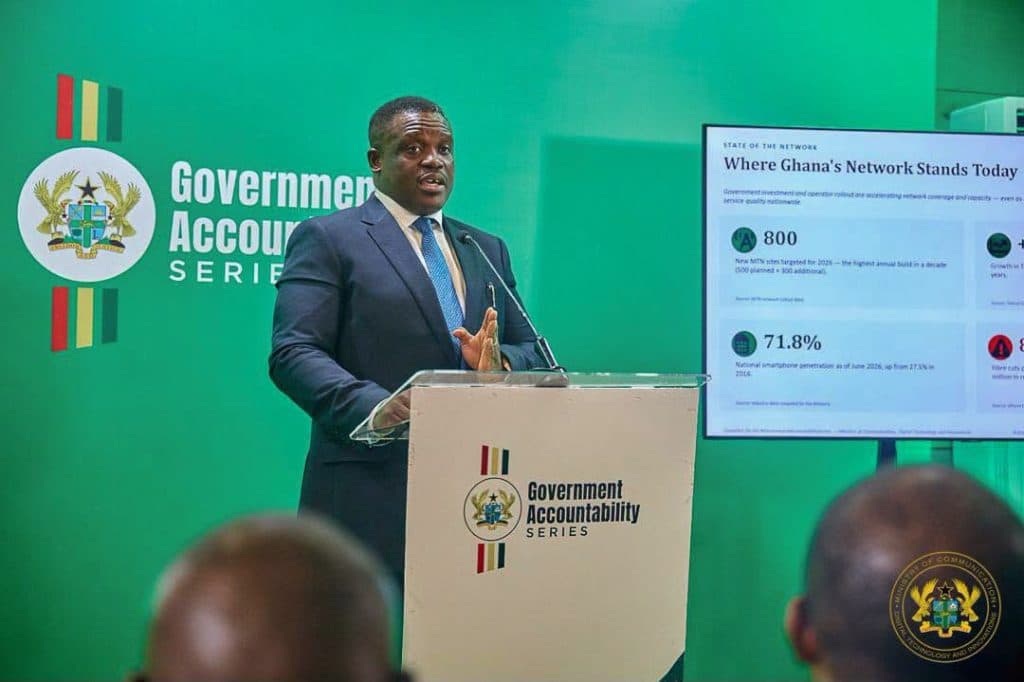
The committee, chaired by former Information Minister, Kojo Oppong Nkrumah, made the demand in response to comments by the Minister for Communication, Digital Technology and Innovations at a Government Accountability Series press conference at Jubilee House on Monday, September 7, 2026, as well as remarks he made during a tour of Rural Telephony Project sites in the Eastern Region on September 4.
While welcoming efforts to reduce data costs and improve fixed broadband pricing, the NPP said the minister’s comments about the history of rural telephony required clarification.
According to the party, the Ghana Rural Telephony and Digital Inclusion Project was launched in 2020, rather than 2022, under the Ghana Investment Fund for Electronic Communications (GIFEC), with financing of €155 million from the China EXIM Bank.
The project was implemented in partnership with Huawei and the China National Technical Import and Export Corporation and was designed to establish 2,016 sites to provide services to between three and four million people in unserved and underserved communities. The first site was commissioned in November 2020.
The NPP said the project built on an earlier phase in which 430 rural sites were constructed and activated between 2017 and 2018 in collaboration with private-sector operators, extending connectivity to about 700,000 people who previously had no service or inadequate coverage.
By the time the Akufo-Addo and Bawumia administration handed over power in January 2025, the party said, the country had an infrastructure footprint of 1,961 constructed rural telephony sites, with equipment in stock to facilitate the deployment of another 400 sites.
The committee also rejected suggestions that some sites constructed in 2024 could not technically be connected because of their locations.
It said a satellite hub at the Kofi Annan Centre of Excellence in ICT had been upgraded, tested and prepared to provide backhaul connectivity for 46 sites in difficult-to-reach communities.
According to the NPP, those communities are not technically unreachable. Rather, the sites remain unconnected because the contracted satellite hub service has not been taken up and paid for.
The party argued that the distinction was important because the problem, in its view, was a commercial and administrative decision rather than a technical limitation.
On developments since the change of government in January 2025, the NPP claimed that no new rural telephony site was constructed during 2025, despite the handover of equipment capable of supporting approximately 400 additional sites.
It further said the current pace of deployment suggested that the remaining sites would not all be completed this year. The party also claimed that a larger proportion of previously constructed and activated sites were now non-operational than at the time of the handover.
The NPP said the Ministry was free to correct those claims with updated data if they were inaccurate.
The party also said it did not oppose the government’s plan to upgrade rural telephony sites to at least 4G, describing the objective as legitimate and necessary in the long term.
However, it cautioned against prioritising the upgrade before completing the existing rollout.
The NPP said the rural telephony infrastructure installed under the previous administration was designed to be upgradeable to 4G and that the upgrade was intended to form part of a subsequent phase.
Its concern, the party said, was the sequencing of the programme.
“A community that has no service at all gains nothing from a decision about whether it should eventually receive 3G or 4G,” the committee said, arguing that the immediate priority should be to connect sites that have already been constructed and paid for, deploy equipment already in stock and restore services that have gone offline.
The party warned that moving ahead with a 4G upgrade before completing the existing programme could leave communities with the weakest coverage waiting even longer for basic connectivity.
The NPP stressed that its position was not intended to turn rural telephony into a contest over which administration should receive credit for the project.
It said rural connectivity was national infrastructure that required continuity across successive governments.
The party is therefore demanding that the Ministry and GIFEC publish, within 30 days, a comprehensive status report covering the project by region and district.
The report, it said, should show the number of sites constructed, connected, operational and built but not yet in service.
It also wants the government to publish a deployment schedule for the equipment handed over for the approximately 400 additional sites, including their locations and completion or expected completion dates.
The NPP further wants the government to disclose the current contractual and operational status of the satellite hub at the Kofi Annan Centre of Excellence in ICT and state whether, and when, the 46 sites intended to use the hub will be connected.
It is also demanding details of the sequencing, cost and financing of the proposed 4G upgrade, including assurances that the upgrade will not delay completion of outstanding rural telephony sites.
The committee has additionally called for the matter to be presented to Parliament’s Select Committee on Communications, saying the status of the project should be established through evidence and official records rather than competing political claims.
The NPP said it was prepared to provide its technical and handover documents to the Ministry and the parliamentary committee to assist in establishing the facts.
“Our interest is a working rural network,” the committee said, stressing that communities currently without reliable connectivity deserved both access to service and a clear explanation of when that service would be delivered.