
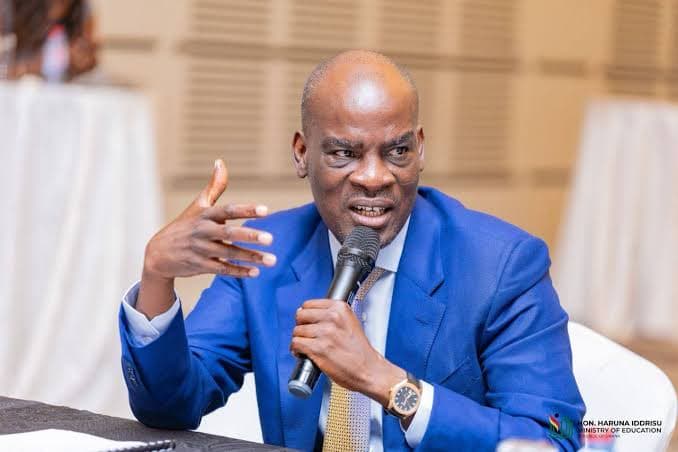
The New Patriotic Party (NPP) has challenged President John Mahama to either apologise to Ghanaians or dismiss Education Minister Haruna Iddrisu over the controversy surrounding the introduction of Arabic and Chinese into Ghana’s education system.
The party’s Education Sector Policy Committee says President Mahama’s recent denial that Cabinet had approved any such policy has created a serious contradiction between the President and his Education Minister.
In a statement made available to Metro TV, the committee argued that if Haruna Iddrisu announced and pursued the policy without presidential or Cabinet approval, then he should be removed from office.
“If, however, the Minister acted with the authority or knowledge of the President or Cabinet, then the President must apologise to the Ghanaian people for denying a policy his Government had already set in motion,” the statement said.
President Mahama, speaking during a citizens’ engagement at the University of Business and Integrated Development Studies (UBIDS) in the Upper West Region on September 12, said Cabinet had not approved a policy to introduce Arabic and Chinese across public schools.
“No such policy has been approved by the cabinet that I chair. So let’s put that matter to rest once and for all,” he said.
He also questioned the practicality of introducing Chinese when Ghana was already facing challenges with the availability of French teachers.
But the NPP committee says events preceding the President’s statement suggest that government institutions had already taken concrete steps towards developing and implementing a Chinese language curriculum.
The committee recalled that on April 24, 2026, Mr Iddrisu publicly announced that Chinese and Arabic would become compulsory foreign languages at the secondary school level and linked the policy to President Mahama’s vision for education.
It said the Ministry of Education subsequently directed the National Council for Curriculum and Assessment (NaCCA) to undertake curriculum-related work.
According to the committee, the process involved about 160 writers and reviewers and resulted in a revised curriculum which included Arabic and Chinese among foreign-language options.
The controversy intensified in July when the revised basic school curriculum was presented, with multiple reports that Chinese was to be introduced as an optional foreign language while Arabic was standardised.
The NPP committee said the Education Minister did not reject the revised curriculum when it was presented to him on July 22.
Instead, it said, he referred it to the Ghana Education Service (GES) and directed the service to prepare for implementation.
The committee further questioned why public resources would have been committed to curriculum development and teacher preparation if there was no government policy behind the process.
“What exactly were taxpayers funding, and who takes responsibility for that expenditure?” it asked.
The issue has also been complicated by subsequent teacher training activities.
On September 4, NaCCA, working with the Confucius Institute at the University of Cape Coast (UCC), held a national training workshop for basic school teachers on the new Chinese language curriculum. UCC said the training was intended to equip teachers with the skills needed to implement the curriculum.
The committee therefore questioned the sequence of events, particularly the fact that curriculum development and teacher training had taken place despite the President’s assertion that Cabinet had approved no such policy.
“If teacher availability remained sufficiently unresolved for the President himself to raise it, why had the process already advanced through curriculum development, GES implementation preparation and teacher training?” the statement asked.
The NPP also distinguished between Arabic and Chinese, arguing that Arabic had already existed as an optional subject at the junior high school level before the current administration.
Chinese, it said, was different because of the developments in 2026.
However, official and institutional records indicate that Chinese was already being offered as an elective at the secondary level before the current controversy. The University of Cape Coast said in December 2025 that its Confucius Institute had launched a Chinese curriculum that had been added as an elective subject at the secondary level by the Ghana Education Service.
The NPP committee said the dispute now raises broader questions about policy coordination within government and the authority of ministers to initiate major policy processes.
“If the Minister could publicly announce a major policy direction, attribute it to the President, commit public institutions and resources to its development and move it towards implementation without the necessary approval, the public is entitled to ask what other decisions he or other Ministers may be taking without the required authority,” it said.
The committee maintained that the controversy should not be closed simply by the President’s declaration that no new policy exists.
“The President cannot have it both ways,” it stated.
It consequently called for either the dismissal of the Education Minister if he acted without presidential authority, or an apology and full disclosure from President Mahama if the process had been undertaken with the knowledge or approval of the presidency or Cabinet.
“Parents, teachers, school administrators and taxpayers are entitled to coherent and transparent Government communication. The matter cannot simply be declared closed. The President must choose: apologise to the nation or sack his Education Minister,” the statement said.