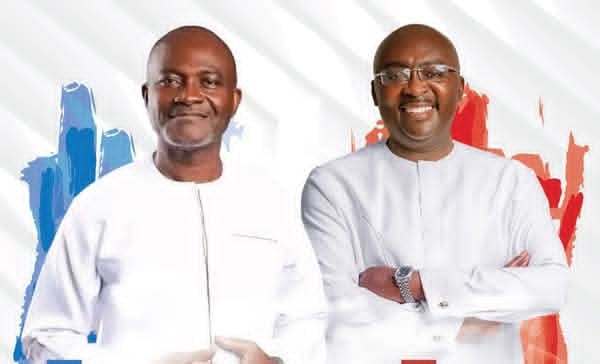
As Ghana’s New Patriotic Party prepares for its flagbearership contest between Dr Mahamudu Bawumia and Hon. Kennedy Agyapong, I find myself in the increasingly uncomfortable position of remaining undecided—sitting, as it were, on the fence.
This indecision, however, is not born of apathy or lack of engagement with the issues at stake. Rather, it stems from a profound and unsettling recognition that this election represents something far more significant than a choice between two individual candidates. It represents a fundamental question about what kind of leadership Ghana requires at this critical juncture in its development, and whether the nation is prepared to embrace genuine change or will once again retreat into the comfortable familiarity of conventional political expectations.
The prevailing narrative surrounding this contest has been remarkably consistent from its inception. Supporters of Dr Bawumia have constructed their case around a simple but seductive proposition: that he represents the quintessential presidential candidate—polished, educated, diplomatic, and possessed of the refined temperament befitting high office. The argument proceeds along predictable lines: Dr Bawumia is presentable on the international stage, an astute and highly educated economist who can articulate Ghana’s interests with sophistication, a man whose demeanour and intellect would do credit to both the party and the nation in global forums. In this telling, he embodies presidential gravitas, commands respect through intellectual authority, and possesses the diplomatic skills necessary to navigate complex international relationships.
By contrast, Kennedy Agyapong has been painted as the antithesis of these qualities—a hot-tempered maverick without appreciation for diplomatic niceties, lacking the presidential aura necessary to represent Ghana abroad, prone to inflammatory rhetoric and confrontational approaches that would embarrass the nation and undermine its standing. The implicit message is clear: Bawumia represents serious, responsible leadership whilst Agyapong represents risk, unpredictability, and potential embarrassment.
This narrative, whilst superficially compelling, demands rigorous interrogation. For it rests upon a fundamental assumption that deserves challenge: that Ghana’s problems can be solved by yet another iteration of the same type of leader we have repeatedly chosen since independence.
Ghana has, since gaining independence in 1957, been led by a succession of highly educated, often foreign-trained, intellectually accomplished individuals. We have had lawyers educated at prestigious British institutions. We have had economists trained at the finest universities in America and Europe. We have had academics with doctoral degrees and impeccable credentials. We have chosen leaders who could hold their own in any international forum, who spoke the language of diplomacy fluently, who understood economic theory and could articulate development policy with sophistication. In short, we have consistently elected precisely the sort of refined, educated, diplomatically skilled leaders that Dr Bawumia’s supporters now present as the obvious and necessary choice.
And yet, despite this parade of intellectual excellence and diplomatic refinement, despite all these well-credentialled, internationally educated, eminently presentable leaders, here we remain—a struggling nation with precious little to show for our natural resource endowments and human potential. Our economic development lags behind nations with far fewer advantages. Our infrastructure remains inadequate. Corruption persists as a systemic challenge. Youth unemployment remains stubbornly high. The gulf between our potential and our achievement yawns ever wider. If the model of leadership we have consistently chosen—refined, educated, diplomatic—were the solution to Ghana’s challenges, surely we would have seen more substantial progress by now?
It therefore strikes me as peculiar, even intellectually dishonest, when supporters of Dr Bawumia continue to market him as embodying the qualities of an ideal Ghanaian president—qualities that define precisely the sort of leaders we have elevated time and again, only to be disappointed repeatedly. Are we truly so wedded to a particular aesthetic of leadership, a particular performance of presidential dignity, that we cannot recognise its consistent failure to deliver transformative results? Have we become so enamoured with the appearance of competence that we no longer notice the absence of actual achievement?
The contemporary moment in Ghana, I would argue, demands a fundamental reassessment of what we mean by “presidential” and what qualities we should prioritise in our leaders. Ghanaians today are exhausted. They are tired of eloquent speeches that yield little tangible improvement in their daily lives. They are weary of leaders who look impressive in international forums whilst presiding over stagnation at home. They are frustrated by the persistent gap between the promises articulated by well-educated politicians and the reality experienced by ordinary citizens trying to build businesses, educate their children, and secure their futures.
In this context, the question is not whether a candidate wears his suits well or speaks with refined diction. The question is brutally simple: can he fix the bloody mess? If the solution to Ghana’s challenges requires someone who doesn’t fit the conventional mould, someone who ruffles feathers and challenges comfortable assumptions, someone who operates outside the boundaries of traditional political decorum—then that is precisely what we need. If a cowboy can deliver where the suited diplomats have failed, then let us have the cowboy.
Kennedy Agyapong is, undeniably, a different kind of politician. His methods are unconventional, often controversial. He speaks with a bluntness that makes the political establishment uncomfortable. He does not soften his positions to avoid giving offence. He operates with a directness that can seem crude when measured against conventional diplomatic standards. Some of his public statements have raised eyebrows, generated controversy, and prompted questions about his suitability for high office. All of this is true, and his supporters would be foolish to deny it.
But here is what is also true, and what deserves equal consideration: unconventional leadership styles are not inherently disqualifying, particularly when conventional approaches have consistently failed to deliver results. Consider the global landscape of leadership in recent years. Donald Trump’s brash, norm-breaking approach to the American presidency horrified establishment politicians and foreign policy experts, yet he delivered on several campaign promises, renegotiated trade agreements, and connected with a base of voters who felt ignored by conventional politicians.
China’s Xi Jinping operates with an iron hand that would be unthinkable in Western democracies, yet has overseen continued economic growth and technological advancement that has repositioned China as a global superpower.
Russia’s Vladimir Putin employs methods that democratic nations condemn, yet maintains domestic support by projecting strength and advancing what his supporters view as Russian interests.
Rwanda’s Paul Kagame rules with authoritarian efficiency that human rights organisations criticise, yet has transformed Rwanda from a nation devastated by genocide into one of the fastest-growing economies in Africa, with improving infrastructure, rising living standards, and decreasing poverty rates.
I am not suggesting that Ghana should emulate authoritarian governance or abandon democratic principles. What I am suggesting is that effectiveness in leadership does not always correlate with conventional diplomatic refinement, and that transformative results sometimes require leaders willing to challenge comfortable assumptions, disrupt established patterns, and operate outside the boundaries of what the political establishment considers acceptable.
The world, and Africa in particular, has been repeatedly failed by the same tired democratic posturing—leaders who say the right things, maintain the appearance of democratic governance, speak eloquently about development and transformation, yet deliver precious little substantive change.
We cannot expect different results if we continue choosing the same kind of people who have disappointed us repeatedly. This is a recognition of an observable historical pattern. Ghana’s trajectory since independence demonstrates that intellectual brilliance and diplomatic polish, whilst admirable qualities, are insufficient on their own to drive the transformative change the nation requires. What use is a leader who can articulate economic policy with sophistication if that policy fails to generate jobs? What value does diplomatic refinement provide if it does not translate into beneficial international partnerships and investment? What purpose does presidential dignity serve if it masks ineffectiveness and tolerates systemic corruption?
I recently attended a gathering where a frustrated participant declared that Ghana needs a tough dictator or military intervention to fix the country’s persistent problems. Whilst I vigorously disagree with any call for dictatorship or military rule—such governance models have their own devastating track record in Africa and would likely compound rather than solve our challenges—I understand the sentiment underlying this extreme statement. What this individual was really expressing, however inarticulately, was exhaustion with weak leadership, frustration with the permissiveness that allows corruption to flourish, and hunger for accountability mechanisms that actually function.
What Ghana needs is not dictatorship, but what might be called “iron hand” leadership—not in the sense of authoritarian rule, but in the sense of leaders who possess the strength of character to make difficult decisions, to hold people accountable regardless of their connections, to resist the pressure to distribute patronage to supporters, and to enforce consequences for corruption and incompetence.
We need leaders who do not owe so many favours to the people around them that they become prisoners of these obligations. We need leaders whose power base is sufficiently independent that they can afford to prosecute wrongdoing even when it affects politically connected individuals. We need leaders whom the corrupt actually fear, rather than leaders who are captured by networks of mutual obligation and shared complicity.
This is where Kennedy Agyapong’s background becomes not a liability but potentially an asset. Unlike many politicians who have risen through party structures and accumulated webs of obligation along the way, Agyapong built his wealth independently before entering politics. He is not beholden to party financiers for his personal economic security. He has demonstrated repeatedly—sometimes controversially—that he is willing to speak uncomfortable truths and confront powerful interests. Whether one agrees with all his methods or not, it is difficult to argue that he operates from a position of weakness or that he can be easily captured by the networks of patronage and mutual obligation that so often paralyse political will.
The New Patriotic Party now has an opportunity—indeed, a responsibility—to offer Ghanaians something genuinely different. Not merely a different face or a different campaign slogan, but a fundamentally different approach to governance and leadership. The nation needs an opposition that represents a clear alternative to the incumbent, that offers not just policy variations within familiar parameters but a departure from business as usual. We need boldness rather than caution, accountability rather than accommodation, fearlessness rather than political calculation.
Ghana is exhausted by intellectual talk that leads nowhere. We have had decades of sophisticated policy documents, impressive development plans, eloquent ministerial statements, and refined diplomatic engagements. What we have not had is consistent delivery, systematic accountability, and leadership willing to make powerful people genuinely uncomfortable when they fail to perform or when they abuse their positions.
The gap between Ghana’s policy rhetoric and its implementation reality has become a chasm, and continuing to elect leaders who excel at the rhetoric whilst failing at the implementation serves no one except those who benefit from the status quo.
This is why the opposition leader must be substantively different from the incumbent—not just in party affiliation or specific policy positions, but in fundamental approach, temperament, and willingness to disrupt comfortable arrangements. If the incumbent and the opposition are essentially interchangeable—if they represent variations on the same theme rather than genuine alternatives—then what compelling reason exists for change? Why should voters take the risk of transition if the opposition offers merely a reshuffling of familiar elements rather than a genuine transformation?
The case for Dr Bawumia rests substantially on continuity—he represents the continuation of a certain tradition of Ghanaian political leadership, the perpetuation of a particular aesthetic of what presidents should look and sound like, the preservation of certain comfortable assumptions about how politics should be conducted. There is safety in this continuity, predictability in this familiarity. One knows what one is getting.
But safety and predictability have not served Ghana well. Familiarity has bred not contempt but stagnation. The comfortable assumptions have produced comfortable failures. Perhaps what the nation requires at this juncture is not the reassurance of the familiar, but the productive discomfort of genuine change—change not merely in personnel but in approach, in priorities, in the willingness to challenge entrenched interests and comfortable arrangements.
Kennedy Agyapong represents risk, undoubtedly. His unconventional methods might backfire. His confrontational style might create unnecessary conflicts. His bluntness might occasionally cause embarrassment. All of this is possible, and voters must weigh these risks soberly. But against these risks must be balanced the near-certainty of what continuing with conventional leadership models has delivered: incremental improvements at best, persistent corruption, structural challenges left unaddressed, and the constant frustration of potential unrealised.
As Ghana’s NPP delegates prepare to cast their votes, they face a choice that transcends personalities and extends to fundamental questions about what kind of country Ghana wishes to become and what kind of leadership can help it get there. Do we continue selecting leaders who fit comfortable moulds and deliver comfortable disappointments? Or do we take the risk of embracing leadership that looks and operates differently, that unsettles established patterns, that prioritises results over appearances?
I remain on the fence not because the choice is unclear, but because it is momentous. What I hope for, what Ghana desperately needs, is victory for the candidate who genuinely represents change—not superficial change in branding or messaging, but substantive change in ideology, approach, and the willingness to prioritise transformation over convention.
May the man who stands authentically for the disruption of failed patterns, who possesses the strength to implement difficult reforms, and who offers not merely different rhetoric but different methods, emerge victorious.
–Chris-Vincent Agyapong, A Lawyer, Hedonist, Contrarian, Atheist, Thinker, Writer, Minimalist, Polygamy Evangelist, Soft Life Ambassador & A Professional Truth Sayer