
A year has passed, but for many Ghanaians, August 6 is not just another date on the calendar. It is a painful reminder of a morning that changed lives forever.
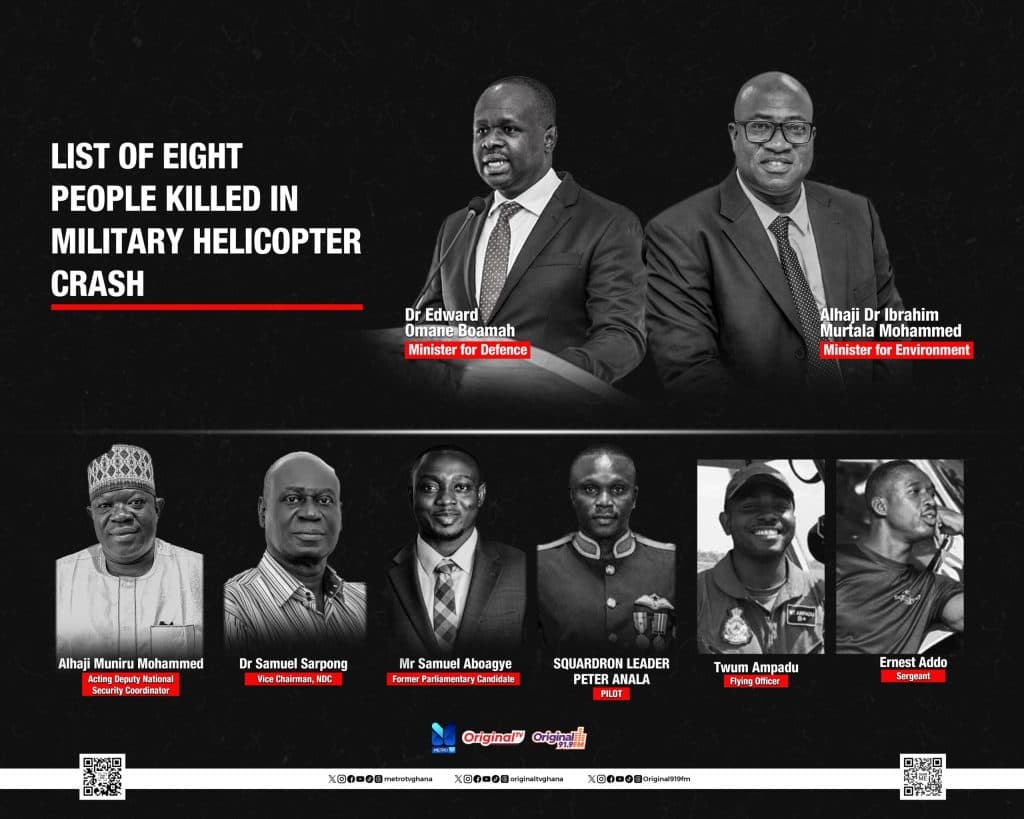
On August 6, 2025, a Ghana Air Force helicopter crashed while on an official mission to Obuasi. Everyone on board lost their lives. Eight people who had left Accra in service of their country never returned home. Among them were Defence Minister Dr. Edward Omane Boamah, Environment Minister Ibrahim Murtala Muhammed, former Ashanti Regional Minister Samuel Sarpong, Acting Deputy National Security Coordinator Alhaji Muniru Mohammed, Deputy Director-General of NADMO Samuel Aboagye, and three military personnel who were flying the aircraft. It remains one of the darkest days in Ghana’s recent history.
For the nation, it was a tragedy. For eight families, it was the beginning of a lifetime of empty chairs at the dinner table, birthdays celebrated with tears instead of laughter, and children growing up with memories instead of presence.
The headlines have long faded. The television cameras have moved on. The national mourning ended months ago.
But grief does not follow a government timetable.
It lives quietly in family albums, in unanswered phone numbers, in offices where familiar voices are no longer heard, and in the hearts of colleagues who still remember the conversations they had just hours before the flight departed.
Many Ghanaians remember exactly where they were when news first broke that the helicopter had disappeared from radar. There was hope that contact would be restored. Then came the confirmation no one wanted to hear.
The nation stood still.
Flags flew at half-mast. Places of worship offered prayers. Political differences disappeared, if only briefly, as Ghanaians mourned together. The loss belonged to everyone.
A year later, the memories remain vivid.
Dr. Edward Omane Boamah was remembered for his years in public service and his dedication to national security. Ibrahim Murtala Muhammed was known for his energy and commitment to environmental governance. Samuel Sarpong carried decades of political and public service experience. The others on board, whether in government or in uniform, shared one thing in common, they were carrying out national duty.
Their journey was one of service. It became one of sacrifice.
This year’s anniversary has been marked with memorial activities organised by the government, including remembrance services and other events intended to honour what officials now describe as the “Departed 8.” The commemorations are designed not only to remember those who died but also to reflect on the price that public service sometimes demands.
Yet beyond the ceremonies and wreath-laying, the anniversary invites a quieter reflection.
It reminds us that behind every public office is a family. Behind every official convoy is a spouse waiting at home. Behind every military uniform is a parent, a child, a friend.
Public servants are often judged by policies, speeches and political debates. Rarely do we pause to remember that they, too, carry hopes, fears and loved ones who simply expect them to come back home.
One year later, Ghana remembers more than a helicopter crash.
It remembers lives interrupted, dreams unfinished and a nation forced to confront how fragile life can be.
Some wounds never truly heal. They simply become part of who we are.
Ghana pauses today to honour the memories of those eight souls who continue to inspire service, humility and unity. And may the families they left behind find strength in knowing that while time moves on, a grateful nation has not forgotten.