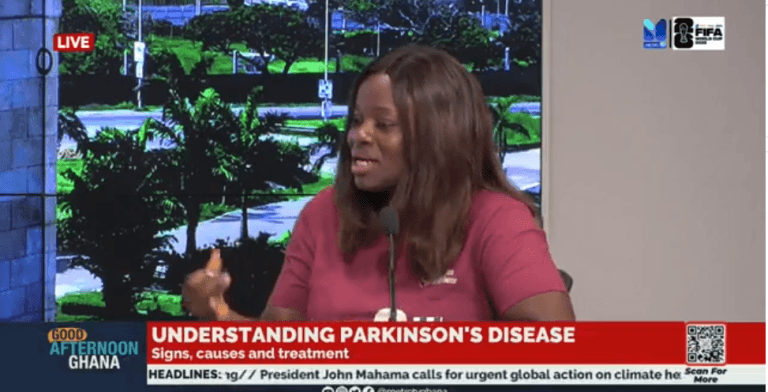
A neurologist at the Komfo Anokye Teaching Hospital, Dr. Vida Obese, is worried about the growing number of younger people being diagnosed with Parkinson’s disease, urging increased awareness and early medical intervention.
Parkinson’s disease is a neurodegenerative condition that affects the brain and disrupts movement due to reduced dopamine production. The disease is associated with ageing and affects the brain.
Speaking on Good Afternoon Ghana on Metro TV on Wednesday, April 8, 2026, Dr. Vida Obese noted that the disease has traditionally been associated with people above 60 years, but recent trends show a worrying shift.
“We are now, in recent years, seeing people below 50 with Parkinson’s disease, and that means that there should be research, especially local, to understand why now younger people are coming up with the disease,” Dr. Obese stated.
According to her, Parkinson’s disease primarily affects movement, causing symptoms such as tremors, muscle stiffness and slowness in movement.
“Patients tend to be very slow in anything that they try to do, even turning in bed they are slow, and then they have tremors and their muscles become stiff,” she explained.
She added that the condition often begins on one side of the body, which sometimes leads to confusion with stroke.
“The key difference is that in stroke it is sudden… but for Parkinson’s disease it is gradual in onset,” she said.
Dr. Obese also pointed out that some early symptoms may appear years before the visible tremors and stiffness. These include constipation, anxiety, depression, sleep disorders and changes in handwriting.
“You realise your handwriting is becoming smaller and smaller and smaller. That’s quite early, an early motor sign,” she noted.
She said low awareness and stigma around neurological conditions have delayed diagnosis in many cases, as families often mistake symptoms for ageing or stroke.
“Because it’s a disease associated with ageing, anybody who is above 60 and is slow, you are likely to say it’s because the person is old, but that patient could be suffering from Parkinson’s disease,” she explained.
Dr. Obese stressed the need for families and caregivers to seek medical attention early when symptoms appear, noting that support groups and public education are helping to improve awareness.
“It is key that we see neurological conditions just like other diseases… if you come to the hospital early, you can seek early treatment and there is help available,” she said.
She added that the Neurology Society of Ghana and Parkinson’s support groups in Accra, Kumasi and other parts of the country are working to educate the public and reduce stigma surrounding the disease.
Dr. Obese encouraged the public to take brain health seriously through proper nutrition, regular exercise and continuous mental stimulation, saying early care and awareness remain the best tools in managing Parkinson’s disease.