
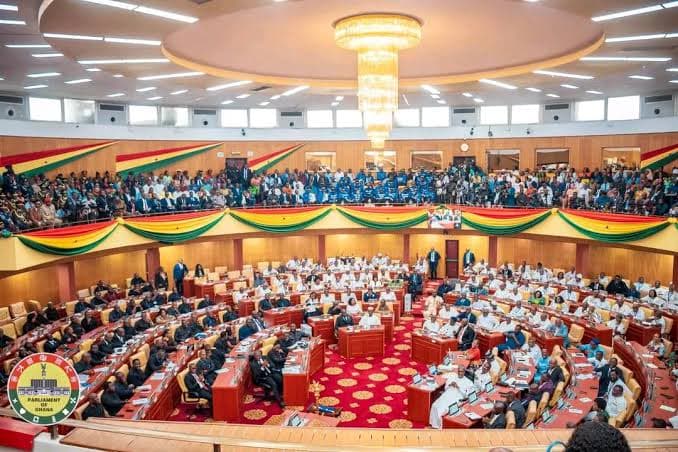
Parliament has passed the Community Service Bill, 2026, introducing community service as an alternative to prison sentences for people convicted of certain offences.
The new law is expected to reduce overcrowding in Ghana’s prisons by allowing courts to sentence eligible offenders to unpaid community work instead of custodial terms.
It also establishes a National Community Service Secretariat to oversee the implementation of the new sentencing regime.
The Bill was laid before Parliament by the Minister for the Interior, Mohammed-Mubarak Muntaka, on 4 March 2026 under Article 106(1) of the 1992 Constitution. It was later referred to Parliament’s Defence and Interior Committee for scrutiny before being approved by the House.
In its report, the committee said Ghana’s criminal justice system has long depended on custodial sentences, a situation that has contributed to chronic congestion in prisons across the country.
According to the committee, overcrowding has stretched the resources of the Ghana Prisons Service, leading to higher government spending on feeding, healthcare, infrastructure and the general upkeep of inmates.
It said the legislation forms part of wider reforms being pursued by the Ministry of the Interior to expand the use of non-custodial sentencing.
The committee explained that the law gives judges another sentencing option for people convicted of minor and other specified offences, while supporting rehabilitation and helping offenders reintegrate into society.
Lawmakers were also told that efforts to introduce a structured community service system date back to 2014, when the Ministry of the Interior, with support from UNICEF, began developing a national policy on non-custodial sentencing.
The new legislation also provides a legal framework for enforcing existing provisions on non-custodial sentencing contained in the Criminal and Other Offences (Procedure) Act, 1960 (Act 30), and the Interpretation Act, 2009 (Act 792).
With the passage of the Bill, courts will now have broader discretion to impose community service in appropriate cases instead of custodial sentences.
The Defence and Interior Committee believes the new law will strengthen Ghana’s criminal justice system, improve the management of correctional facilities and ensure prison sentences are reserved for offenders whose crimes require incarceration.