
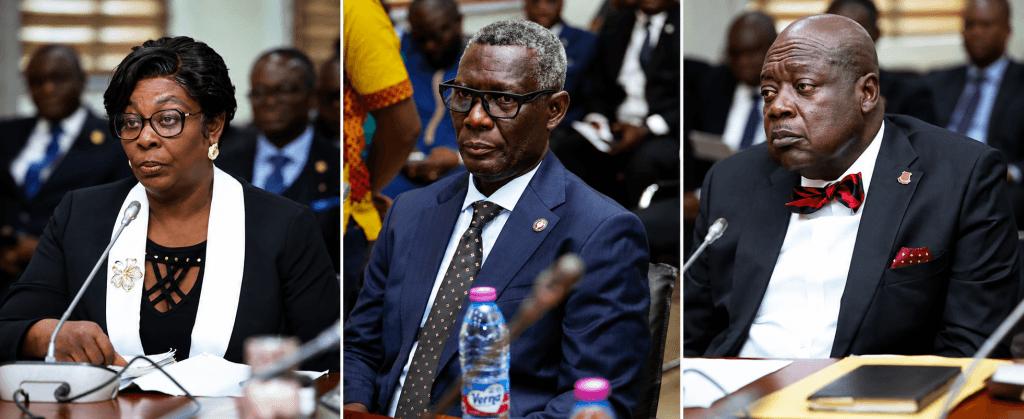
Parliament has approved the nominations of Justice Sophia Rosetta Bernasko Essah, Justice Edward Amoako Asante and private legal practitioner Anthony Forson Jnr for appointment as Justices of the Supreme Court.
The approval followed the adoption of the report of Parliament’s Appointments Committee, which recommended all three nominees after their vetting on Thursday, August 27.
The nominations were made by President John Dramani Mahama in consultation with the Judicial Council and subsequently referred to Parliament for consideration.
The House approved the nominees after adopting the report of the Appointments Committee, which recommended their appointment following their vetting.
The approval moves the three nominees a step closer to joining Ghana’s highest court.
Their approval is expected to increase the number of Justices on Ghana’s apex court from 18 to 21.
Who are the three nominees?
Justice Sophia Rosetta Bernasko Essah is a Justice of the Court of Appeal with extensive judicial experience.
She was previously nominated for appointment to the Supreme Court in 2024, but the process was not completed before the change in administration.
Justice Edward Amoako Asante is also a Court of Appeal Justice and has significant experience in international judicial administration.
He previously served as President of the ECOWAS Court of Justice before returning to Ghana’s Court of Appeal.
Anthony Forson Jnr is a private legal practitioner and former President of the Ghana Bar Association. He brings several years of experience from private legal practice and has been involved in discussions on judicial reforms.
Mahama taps two judges, ex-GBA President for Supreme Court
What they said during vetting
During her vetting, Justice Bernasko Essah addressed the question of whether the Supreme Court could depart from its own previous decisions.
She explained that although judicial precedent is important for ensuring consistency and predictability, the court is not permanently bound by its earlier decisions.
According to her, the Supreme Court can depart from a previous decision where there are compelling reasons to do so, particularly where maintaining the precedent could result in injustice or perpetuate an error in the law.
She cited Article 129(3) of the 1992 Constitution, which gives the Supreme Court the power to depart from its previous decisions when necessary.
Justice Amoako Asante, during his vetting, focused on constitutional rights and the treatment of suspects in police custody.
He said suspects who are detained beyond the constitutionally prescribed 48-hour period have the right to seek redress through the courts.
He questioned why suspects and their lawyers do not routinely take legal action when the police exceed the 48-hour limit, arguing that court action could help discourage unlawful or prolonged detention.
He also spoke about the growing use of artificial intelligence in the legal profession, insisting that AI would not replace lawyers or judges because human reasoning remains essential to the administration of justice.
Anthony Forson Jnr, meanwhile, opposed proposals to place a fixed cap on the number of Justices who can serve on the Supreme Court.
He argued that the workload and broad jurisdiction of the apex court make it difficult to justify a rigid limit on the number of judges.
Minority walks out over vetting of three Supreme Court nominees
Mr Forson also proposed greater use of technology and extended court sittings as possible measures to reduce the backlog of cases.
He further told the committee that he had no objection to the establishment of public tribunals, arguing that such tribunals are provided for under the 1992 Constitution.
Minority objects to vetting process
The approval came after a contentious vetting process that saw the Minority Caucus walk out of the Appointments Committee.
Minority Leader Alexander Afenyo-Markin had challenged the decision to fast-track the vetting, arguing that there was no immediate vacancy on the Supreme Court bench requiring urgent appointments.
He maintained that the Minority’s objection was not directed at the nominees or President Mahama’s constitutional authority to nominate persons to the Supreme Court.
Instead, he said the concern was about the procedure and timetable adopted by the committee.
Mr Afenyo-Markin subsequently led Minority members out of the committee after Chairman Bernard Ahiafor rejected the objection and ruled that the vetting should proceed.
Mr Ahiafor described the Minority’s reasons as “flimsy”, “hollow” and “baseless”.
The Majority members then proceeded with the vetting, paving the way for the committee to recommend the approval of the three nominees.
With Parliament’s approval secured, Justice Bernasko Essah, Justice Amoako Asante and Anthony Forson Jnr have cleared another major hurdle in the constitutional process towards their appointment to Ghana’s highest court.